Establishing secure connection…Loading editor…Preparing document…

Washington Motion

This template is fully customizable. Edit the text, fill out the fields, and send it for signature. Give it a try!
Washington Motion

What a Washington Motion Is and when it’s used

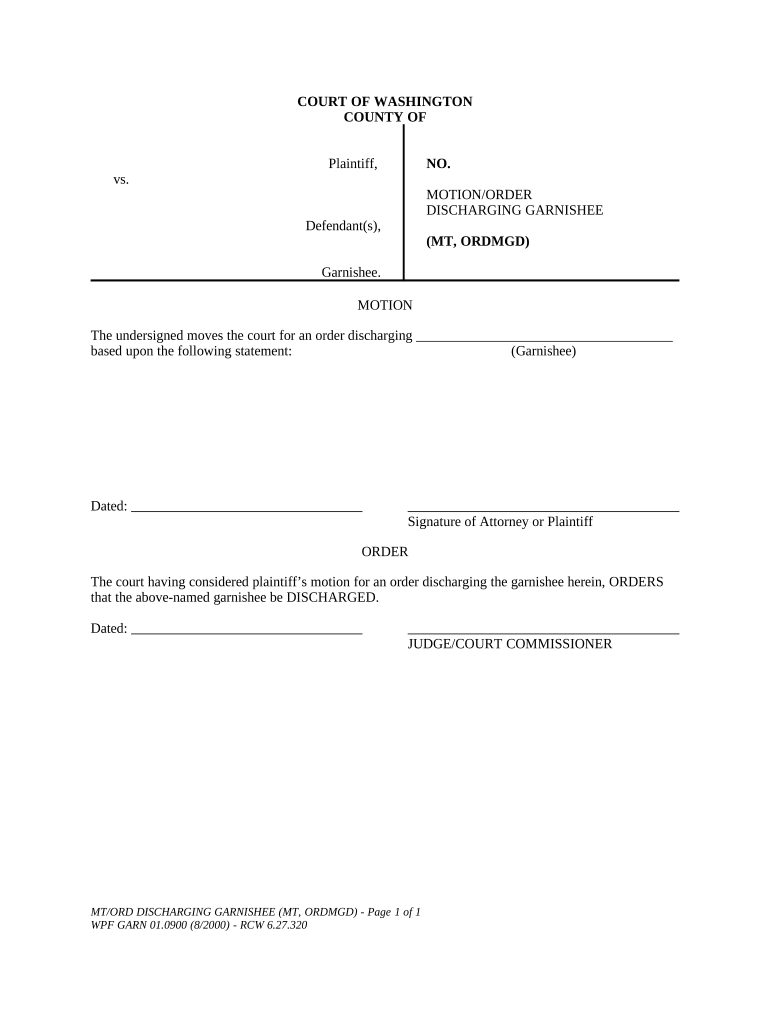
A Washington Motion is a formal written request submitted to a court in Washington state asking the judge to take a specific action — for example, to grant relief, set a hearing, compel discovery, or dismiss claims. Motions combine a caption, a clear statement of requested relief, supporting facts and legal authority, and usually a proposed order. They may be filed in person, by mail, or through a court e-filing system where accepted. Procedures and timing are governed by the applicable rules of civil procedure and local court rules.

Why a properly drafted Washington Motion matters

A clear, procedurally correct motion frames the issue for the court, preserves arguments for appeal, and improves the chance of obtaining the requested relief without delay. Accuracy in legal citation, facts, and service avoids sanctions and adverse rulings.

Why a properly drafted Washington Motion matters

Who prepares and files Washington Motions

Both counsel and self-represented litigants use motions to advance discrete legal requests during litigation in state courts.

  • Private attorneys representing plaintiffs or defendants in civil litigation, ensuring adherence to court rules and strategic framing.
  • Pro se litigants filing motions themselves; must follow local formatting, service, and timing requirements carefully.
  • Court clerks and support staff process filings, check compliance with e-filing rules, and docket motion events.

Timely service and correct formatting are essential regardless of who files; follow local rules and verify e-filing acceptance in the relevant court.

Essential components of a professional Washington Motion

A complete motion groups several standardized elements so the court and opposing parties can evaluate the request quickly and accurately.

Caption

Complete court caption listing court, case number, and party names exactly as they appear on the docket; essential for clerks and electronic docketing.
Title

Short motion title stating the relief sought (for example, Motion to Compel Discovery or Motion for Summary Judgment) and whether it is interlocutory or final.

Statement of Facts

Concise factual summary with dates, events, and citations to exhibits or prior filings that support the legal argument.

Legal Argument

A focused memorandum of law explaining legal standards and applying them to the facts, with statutory or case law citations.

Request for Relief

A specific, numbered list of the orders requested so the judge can enter a clear ruling or proposed order.

Proof of Service

A declaration or certificate showing how and when opposing parties were served; required for most courts before the motion is heard.

Step-by-step: preparing and filing a Washington Motion

Follow an orderly sequence from drafting through service to avoid procedural defects and preserve timeliness.

  • 01
    Draft motion: Prepare caption, facts, argument, exhibits, and proposed order.
  • 02
    Check local rules: Confirm formatting, page limits, and timing under the court’s local rules.
  • 03
    Serve opposing counsel: File proof of service and serve per rule (email, e-service, or personal service).
  • 04
    File with court: Submit via e-filing where available or deliver paper copies with required number of chambers copies.

Setting up an e-filing and e-service workflow

Configure filing settings and attachments to match court system requirements and ensure reliable delivery to opposing parties.

Field Configuration
File Format PDF/A recommended; include searchable text where required.
Signature Type Electronic signature accepted where court rules permit; include printed name and date.
Service Method Use court e-service, certified mail, or email as local rules require.
Exhibit Handling Number exhibits and attach a separate exhibit index or bookmarks in the PDF.

How electronic filing and service typically proceed

E-filing platforms streamline delivery, but you must still meet service requirements and preserve proof of transmission.

  • Upload document: Sender uploads the signed motion and exhibits in required format.
  • Assign parties: Select case number and list parties to be served by the system.
  • Transmit to court: The platform forwards the filing to the court e-filing system.
  • Receive confirmation: Clerk or system returns an acceptance notice and a docket entry is created.

Technical requirements for eSubmission and signing

Verify the e-filing service accepts the file types and signature methods you plan to use before submission.

  • File types: PDF and DOCX are widely accepted; courts often require PDF/A for preservation.
  • Authentication: Email link or two-factor authentication may be used for signer attribution.
  • Integrations: Platforms commonly integrate with case management, cloud storage, and calendaring systems.

Required document information at a glance

Case caption: Court and case number
Party names: Plaintiff and defendant
Relief requested: Specific orders sought
Exhibit list: Numbered attachments
Signature block: Signer name and date
Proof of service: Service details

Common preparation pitfalls to avoid

  • Omitting the correct case number or misnaming parties causes clerks to reject or misdocket the filing and delays processing.
  • Failing to attach or properly label supporting exhibits weakens factual support and may force continuance of the hearing.
  • Using vague relief language (for example, 'relief as the court deems fit') can result in an ambiguous order that is hard to enforce.
  • Neglecting service or using the wrong method can render the motion procedurally defective and subject to sanctions.

Consequences of procedural errors or false statements

Dismissal: Case or motion dismissal
Sanctions: Monetary or other sanctions
Fee awards: Adverse cost shifting
Default judgment: Loss by default
Evidentiary exclusion: Evidence barred
Perjury risk: Criminal exposure

Typical timing and response windows for motions

Courts set specific deadlines for filing, serving, and responding to motions. Local rules and statutes determine exact timeframes; check the applicable court rules.

Filing deadline:

Varies by motion type and local rule; confirm before filing.

Response period:

Opposing party response windows typically range from 7–30 days depending on jurisdiction and motion type.

Reply period:

Some courts allow a short reply period, often 7–14 days after response.

Hearing scheduling:

Clerk or judge sets a hearing date based on calendar and notice requirements.

Emergency motions:

Expedited relief requires immediate notice and supporting declarations under local emergency rules.

Key milestones from draft to hearing

A sequential view helps coordinate drafting, service, and calendar management for the motion lifecycle.

01

Draft Complete

Finalize motion, exhibits, and proposed order before initiating service.

02

File and Serve

Submit to court and serve opposing parties per local rule.

03

Opposition Filed

Receive and review any opposition or response.

04

Hearing and Ruling

Appear at hearing or await written ruling entered on the docket.

Real-world examples of motion use

These concise case examples show how parties use motions to advance discrete procedural or substantive requests in litigation.

Optica Ventures — Discovery Motion

Optica Ventures sought production of records in a contract dispute.

  • Court granted targeted production after in-camera review.
  • The company used numbered exhibits and a focused legal memorandum to limit the scope and obtain relief without further delay.

Martin Properties — Summary Judgment

Martin Properties moved for summary judgment on a lease dispute.

  • Judge denied in part, granted partial relief.
  • Clear factual statements, supporting declarations, and a proposed order helped the court identify uncontested issues and narrow trial scope.

Comparison: eSignature vendor pricing and feature availability

Basic pricing and feature availability across common eSignature vendors. signNow is shown first per platform comparison conventions.

signNow DocuSign Adobe Sign PandaDoc HelloSign
Starting Price $8/user/mo $15/user/mo $14/user/mo $19/user/mo $15/user/mo
Free Trial 7-day trial Varies Varies Varies Varies
Bulk Send Yes Yes Yes Yes No
Audit Trail Yes Yes Yes Yes Yes
HIPAA Compliant Yes Yes Yes No No
Envelope Cap No cap 100 envelopes/user/year Varies Varies Varies

Practical tips for accurate, efficient motion practice

Small process improvements reduce risk of rejection and accelerate judicial consideration of your motion.

Use a consistent caption template
Maintain a standard caption template with court name, case number, and party names to avoid clerical rejections and misdocketing.
Number and tab exhibits
Number exhibits and include an exhibit index to help judges and clerks locate supporting materials quickly during review.
Confirm service method
Verify the permitted service methods under local rules and file a proof of service immediately after serving opposing parties.
Preserve audit trails
If using electronic signatures or e-filing, retain the platform’s audit trail, timestamps, and delivery receipts as evidence of service and execution.

Frequently asked questions about Washington Motions

Answers to common procedural and technical questions about drafting, signing, filing, and serving motions in Washington.


Need help? Contact support

be ready to get more
Join over 28 million airSlate SignNow users