Parties
Identify grantor, grantee, and any enforcement or successor holders with full legal names, entity types, addresses, and authorized signer details to avoid ambiguity in title and notice.
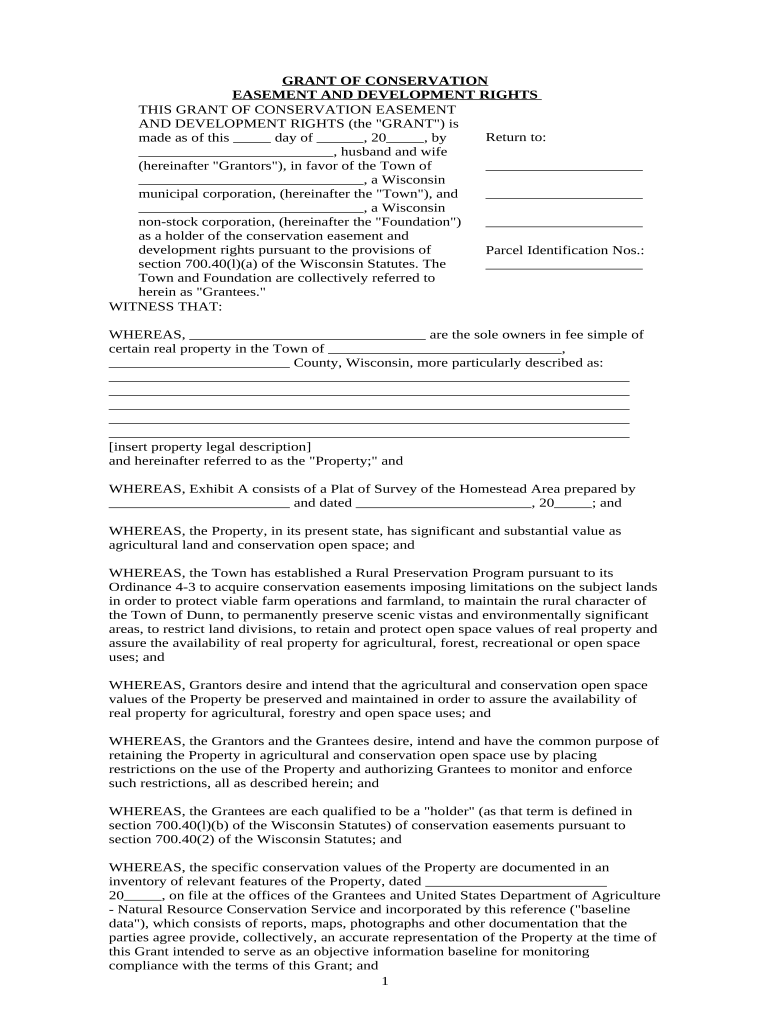
A clear, recorded grant secures conservation objectives, creates enforceable restrictions, preserves ecological and scenic values, and establishes notice to future owners. It also clarifies whether development rights are extinguished, banked, or transferable, which affects planning, tax treatment, and marketability.

Typical parties who prepare or receive this instrument include landowners, land trusts, municipal agencies, and conservation attorneys.
Identify grantor, grantee, and any enforcement or successor holders with full legal names, entity types, addresses, and authorized signer details to avoid ambiguity in title and notice.
Include a precise metes-and-bounds description, parcel or tax ID, and a certified survey or exhibit so the county records and title insurer can accurately index the easement.
Set explicit prohibited and permitted activities—such as building, subdivision, excavation, or vegetation removal—and specify conditional exceptions and approval procedures to reduce disputes.
State whether development rights are reserved, transferred, extinguished, or banked; describe transfer mechanisms, units, caps, and timelines to ensure predictable administration.
Define the conservation objectives (habitat, watershed, scenic, agricultural) to support enforcement, stewardship, and any tax or grant eligibility requirements.
Specify inspection rights, remedy options, amendment standards, termination triggers, and whether the easement is perpetual or limited with reversion provisions.
| Field | Configuration |
|---|---|
| Document Template Name | Conservation Easement Grant template |
| Signer Roles | Grantor | Grantee | Witness | Notary |
| Authentication | Email + SMS code or ID verification |
| Recording Delivery | Download PDF | deliver to recorder or upload via portal |
Digital execution can include eSign, remote online notarization, and secure routing when state law permits.
Enter MM/DD/YYYY; governs rights start date.
Record at county immediately to protect priority.
File required documentation with tax return year.
Observe any time limits or allocation schedules.
Follow notice periods specified in the grant.
A regional land trust drafted a Wisconsin grant to secure 120 acres of wetland and upland buffers, attaching a certified survey and baseline report.
A municipality used a grant to remove development rights from a floodplain parcel and bank them for transfer to growth zones elsewhere under a TDR program.
Private landowners initiating a Wisconsin conservation easement typically seek to protect natural resources while retaining limited continuing uses. They consult counsel, surveyors, and tax advisors to ensure accurate legal descriptions and alignment with conservation and tax objectives.
Land trusts or conservation agencies that serve as grantees enforce restrictions, perform monitoring, and manage stewardship funds. They require baseline documentation, clear enforcement clauses, and funding commitments for long-term stewardship responsibilities.
Agree on conservation terms and compensation.
Prepare legal text, exhibits, and baseline documentation.
Sign, notarize, and obtain witness attestations.
Record with county and commence monitoring schedule.
| signNow | DocuSign | Adobe Sign | PandaDoc | HelloSign | |
|---|---|---|---|---|---|
| Starting Price | $8/user/mo | $15/user/mo | $14/user/mo | $19/user/mo | $15/user/mo |
| Free Trial | 7-day free trial, no credit card required | Varies by vendor | Varies by vendor | Varies by vendor | Varies by vendor |
| Bulk Send | Yes | Yes | Yes | Yes | No |
| Audit Trail | Yes | Yes | Yes | Yes | Yes |
| HIPAA Compliant | Yes | Yes | Yes | No | No |
| Envelope Cap | No cap | 100 envelopes/user/year | Varies by plan | Varies by plan | Varies by plan |