Establishing secure connection…Loading editor…Preparing document…

Writ of Certiorari

This template is fully customizable. Edit the text, fill out the fields, and send it for signature. Give it a try!
Writ of Certiorari

What a Writ of Certiorari Is and when it applies

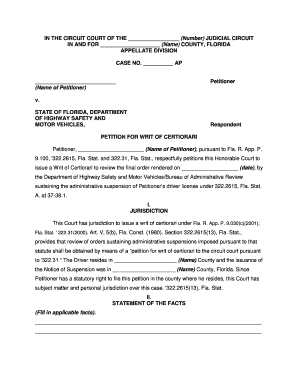
A Writ of Certiorari is a petition asking the Supreme Court of the United States to review a lower court's decision. It is not an appeal as of right; the Court grants certiorari only for cases that raise important federal or constitutional questions, conflicts among courts of appeals, or issues of exceptional public significance. The petition explains the legal question, summarizes record facts, and cites relevant authorities. Preparation requires strict compliance with the Court's rules on format, page limits, service, and filing to avoid procedural dismissal.

Why the writ matters for appellate strategy

A writ of certiorari is the primary route to obtain Supreme Court review and potentially establish nationwide precedent. Timely, properly framed petitions can resolve circuit splits or secure uniform interpretation of federal law.

Why the writ matters for appellate strategy

Who files or prepares a petition for certiorari

Typical filers include litigants, appellate counsel, and institutions seeking review. Petitions require experienced appellate drafting and familiarity with Supreme Court Rules.

  • Private litigants and counsel preparing legal arguments and record citations for certiorari review.
  • Government counsel (state or federal) submitting petitions or oppositions in high-profile matters.
  • Legal aid clinics or amici curiae drafting supporting briefs to highlight broader implications.

Core components of a professional certiorari petition

A complete petition follows the Supreme Court Rules and includes a question presented, list of parties, statement of the case, reasons for granting review, appendix references, and copies of lower-court decisions.

Question Presented

A concise, framed legal question the Court is asked to decide; clarity and narrow scope increase consideration for certiorari.
Reasons for Review

Explain circuit conflicts, important federal questions, or national significance; tie factual context to legal stakes and precedent.

Statement of Case

Succinct procedural and factual summary; cite record pages and lower-court holdings with pinpoint citations.

Appendix

Include relevant lower-court opinions, material parts of the record, and statutory text per rule requirements for ease of review.

Certificates

Certificates of interested persons, service, and compliance with rule formatting and word/page limits are required under the Court’s rules.

Covers and Formatting

Follow the Supreme Court’s strict typeface, margin, and page-limit rules; nonconforming petitions risk rejection or return.

Step-by-step: preparing and submitting a petition

Follow a disciplined sequence: prepare record excerpts, draft the petition, confirm formatting, file with the Clerk, and serve opposing parties.

  • 01
    Prepare Record: Assemble relevant opinions and excerpts for the appendix.
  • 02
    Draft Petition: Write the question presented and reasons for review.
  • 03
    Check Compliance: Verify page limits, fonts, citations, and required certificates.
  • 04
    File and Serve: File with the Clerk and serve opposing counsel per Court rules.

Configuring an online workflow for petition drafting

Set up a reproducible online template to ensure consistent formatting, version control, and secure distribution among counsel.

Document Template Create standardized fields for caption, question, and certificates.
Version Control Enable tracking to record edits and author history.
Signer Roles Assign lead counsel and co-counsel signing privileges.
Appendix Attachment Require uploaded lower-court opinions and record excerpts.
Proofing Checklist Include automated checks for fonts, pagination, and page limits.

Where and how to file a petition for certiorari

Petitions are filed with the Clerk of the Supreme Court following the Court’s rules; service and certificate requirements must accompany filing.

  • Clerk Filing: Submit the petition and required copies to the Clerk’s office.
  • Service: Serve opposing counsel and include certificates of service.
  • Appendix Submission: File appendix materials per the Court’s format requirements.
  • Proof of Compliance: Provide certificates confirming page limits and formatting adherence.

Technical considerations for signing and e‑submitting materials

Use a secure platform that supports required PDF formats, audit trails, and role-based signing for counsel and clients.

  • File formats: PDF and DOCX supported
  • Security: TLS in transit, AES-256 at rest
  • Integrations: Connects to common case tools

Key timing rules and filing windows

Certiorari petitions are time-sensitive. Observe Court rules for filing deadlines, service intervals, and appendix submission to avoid dismissal.

Filing Deadline:

90 days after entry of judgment (S. Ct. Rule 13.5)

Response Timing:

Briefs in opposition may be filed according to Court scheduling

Appendix Deadline:

Appendix must accompany or be filed per rule direction

Extensions:

Extensions are rare and require strong cause

Service Requirement:

Serve all parties at the time of filing per Court rules

Major milestones from judgment to Supreme Court decision

Track each stage carefully; missed milestones can foreclose review or require emergency relief.

01

Lower-Court Judgment

Entry of judgment starts the clock for certiorari filing.

02

Petition Preparation

Draft petition, assemble appendix, and obtain signatures and certificates.

03

File Petition

Submit to the Clerk and serve opposing parties in compliance with rules.

04

Court Conference

Justices consider petitions at scheduled conferences for grant/denial.

Consequences of procedural errors or noncompliance

Timely Dismissal: Untimely petitions may be dismissed.
Return for Correction: Clerk may return nonconforming papers.
Waiver of Issues: Improper presentation can forfeit issues.
Sanctions Risk: Frivolous filings may invite sanctions.
Costs Liability: Costs may be taxed against a party.
Lost Review Opportunity: Procedural error can end further review.

Common mistakes to avoid when preparing a petition

  • Missing the 90-day filing window and failing to request emergency relief when appropriate.
  • Submitting an appendix with incorrect pagination or omitted opinions, making review difficult for the Court.
  • Failing to include required certificates of interested persons and service, resulting in procedural rejection.
  • Using unclear or overly broad questions presented that fail to identify circuit splits or concrete legal stakes.

Realistic scenarios where a writ of certiorari is used

These illustrative scenarios show typical reasons to seek Supreme Court review and what petitioners must demonstrate.

Conflict Among Circuits

A party asks the Court to resolve conflicting circuit decisions on a federal statute.

  • The circuit split affects nationwide interpretation.
  • The petition focuses on the split, developing record citations and highlighting practical consequences to show national significance.

Significant Constitutional Question

A litigant raises an unsettled constitutional issue with broad application.

  • The question has recurring lower-court variance.
  • The petition emphasizes constitutional stakes, authoritative precedent, and why the Court’s review would settle an important legal question.

Practical tips for accurate, efficient petition preparation

Adopt a checklist-driven approach to reduce errors and ensure compliance with the Supreme Court’s procedural and formatting rules.

Start Early and Track Time
Begin petition drafting immediately after judgment to allow time for careful briefing, internal review, and any necessary corrections before the 90‑day deadline.
Use a Formatting Checklist
Confirm fonts, margins, and page limits against the Court’s rules to avoid return or rejection for nonconformity.
Double-Check the Appendix
Ensure all cited pages are present and paginated correctly; missing pages hinder the Court’s review and reflect poorly on counsel.
Document Service Carefully
Retain proof of service, certificates, and delivery receipts to demonstrate compliance with service rules and avoid disputes.

eSignature vendor comparison for petition preparation and signing

Compare common capabilities and entry pricing for eSignature platforms useful when preparing and signing court filings and supporting affidavits.

signNow DocuSign Adobe Sign PandaDoc HelloSign
Starting Price $8/user/mo $15/user/mo $14/user/mo $19/user/mo $15/user/mo
Free Trial 7-day trial Trial available Trial available Trial available Trial available
Bulk Send Yes Yes Yes Yes No
Audit Trail Yes Yes Yes Yes Yes
Envelope Cap No cap 100 env/yr cap Varies Varies Varies

Frequently asked questions about petitions for certiorari

Common practitioner questions about deadlines, form requirements, and electronic signing are answered to reduce procedural risk and clarify next steps.


Need help? Contact support

be ready to get more
Join over 28 million airSlate SignNow users