Establishing secure connection…Loading editor…Preparing document…

Unanimous Consent to Action by Sole Member of LLC

This template is fully customizable. Edit the text, fill out the fields, and send it for signature. Give it a try!
Unanimous Consent to Action by Sole Member of LLC

What the Unanimous Consent to Action by Sole Member of LLC Is

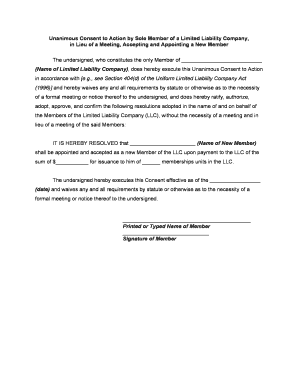
A Unanimous Consent to Action by Sole Member of LLC is a written resolution documenting a sole member's formal approval of a corporate action without convening a meeting. It records the LLC name, the member's decision, the effective date, and the member's signature; it serves as the official minute that third parties, banks, and regulators may rely on to verify corporate authority. When delivered in electronic form with proper consent and retention, an e-signature satisfies federal ESIGN requirements (15 U.S.C. §7001) and most state UETA rules for enforceability.

Why a Formal Unanimous Consent Matters

A signed unanimous consent creates a clear, auditable record of actions taken by the sole member, reducing ambiguity for banks, counterparties, or courts.

Why a Formal Unanimous Consent Matters

Who Typically Prepares and Relies on This Document

Common users create and keep this consent as part of corporate minutes and transactional records.

  • Sole owners of single-member LLCs who must document authority for contracts or transfers.
  • Company managers or registered agents preparing records for institutional counterparties or lenders.
  • Attorneys and paralegals assembling closing binders or corporate minute books for clients.

Representative Signers and Their Roles

Sole Member — Owner

The sole member as owner signs to authorize an action on behalf of the LLC; the signature confirms intent and binding authority, and should match the LLC records and any filing agent documentation exactly.

Corporate Counsel — Attorney

Corporate counsel often drafts or reviews the consent, confirms statutory compliance, and may attach a cover memo; counsel does not sign as member but certifies form and legal sufficiency when requested by third parties.

Core Components of a Professional Unanimous Consent

A complete unanimous consent includes identifying data, clear resolution language, execution details, and retention instructions to ensure enforceability and ease of use by third parties.

Title and Intro

Identifies the document as 'Unanimous Consent to Action by Sole Member of LLC', states the LLC's jurisdiction, and explains that action is taken without a meeting.
Recitals

Brief background facts (e.g., governing documents, authority) that explain why the member is approving the action and reference the operating agreement if relevant.

Resolution Language

Concisely describes the specific action being approved (authorize bank account, appoint manager, approve sale) with unambiguous terms and amounts where applicable.

Effective Date

Specifies the exact effective date of the action in MM/DD/YYYY format or as otherwise agreed, since rights and obligations typically attach on that date.

Execution Block

Signature line for the sole member, printed name, title (if any), date signed, and optional witness or notary acknowledgment if third parties request added authentication.

Attachments

Supporting exhibits (resolution exhibits, contracts, certificates of good standing) referenced in the consent should be attached and labeled for clarity.

Essential Information to Include

LLC Legal Name: Full legal name
State of Formation: State and jurisdiction
Sole Member Name: Exact legal name
Description of Action: Clear action summary
Effective Date: MM/DD/YYYY format
Signature Block: Signer's printed name

Step-by-Step: Completing the Consent

Follow these steps to prepare, approve, and preserve the unanimous consent so it can be relied on by third parties and internal recordkeeping.

  • 01
    Draft the Resolution: State LLC name, member name, and exact action in clear language.
  • 02
    Set Effective Date: Enter date in MM/DD/YYYY and confirm whether retroactive wording is needed.
  • 03
    Sign and Authenticate: Sole member signs; add notary or witness if requested by banks or title companies.
  • 04
    Store and Distribute: Provide copies to bank, counsel, and permanent corporate records.

How to Configure an Online Execution Workflow

Set up a simple electronic workflow to collect the member signature, optional notary steps, and automatic distribution to stakeholders.

Field Configuration
Authentication Method Email link or SMS code; add KBA for higher assurance
File Format Use PDF/A for long-term retention and compatibility
Notification Recipients Bank, counsel, registered agent as needed
Template Name Save as 'Unanimous Consent — Sole Member' for reuse

Where to Send or File the Signed Consent

Decide who needs a copy and whether notarization or a certified state filing is required for the specific transaction.

  • Internal Records: Add original to the LLC minute book and digital archive.
  • Bank or Lender: Provide executed copies to update signatory authority or open accounts.
  • Third-Party Counterparty: Attach to closing documents or contracts as proof of authority.
  • State Filings: Usually not required; obtain certified copies only when requested.

Digital Execution and Platform Considerations

Choose a signing platform that supports PDF signatures, audit trails, and appropriate signer authentication for your risk level.

  • Supported Formats: PDF, DOCX accepted
  • Signer Authentication: Email link, SMS code, or KBA
  • Integrations: Salesforce, NetSuite, Google Workspace

Potential Legal Risks and Consequences

Invalid Action: Action deemed void
Bank Refusal: Access denied by financial institution
Piercing Risk: Corporate veil exposure
Contract Dispute: Third-party challenges possible
Filing Rejection: Certified copy refused
Regulatory Penalty: Agency fines or remediation

Common Preparation Mistakes to Avoid

  • Using abbreviated or inconsistent names across documents, which can cause banks and title agents to request corrective affidavits or refuse acceptance.
  • Vague resolution language that fails to specifically authorize the action or the person empowered to act, producing ambiguity in enforcement or reliance.
  • Skipping authentication steps when a counterparty expressly requests notarization or certified copies, which can delay closings and require re-execution.
  • Storing only a scanned copy without retaining a verifiable audit trail or original signed record when relying on electronic signatures for evidentiary purposes.

Practical Tips for Accurate and Efficient Completion

Adopt consistent templates, validate identity, and preserve audit trails to reduce friction with banks, counterparties, and regulators.

Use a standard template
Maintain a single, reviewed template for unanimous consents to prevent drafting errors; have counsel approve the template to ensure statutory compliance and consistent language across transactions.
Match names and titles exactly
Ensure the LLC name, member name, and any signatory titles match formation documents and bank records to avoid delays, additional documentation requests, or rejected transactions.
Choose appropriate authentication
For high-value transactions, require stronger signer authentication or notarization; document the chosen method in the consent and preserve the audit trail for proof of intent.
Keep organized records
Store executed consents in the corporate minute book and a secure digital archive with indexing for quick retrieval when banks, auditors, or regulators request verification.

Realistic Use Cases for Unanimous Consents

Below are two concise scenarios showing typical uses of a sole-member unanimous consent in business operations and transactions.

Real Estate Closing

A single-member LLC approves sale of commercial property; the consent authorizes the manager to sign closing documents.

  • Lender and title company required an executed consent for authority verification.
  • The executed consent, attached to the closing package, removed the need for a meeting and satisfied the title company's documentation checklist, enabling a timely closing.

Bank Account Authority

The sole member designates a bank signatory to manage operating funds; the consent specifies account number and signatory authority.

  • Bank required a signed copy with member ID.
  • Providing the signed unanimous consent and identity documents allowed the bank to update signatory records and issue corporate debit access without further corporate minutes.

eSignature Vendor Pricing Snapshot for Executing Consents

Compare basic pricing and core features relevant to executing and storing signed unanimous consents; signNow appears first as the initial column for comparison.

signNow DocuSign Adobe Sign PandaDoc HelloSign
Starting Price $8/user/mo $15/user/mo $14/user/mo $19/user/mo $15/user/mo
Free Trial 7-day free trial Varies by plan Varies by plan Varies by plan Varies by plan
Bulk Send Yes Yes Yes Yes No
Audit Trail Yes Yes Yes Yes Yes
HIPAA Compliant Yes Yes Yes No No

Frequently Asked Questions About Unanimous Consents

Answers to common legal and practical questions about preparing, signing, and relying on a Unanimous Consent to Action by Sole Member of LLC.


Need help? Contact support

be ready to get more
Join over 28 million airSlate SignNow users