Field types
Support for text, date, checkbox, radio, dropdown, and signature fields to mirror form needs and capture structured data consistently from signers.




Embedding text tags reduces manual form editing, enforces consistent field placement, and accelerates document preparation for recurring processes while maintaining accuracy and auditability across signing sessions.

A Contract Manager uses text tags to create reusable agreement templates, enforce required fields such as effective date and signature blocks, and coordinate approval routing. They rely on tag conventions to ensure accurate data extraction for contract analytics and to minimize legal review time.
An HR Administrator embeds text tags in onboarding and benefits forms to capture employee data, apply input validation for SSNs or tax IDs, and ensure consistent field placement so documents render correctly across desktop and mobile signers.
Legal, HR, sales operations, and administrative teams commonly embed text tags to standardize forms and speed routing.
Teams benefit from fewer manual edits and clearer audit trails when tags are applied consistently across templates.
Support for text, date, checkbox, radio, dropdown, and signature fields to mirror form needs and capture structured data consistently from signers.
Display logic that shows or hides fields based on prior inputs, reducing signer confusion and ensuring only relevant information is requested.
Built-in validators for formats such as dates, emails, phone numbers, and custom regex to ensure collected values meet required patterns.
Ability to define repeatable tag groups for line items or multi-entry sections so templates accommodate variable-length data cleanly.
Centralized storage of tagged templates with version control, access permissions, and standard naming for consistent organization across teams.
Preview mode that renders tags as interactive fields prior to sending, allowing validation of placement and logic with test signers.
Convert templates from Google Docs by exporting to DOCX or PDF and applying tag syntax so document layout and collaborative editing stay intact before finalizing tags.
Map tag-named fields directly to CRM object fields to populate records automatically after signing and reduce duplicate data entry across sales or account teams.
Store tag-enabled templates in Dropbox or Google Drive to maintain version control and allow non-technical users to update base content without touching tag logic.
Export tagged form data to invoicing or ERP systems to trigger billing workflows after signature completion, reducing manual processing time.

| Setting Name | Configuration |
|---|---|
| Tag Syntax Standard | Bracketed tokens |
| Reminder Frequency | 48 hours |
| Field Validation Mode | Strict |
| Template Access | Role restricted |
| Data Export Format | CSV or JSON |
Tag parsing and field rendering generally work across desktop, tablet, and modern mobile browsers, but device-specific testing is recommended.
Verify templates on the actual target devices used by signers; small layout shifts can affect field alignment, and native apps may offer improved rendering for complex tagged documents.
A medical group embeds text tags in patient intake PDFs to capture demographic and insurance details in predefined fields
Leading to reduced intake time and fewer billing discrepancies.
A B2B seller uses text tags in quotes and order forms to place price, quantity, and signature fields precisely
Ensures faster order fulfillment and cleaner downstream revenue recognition.
| Feature / Criteria | signNow (Recommended) | DocuSign | Adobe Sign |
|---|---|---|---|
| Add Text Tags Support | Yes, native parser | Yes, limited helper tools | Yes, manual placement |
| Template Library | Built-in templates | Template folders | Template management |
| Bulk Send | Bulk Send supported | Bulk Send supported | Bulk Send supported |
| Mobile Tagging | Yes, mobile-friendly | Partial support | Limited mobile features |
Seven years recommended for business contracts
Follow HIPAA and state rules
Comply with FERPA retention guidance
Maintain according to IRS schedules
Preserve for minimum compliance period
| Plan Feature | signNow (Recommended) | DocuSign | Adobe Sign | HelloSign | PandaDoc |
|---|---|---|---|---|---|
| Free tier availability | Free plan available with basic features and limited sends per month suitable for small teams. | Free trial available for limited time with full features. | No ongoing free tier; trial only and paid plans required. | Free tier with limited monthly documents and branding restrictions. | Free trial followed by paid subscription for full feature access. |
| Entry-level monthly price | Affordable per-user starter price that includes templates, basic tagging, and mobile signing. | Mid-range per-user pricing focused on enterprise-grade controls and integrations. | Higher entry price aimed at Adobe product ecosystem customers with added cloud services. | Competitive starter price for independent professionals and small businesses. | Pricing aimed at sales teams with document automation at moderate cost. |
| Business plan features | Includes advanced templates, API access, bulk send, and role-based permissions suitable for teams. | Offers advanced workflow and enterprise connectors with strong compliance features. | Business plans integrate with Creative Cloud and Enterprise ID management. | Business tier adds team management and basic API capabilities. | Business plan emphasizes document workflows and CRM integrations for sellers. |
| Enterprise capabilities | Enterprise tier provides SSO, advanced security controls, custom branding, and dedicated support. | Enterprise includes global compliance, large-scale deployments, and advanced admin controls. | Enterprise focuses on large organizations with centralized Adobe identity and rights management. | Enterprise offers SSO and enhanced admin features for larger teams. | Enterprise supports custom workflows, SSO, and admin tooling for scale. |
| Notes on tag support | Native text tag parser plus documentation and testing tools for reliable template creation. | Tag-like templates supported via APIs and template tools; requires additional configuration. | Field placement primarily via visual editor with template APIs available. | Simple tag support through templates and basic editors; fewer advanced validators. | Strong document automation features with visual editors and tag mapping capabilities. |
Text tags in airSlate SignNow are specifically formatted combinations of symbols that can be placed anywhere within your documents in order to preset the location, size and type of various fields such as Signature, Text, Initial fields etc.
1. To use text tags, you must add them to your document before uploading.
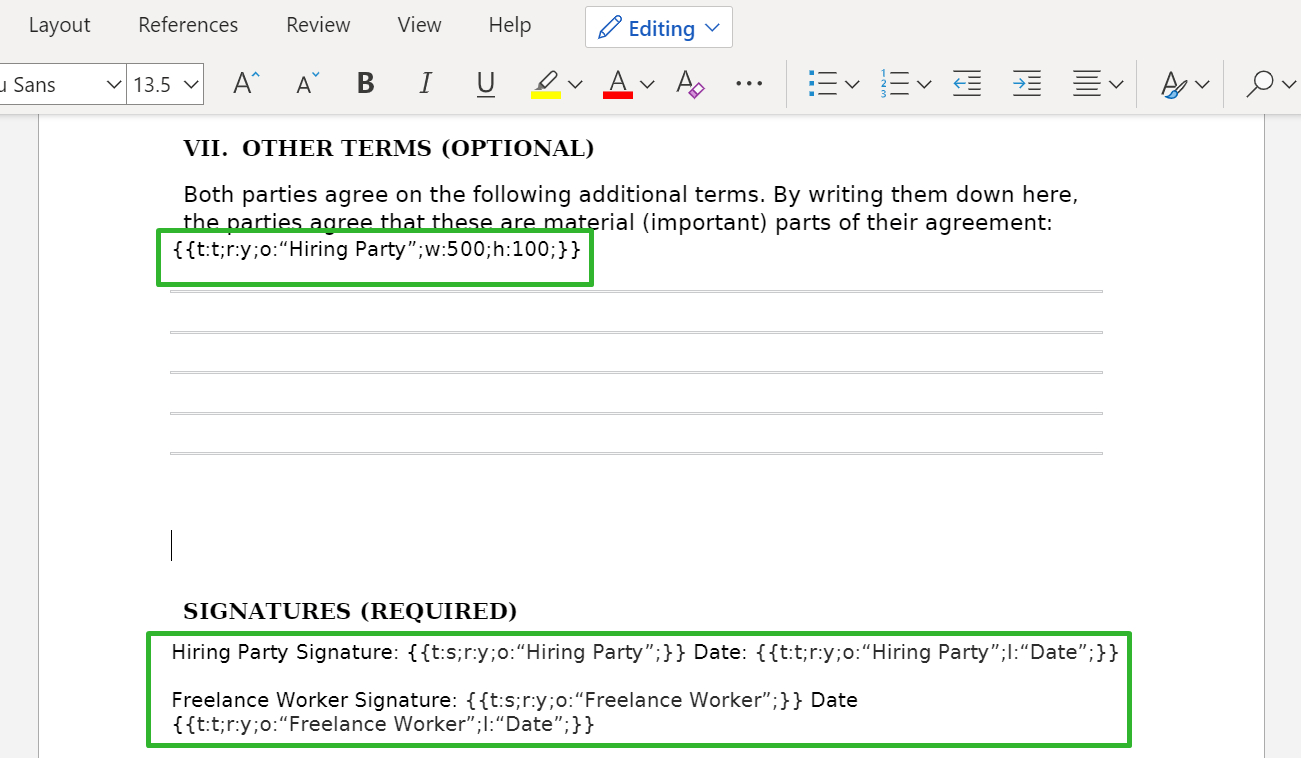
For example, the text tags being used for the ‘Date’ line are the following:
{t (for the Type of field): t (for Text): r (for Required): y (for Yes): o (for Role): “Customer”; l (for Label): “Date”; }
The text tags being used on first the ‘Sign Here’ line are the following:
{ t (for Type of field): s (for Signature); r (for Required): y (for Yes); o (for Role): “Customer”;}
The text tags being used on the second ‘Sign Here’ line are the following:
{ t (for Type of field): s (for Signature); r (for Required): y (for Yes); o (for Role): “Agent”; }
After placing text tags in your document and uploading it to airSlate SignNow, the document fields will show up automatically:
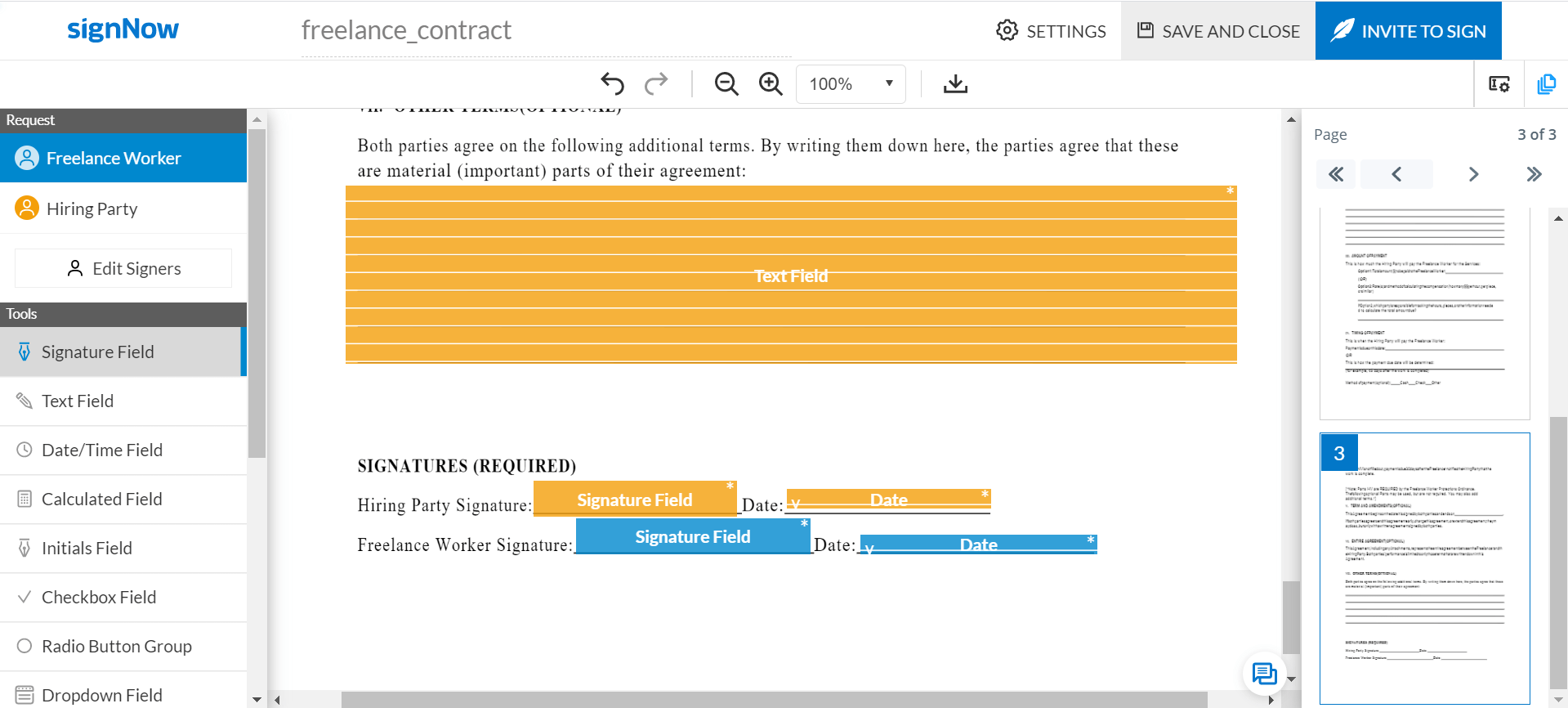
The table below shows the most widely used text tags in airSlate SignNow along with the types of fields for which these text tags can be applied.
| KEY | What does it mean? | Accepted format & values | When fields need this KEY? |
|---|---|---|---|
| t | TYPE of the field |
s (for signature) i (for initials) t (for text) d (for dropdown) c (for checkboxes) |
For every field |
| r | REQUIRED |
y (for required) n (for optional) |
For every field |
| o | ROLE |
"
|
For every field |
| l | LABEL | " | Only for Text and Drop down fields |
| dd | DROPDOWN | "option1, option2, option2, ...." | Only for Drop down fields |
| f | FILE |
"
|
File attachment |
| w | WIDTH | w (width) | For every field |
| h | HEIGHT | h (height) | For every field |
| v | VALIDATOR_ID | v (validator_id) | Only for Text field |
| 1 | To create a field of TYPE signature, with required REQUIREMENT, ROLE 'CEO', WIDTH '100', and HEIGHT '15' | {{t:s;r:y;o:"CEO";w:100;h:15;}} |
| 2 | To create a field of TYPE initials, with optional REQUIREMENT, ROLE 'CEO', and WIDTH '50' | {{t:i;r:n;o:"CEO";w:50;}} |
| 3 | To create a field of TYPE text, with optional REQUIREMENT, ROLE 'CEO', LABEL 'Label', and HEIGHT '75' |
{{t:t;r:n;o:"CEO";l:"Label";h:75;}} |
| 4 | To validate a date for TYPE text, with optional REQUIREMENT, ROLE 'CEO', LABEL 'Label', WIDTH '100', and VALIDATOR_ID '13435fa6c2a17f83177fcbb5c4a9376ce85befeb' |
Date: {{t:t;r:n;o:"CEO";l:"Label";w:100;v:"13435fa6c2a17f83177fcbb5c4a9376ce85befeb";}} |
| 5 | To validate a US phone number for TYPE text, with optional REQUIREMENT, ROLE 'CEO', LABEL 'Label', WIDTH '100', and VALIDATOR_ID '13cc1d661da456d27b249b73056ed4d1f2e72d8e' | {{t:t;r:n;o:"CEO";l:"Label";w:100;v:"13cc1d661da456d27b249b73056ed4d1f2e72d8e";}} |
| 6 | To validate a US zip code for TYPE text, with optional REQUIREMENT, ROLE 'CEO', LABEL 'Label', WIDTH '100', and VALIDATOR_ID '1671f4eb87444a24e1e00f149bade8b7cf3af5da' | {{t:t;r:n;o:"CEO";l:"Label";w:100;v:"1671f4eb87444a24e1e00f149bade8b7cf3af5da";}} |
| 7 | To validate an age for TYPE text, with optional REQUIREMENT, ROLE 'CEO', LABEL 'Label', WIDTH '100', and VALIDATOR_ID '1a203fa91791b0458608be045a454ba90557fb26' |
{{t:t;r:n;o:"CEO";l:"Label";w:100;v:"1a203fa91791b0458608be045a454ba90557fb26";}} |
| 8 | To validate an email address for TYPE text, with optional REQUIREMENT, ROLE 'CEO', LABEL 'Label', WIDTH '100', and VALIDATOR_ID '7cd795fd64ce63b670b52b2e83457d59ac796a39' |
{{t:t;r:n;o:"CEO";l:"Label";w:100;v:“7cd795fd64ce63b670b52b2e83457d59ac796a39”;}} |
| 9 | To validate a US state for TYPE text, with optional REQUIREMENT, ROLE 'CEO', LABEL 'Label', WIDTH '100', and VALIDATOR_ID '3123849de563f9e14acacc2739467e3d30e426b6' |
{{t:t;r:n;o:"CEO";l:"Label";w:100;v:“3123849de563f9e14acacc2739467e3d30e426b6”;}} |
| 10 |
To create a field of TYPE signature, with required REQUIREMENT, and ROLE 'CFO' |
{{t:s;r:y;o:"CFO";}} |
| 11 |
To create a Field of TYPE Text, with optional REQUIREMENT, with ROLE 'CFO', and with LABEL "notes" |
{{t:t;r:n;o:"CFO";l:"notes";}} |
| 12 |
To create a Field of TYPE Initial, with optional REQUIREMENT, and ROLE 'CFO' |
{{t:i;r:n;o:"CFO";}} |
| 13 | To create a Field of Type Drop down, with required REQUIREMENT, with ROLE 'Employee', with LABEL 'Date', and with DROPDOWNS '2012,2013,2014' | {{t:d;r:y;o:"Employee";l:"Year";dd:"2012,2013,2014";}} |
| 14 |
To create a Field of TYPE Text, with a Date label which will auto-fill with current date |
{{t:t;r:y;o:"CFO";l:"Date";}} |
| 15 |
To create an Invite tag with signing order, with required REQUIREMENT, with ROLE 'Role1', 'Client', 'Manager': |
{{t:e;o:"Role1";e:"siri@mailinator.com";order:1;}} |
There can also be more complex tags which consist of a tag_name and the airSlate SignNow field creation information as presented in the call PUT /document/.
These complex tags appear in the format {{}} such as {{my signature}} or {{ClientSignatureDate}}.
Here are some of the most popular examples of such complex tags:
| Text Tag |
{ tag_name:'TextTagExample', }, |
| Date Validator Tag |
{ "tag_name":"DateValidatorTagExample", }, |
| Initials Tag |
{ "tag_name":"InitialsTagExample", }, |
| Signature Tag |
{ "tag_name":"SignatureTagExample", }, |
| Drop-Down Tag |
{ "tag_name":"DropDownTagExample", }, |
| Attachment Tag |
{ tag_name:'AttachmentTagExample', } |
| Checkbox Tag |
{ |
To begin, you can simply copy-paste the needed tag from the table below and add it your document prior to uploading it to airSlate SignNow. Height and width are easily adjusted manually, just change the numbers as per your needs.











