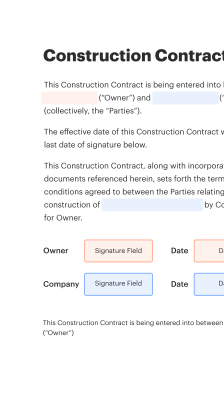
Adjust Signature Default in SignNow

Get rid of paper and automate digital document processing for more productivity and limitless possibilities. Sign anything from a comfort of your home, quick and accomplished. Experience a greater manner of running your business with airSlate SignNow.

Award-winning eSignature solution

What adjust signature default does and why it matters

The adjust signature default feature lets account administrators and document authors set a consistent signature appearance, placement, and behavior that applies automatically when adding signature fields to documents. In signNow this controls default signature style, whether initials are included, signature font or drawn style, and alignment on the page. A clear default reduces manual tweaks, enforces branding or compliance rules, and shortens document preparation time while preserving audit metadata and signer intent across recurring templates and workflows.

Benefits of configuring a default signature

Setting a default signature in signNow saves time, ensures consistent presentation across documents, and reduces signing errors while supporting auditability and compliance for business workflows.

Benefits of configuring a default signature

Common obstacles before using adjust signature default

  • Inconsistent signature placement across documents creates extra review and rework for administrators and signers.
  • Manual styling for every document increases preparation time and risks visual errors or misalignment.
  • Different teams using varied signature formats complicate brand consistency and internal standards enforcement.
  • Lack of centralized defaults can lead to missing initials, wrong signer roles, or incomplete signature fields.

Typical user profiles for adjust signature default

Contract Manager

A Contract Manager uses adjust signature default to enforce consistent signature placement and style across hundreds of vendor and client agreements, reducing preparation time and ensuring each executed PDF carries a clear audit trail and standardized signer fields.

HR Director

An HR Director applies default signatures to onboarding packages and policy acknowledgements so new-hire documents appear uniform, minimize field-placement errors, and meet internal recordkeeping needs while maintaining signer clarity.

Teams and roles that benefit most from default signatures

Organizations that send recurring contracts, HR forms, or standardized agreements gain the most from a configurable default signature.

  • Legal and contracts teams who prepare high volumes of similar agreements.
  • Human resources departments managing offer letters, onboarding, and consent forms.
  • Sales operations and account managers sending standardized client contracts and NDAs.

Centralized defaults reduce manual steps, improve compliance, and make bulk sends and templates easier to manage across departments.

Additional controls and options for larger teams

Enterprise and advanced accounts can access finer controls to manage defaults across users, integrations, and specialized authentication requirements.

Role-based defaults

Assign different default signature settings by role or team so legal, HR, and sales groups each use the appropriate style and required fields.

Per-recipient settings

Set signature defaults that vary by recipient type, such as requiring initials for witnesses or additional fields for company signers.

Conditional logic

Combine defaults with conditional fields so signature behavior adapts to form answers or selected contract options automatically.

Integration behavior

Control how defaults are applied when documents originate from integrated apps like CRMs or cloud storage to maintain consistent output.

Audit configuration

Adjust how signature metadata is recorded in logs, including optional additional signer identifiers for compliance-sensitive workflows.

Template locking

Lock template elements to enforce default signature placement and prevent accidental edits by non-admin users.

be ready to get more

Choose a better solution

Core controls that shape the default signature experience

Several configurable options determine how default signatures behave, letting administrators balance consistency with flexibility for different workflows and compliance needs.

Signature type

Choose whether signatures default to drawn, typed, or uploaded image formats, and set whether initials are added automatically for clarity in multi-signer documents.

Appearance

Define font style, size, and color for typed signatures or set preferred stroke thickness for drawn signatures to ensure readability and match brand guidelines.

Placement rules

Configure default alignment, margins, and whether signature fields snap to anchors or predefined positions to reduce manual repositioning during document setup.

Template inheritance

Decide if defaults apply to all templates or specific folders, enabling different defaults for HR, sales, or legal departments while keeping centralized control.

How adjust signature default applies when creating documents

This sequence shows how defaults are applied automatically during template creation, document editing, and bulk sends so users maintain consistent signer fields.

  • Template creation: Defaults pre-fill signature field style.
  • Document upload: New signature fields inherit defaults.
  • Field adjustments: Admins can override per document if needed.
  • Bulk send: Defaults speed mass distribution and signing.
Collect signatures
24x
faster
Reduce costs by
$30
per document
Save up to
40h
per employee / month

Quick setup: configure a default signature in signNow

Follow these concise steps to set or change the default signature behavior in a signNow account for fast, consistent document preparation.

  • 01
    Open settings: Access account or admin settings.
  • 02
    Signature defaults: Locate the default signature configuration.
  • 03
    Choose style: Select drawn, typed, or image signature.
  • 04
    Save changes: Apply defaults to templates and new documents.

Audit trail setup and reviewing signed documents

Follow these steps to ensure default signature changes and signed PDFs include required audit data and are easy to review for compliance.

01

Enable logging:

Turn on detailed event logs.
02

Record defaults:

Include default signature metadata.
03

Post-sign checks:

Verify document integrity.
04

Export reports:

Generate signer activity exports.
05

Store artifacts:

Save signed PDFs and logs.
06

Periodic review:

Audit records quarterly.
be ready to get more

Why choose airSlate SignNow

  • Free 7-day trial. Choose the plan you need and try it risk-free.
  • Honest pricing for full-featured plans. airSlate SignNow offers subscription plans with no overages or hidden fees at renewal.
  • Enterprise-grade security. airSlate SignNow helps you comply with global security standards.
illustrations signature

Recommended workflow settings for default signatures

Use these suggested workflow configuration entries to align default signature behavior with typical operational needs and compliance considerations.

Setting Name and Default Configuration Configuration Value
Default signature appearance setting option Typed signature
Default initials behavior for signers Enabled
Signature position auto-alignment threshold 5 mm
Template inheritance scope for defaults Folder-level
Post-signature document locking policy Enable locking

How to adjust signature default across devices

Adjust signature defaults using signNow's web dashboard; mobile apps inherit those settings but allow per-document overrides when editing on device.

  • Desktop (web): Full admin controls
  • Mobile apps: Overrides possible per document
  • Tablets: Same editor capabilities

For consistent enforcement, set defaults at the account or folder level in the web dashboard; inform teams that mobile and tablet editors can override defaults for single documents when necessary.

Security and authentication controls relevant to signature defaults

Audit trail: Detailed event logs
Access controls: Role-based limits
Encryption: Transport and storage
Authentication: Multi-factor options
Document locking: Post-signature protection
Certificate support: Digital signature IDs

Real-world examples of adjust signature default in use

Practical case examples show how standardized signature defaults speed preparation, reduce errors, and support compliance in different industries.

Healthcare consent forms

A regional clinic standardized signature appearance across patient consent packets to reduce administrative editing time and ensure signs align with form fields

  • Default signature style and initials enabled for clinician and patient fields
  • Saves staff time and reduces patient confusion during intake

Resulting in faster processing, clearer records, and easier HIPAA-aligned audit reviews.

Sales contract templates

A software vendor applied a default signature and position to recurring subscription agreements to keep branding consistent and prevent placement mistakes

  • System default locks signature size and minimum margins
  • Reduces back-and-forth edits and speeds sales cycle approvals

Leading to shorter close times, fewer document revisions, and consistent legal presentation for audits and recordkeeping.

Best practices to manage signature defaults securely

Adopt these practices to keep default signature settings consistent, auditable, and aligned with legal and operational requirements across your organization.

Documented change control for signature defaults
Maintain a written record of default signature configurations, who authorized changes, and why. Use versioned templates and a staging area to test changes before applying them account-wide to reduce the risk of widespread formatting errors or compliance lapses.
Role-based assignment and limited admin access
Grant default configuration privileges only to a small group of administrators and apply role-based controls so template editors cannot modify account-level defaults without approval.
Combine defaults with strong authentication
Pair signature appearance defaults with appropriate signer authentication—email, SMS, SSO, or digital certificates—depending on transaction sensitivity to meet ESIGN and UETA evidentiary standards.
Regular audits and template reviews
Schedule periodic audits of templates and default settings to ensure they remain aligned with evolving legal requirements, branding updates, and operational needs.

FAQs and troubleshooting for adjust signature default

Common questions and solutions address setup errors, missing defaults, and differences between account-level and template-level settings to help administrators resolve issues quickly.

How signNow compares for default signature controls

Quick comparison of default signature capabilities and compliance features across common eSignature vendors to inform platform selection.

Feature and Compliance Comparison Matrix signNow (Recommended) DocuSign Adobe Sign
Default signature style adjustment availability
Role-based default assignment support
Template inheritance and folder scope Folder-level Template-level Folder & account
HIPAA support and controls
be ready to get more

Get legally-binding signatures now!

Retention and archival timelines related to default signatures

Retention policies should reflect legal requirements and internal recordkeeping standards for signed documents and their audit trails.

Standard retention period:

7 years for most contracts.

HIPAA-related documents:

6 years is common.

Tax-related agreements:

Keep for 7 years minimum.

Employment records:

Retain for recommended 6 years.

Document disposal policy:

Secure deletion after retention period.

Operational and compliance risks from improper defaults

Signature ambiguity: Misinterpretation risk
Formatting errors: Document rejection
Noncompliance: Regulatory exposure
Poor audit records: Evidence gaps
Unauthorized changes: Validity concerns
Inefficient workflows: Increased costs

Pricing overview and starting tiers for common eSignature platforms

Representative starting plans and typical service scope for each vendor; check current vendor pages for exact promotions, enterprise pricing, and add-ons.

Pricing and Limits Overview signNow (Featured) DocuSign Adobe Sign Dropbox Sign (HelloSign) PandaDoc
Entry-level per-user plan and inclusions Starts at $8/user/month with unlimited basic eSignatures and templates Starts at $10/user/month with core signing features Starts at $12.99/user/month often bundled with Acrobat Starts at $15/user/month for essential eSignature features Starts at $19/user/month including CRM integrations
Template and document limits in base plan Unlimited templates and documents Limited templates depending on plan Templates included with Acrobat subscription Templates included, limits vary Generous templates, limits depend on tier
Advanced compliance and enterprise options Available with business and enterprise plans Enterprise compliance add-ons available Enterprise and business offerings include compliance Enterprise features via Dropbox business Enterprise eSignature with higher tiers
Integration availability Native integrations with common CRMs and cloud storage Wide ecosystem integrations Strong Adobe ecosystem integrations Cloud storage and productivity integrations CRM and document workflows supported
Reporting and admin controls in base plan Basic admin and reporting included Advanced reporting in higher tiers Admin console with Acrobat plans Admin features vary by plan Reporting included at business tiers

Simplify complex workflows

Create, execute, and manage workflows of any complexity, electronically from virtually anywhere. Scalable eSignature capabilities allow you to share documents with the right people in the correct order and define roles for each recipient. Execute document workflows faster and easier than ever before.

Automate document management

Optimize complex signing processes with airSlate SignNow’s powerful features to enhance your business. Control your automated eSignature workflows to ensure they're running at peak performance with instant notifications and reminders.

Optimize in team collaboration

Bring teams together in a secure, shared environment. Manage documents, use form templates and notifications to create more efficient cross-organization collaboration. Free your employees from having to spend time on repetitive activities so that they can focus on valuable, business-critical tasks.

Integrate into your existing systems

Run your projects with industry-leading integration. Collect Salesforce, Microsoft Teams, and SharePoint all in one business flow. Connect your software to a single system for endless possibilities and more productiveness.

Stay compliant with best-in-class data protection

Feel safe knowing that your data is protected by the most recent in encryption security. airSlate SignNow is GDPR and eIDAS certified and offers you exposure into your eSigning procedure with court-admissible audit trails. Configure user authorization and rights to control who has access to what.


walmart logo
exonMobil logo
apple logo
comcast logo
facebook logo
FedEx logo
be ready to get more

Get legally-binding signatures now!