Agreement Management Software for Procurement

Experience effortless document management and eSigning with airSlate SignNow, your cost-effective solution for efficient procurement.

Award-winning eSignature solution

What agreement management software for procurement is and how it works

Agreement management software for procurement centralizes creation, negotiation, approval and storage of purchase-related contracts and supplier agreements. It combines reusable templates, clause libraries, approval routing, electronic signature capture, and audit trails to reduce manual handoffs. Integrated workflows enforce procurement policies while connectors sync contract metadata with ERP, sourcing, and vendor management systems. For compliance and traceability it records timestamps, signer identities, and version history, helping teams reduce cycle times and maintain a searchable contract repository across sourcing, legal review, and finance stakeholders.

Why procurement teams adopt agreement management software

Procurement teams use agreement management software to reduce approval delays, lower error rates, and centralize supplier terms. The software enforces consistent clauses, improves visibility into obligations, and shortens the time from negotiation to execution.

Why procurement teams adopt agreement management software

Common procurement contract challenges

  • Fragmented contract storage across email and shared drives causes missed renewals and poor visibility into supplier commitments.
  • Manual approval chains and ad hoc redlining increase turnaround times and raise the risk of inconsistent contract language.
  • Lack of template control leads to unauthorized clause modifications and compliance gaps across purchasing categories.
  • Difficulty linking contracts to PO and invoice systems creates reconciliation gaps and delays in vendor payment processing.

Representative user profiles

Procurement Manager

A procurement manager coordinates supplier selection, issues RFPs, and needs a central contract repository with approval routing and automated reminders to manage renewals and compliance across multiple categories.

Corporate Counsel

An in-house lawyer enforces standardized clauses, reviews redlines, and requires audit trails and secure signature evidence to demonstrate adherence to policy and regulatory obligations during audits.

Typical users and team roles for procurement agreement tools

Procurement agreement platforms support cross-functional teams that need standardized contracts and controlled approvals.

  • Procurement and sourcing teams managing supplier selection, negotiations, and contract lifecycle oversight.
  • Legal and compliance groups reviewing terms, approving unusual clauses, and maintaining clause libraries.
  • Finance and accounts payable reconciling contract terms with POs, invoices, and payment schedules.

The tool improves collaboration between these groups by providing shared access, defined approvals, and traceable execution records.

Core features to evaluate for procurement agreements

Evaluate features that address clause control, approvals, execution, and integrations to ensure the procurement process is auditable and efficient.

Template and clause library

A centralized library of approved templates and clauses enforces consistent language across teams, reduces drafting time, and limits ad hoc alterations during negotiations to maintain compliance with procurement policies.


Approval routing

Configurable sequential and parallel approval flows route contracts to procurement, legal, and finance based on criteria such as spend threshold, contract type, or vendor classification to accelerate signoff.

Electronic signatures

Integrated eSignature capabilities capture signer identity, consent, and timestamped evidence compliant with ESIGN and UETA, enabling legally binding electronic execution of procurement agreements.

Audit trail and versioning

Immutable audit logs record each action, version differences, and reviewer notes so teams can prove the negotiation timeline and signer intent during disputes or audits.

ERP and procurement integrations

Bidirectional connectors sync contract metadata with ERP, S2P, and vendor management systems so purchase orders, supplier records, and financial data remain aligned with contract terms.

Reporting and alerts

Custom dashboards and automated reminders provide visibility into expirations, renewals, and SLA compliance so teams can mitigate risks before contract deadlines.

be ready to get more

Choose a better solution

Integrations and template customization that matter

Look for integrations and templating that reduce copying, maintain clause control, and connect contracts to work systems used by procurement teams.

Google Docs integration

Bi-directional sync with Google Docs allows users to draft and collaborate in familiar editors, then publish approved content to templates while preserving formatting and reducing reconciliation between drafts and executed contracts.

CRM and ERP connectors

Native integrations with CRM and ERP systems automatically populate contract fields with vendor and purchase order data, ensuring consistency across procurement, finance, and supplier management systems.

Cloud storage integrations

Direct links to cloud storage providers like Dropbox and Google Drive enable secure archival of executed agreements with consistent folder structures and access controls.

Custom templates and fields

Template editors that support conditional fields, calculated values, and role-based placeholders let procurement teams automate repetitive sections and adapt documents to category-specific requirements.
How the procurement agreement lifecycle is automated

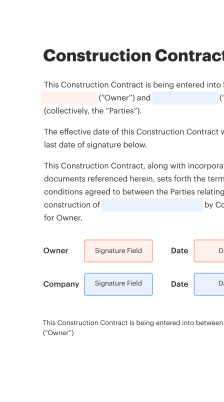
A typical automated lifecycle reduces manual handoffs by linking template generation, review, signature collection, and storage in a single flow.

  • Template generation: Populate clauses and variable fields automatically.
  • Approval workflows: Define approvers and escalation rules.
  • Signature capture: Collect signatures online or via mobile.
  • Archival: Store executed contracts with metadata and audit trail.
Collect signatures
24x
faster
Reduce costs by
$30
per document
Save up to
40h
per employee / month

Quick setup: from template to signed supplier agreement

Follow these steps to create, route, and finalize a procurement agreement with consistent approvals and recorded signatures.

  • 01
    Create template: Build a reusable contract with standard clauses and placeholders.
  • 02
    Initiate request: Start agreement from template and attach procurement details.
  • 03
    Route for approval: Assign reviewers and set sequential or parallel approvals.
  • 04
    Execute: Collect eSignatures and archive the final executed copy.

Managing audit trails and post-execution records

Maintain thorough records for every procurement transaction to support audits, dispute resolution, and compliance checks.

01

Capture metadata:

Record supplier, value, and renewal dates
02

Record signer identity:

Log IP, email, and authentication method
03

Store version history:

Preserve all draft and redline versions
04

Immutable audit log:

Ensure tamper-evident activity records
05

Retention settings:

Apply company retention policies
06

Export capabilities:

Support PDF/A or CSV exports
be ready to get more

Why choose airSlate SignNow

  • Free 7-day trial. Choose the plan you need and try it risk-free.
  • Honest pricing for full-featured plans. airSlate SignNow offers subscription plans with no overages or hidden fees at renewal.
  • Enterprise-grade security. airSlate SignNow helps you comply with global security standards.
illustrations signature

Typical workflow settings for procurement agreement automation

Default workflow configurations reduce setup time and provide predictable approval behavior while allowing administrators to adjust thresholds and notifications.

Procurement Workflow Setting Name Header Default Configuration and Admin Value
Approval Routing Sequence Sequential by default
Reminder Frequency 48 hours before deadline
Auto-escalation rules Escalate after 72 hours
Signature collection method Email or mobile eSignature
Template locking policy Admin lock after publish

Supported devices and browser requirements

Modern agreement platforms support desktop, tablet, and mobile access with standard browser compatibility and native app options.

  • Desktop browsers: Chrome, Edge, Safari supported
  • Mobile platforms: iOS and Android apps available
  • Offline use: Limited offline signing support

Ensure IT validates browser versions and mobile OS compatibility for corporate devices, confirm single sign-on support, and verify that any native apps meet your organization's security policies before broad deployment.

Security and document protection features

Data encryption: AES-256 at rest and TLS in transit
Access controls: Role-based permissions and SSO
Authentication options: Email, SMS, and OAuth methods
Document integrity: Tamper-evident audit logs
Storage compliance: Redundant cloud backups
Regulatory support: HIPAA and FERPA compatibility

Procurement use cases and examples

Real-world procurement scenarios show how agreement management software reduces cycle time and enforces policy across suppliers and internal stakeholders.

Large enterprise vendor onboarding

A global retailer standardized supplier contracts across regions to centralize terms and approvals

  • Template library with pre-approved clauses
  • Reduced legal review time by standardizing clauses

Resulting in faster vendor onboarding, fewer contract exceptions, and centralized compliance reporting across procurement teams.

University purchasing and grant compliance

A public university integrated procurement agreements with grant management to ensure sponsor terms were recorded

  • Automated approval routing to campus counsel and finance
  • Automatic linkage of contract terms to grant budgets and reporting

Ensures compliance with funding requirements and accurate obligation tracking for audits and reporting.

Best practices for secure and accurate procurement agreements

Adopt consistent procedures and controls to reduce risk while maximizing the productivity advantages of digital agreement management.

Establish a governed template and clause library
Maintain a single source of approved templates and clauses managed by legal and procurement to ensure consistent terms, speed up drafting, and minimize off-policy language in supplier contracts.
Define clear approval thresholds and routing rules
Configure workflows that route contracts based on monetary thresholds, contract type, or vendor risk level to ensure appropriate review without unnecessary bottlenecks.
Use audit trails and standardized metadata
Require structured fields for supplier, category, contract value, and renewal date so reporting, renewals, and compliance checks can be automated and easily audited.
Train users and enforce access controls
Provide role-based training for procurement, legal, and finance teams and apply least-privilege permissions to prevent unauthorized edits and preserve contractual integrity.

FAQs About agreement management software for procurement

Answers to common questions about legal validity, integrations, security, and implementation help procurement teams plan a compliant deployment.

Quick feature comparison for procurement eSignature and agreement tools

A concise comparison of essential procurement features across two leading providers for quick reference.

Procurement Agreement Comparison Criteria List signNow (Recommended) DocuSign
eSignature legal compliance
Mobile signing support
API access and webhooks REST API with webhooks REST API with webhooks
Bulk Send capability Bulk Send available Bulk Send available
be ready to get more

Get legally-binding signatures now!

Operational and legal risks without proper tools

Missed renewals: Lost discounts and auto-renewal costs
Unauthorized terms: Legal exposure and liability
Payment delays: Penalties and strained supplier relations
Audit failures: Regulatory fines or remediation
Data breaches: Sensitive vendor information exposed
Contract disputes: Increased legal costs

Representative pricing and plan notes for procurement deployments

Pricing and plan structures vary by vendor; the table lists typical entry points, mid-tier options, and enterprise considerations to guide procurement evaluations.

Pricing and Plans signNow (Featured) DocuSign Adobe Sign Dropbox Sign PandaDoc
Entry monthly price Starts at approximately $8 per user per month Starts at approximately $10 per user per month Starts at approximately $9.99 per user per month Starts near $15 per user per month Free tier available, paid tiers start around $19
Mid-tier plan offering Business plan with team features and API access Standard or Business Pro with advanced features Small Business plan with templates and admin controls Standard plan for teams with enhanced features Essentials and Business plans with eSignature and templates
Enterprise options Enterprise plans with SSO, advanced security, and SLAs Enterprise solutions with advanced integrations and support Enterprise licensing with Adobe Experience Cloud options Business Enterprise with SSO and custom integrations Enterprise with dedicated support and custom pricing
Free trial and onboarding Free trial available and documentation for admins Free trial available with guided onboarding Free trial and extensive learning resources Trial available; Dropbox integration focus Free trial plus onboarding for higher tiers
Per-user vs account billing Per-user and volume licensing available Per-user or volume agreements Per-user subscriptions and enterprise billing Per-user or team-based pricing Flexible per-user and enterprise contract options
Contract customization and SLAs Custom contracts and SLAs for enterprise customers Enterprise SLAs and custom agreements Enterprise support with contract options Business and enterprise contracts available Custom SLA and enterprise contracting available
walmart logo
exonMobil logo
apple logo
comcast logo
facebook logo
FedEx logo
be ready to get more

Get legally-binding signatures now!