Best Billing Format for Client for Financial Services

Watch your invoice workflow turn fast and effortless. With just a few clicks, you can execute all the necessary actions on your best billing format for client for Financial Services and other important files from any gadget with internet access.

Award-winning eSignature solution

What the best billing format for client for financial services entails

A best billing format for client for financial services is a standardized invoice and billing packet that clearly documents services, rates, dates, taxes, payment terms, and client information to support fast reconciliation and regulatory compliance. It combines an itemized service section, invoice header, unique invoice identifier, payment instructions and accepted methods, tax and withholding details, and any required disclosures or retainer balances. For digital workflows, it also includes fields for client approval and a secure signature. Implementing a consistent format reduces disputes, improves cash flow, and supports auditability under U.S. rules such as ESIGN and UETA.

Why adopt a standardized billing format

Standardized billing formats reduce errors, shorten payment cycles, and make audits simpler by keeping consistent line items, required disclosures, and signatures in a predictable layout.

Why adopt a standardized billing format

Common billing challenges in financial services

  • Inconsistent line-item descriptions that cause client confusion and payment delays.
  • Missing tax or regulatory disclosures that trigger reconciliation work and compliance checks.
  • Manual entry errors in client or amount fields leading to rejected payments.
  • Lack of clear payment instructions or multiple payment methods causing processing delays.

Typical user profiles for billing workflows

Finance Manager

A Finance Manager oversees invoicing policies, standardizes billing templates across clients, enforces approval routing, and analyzes collections data to reduce days sales outstanding while ensuring records meet regulatory retention requirements.

Client Service Rep

A Client Service Rep prepares client invoices, clarifies line items, coordinates payment arrangements, and ensures signed client authorizations are attached to billing records to prevent disputes and speed collections.

Teams and roles that rely on structured billing

Financial advisors, accounting teams, compliance officers, and client operations commonly use standardized billing formats to reduce disputes and document approvals.

  • Accounting teams who reconcile invoices and ledgers across client accounts.
  • Client operations teams responsible for issuing invoices and receiving payments.
  • Compliance officers verifying disclosures and record retention against regulations.

Consistent formats help internal teams collaborate across client onboarding, billing reconciliation, and year-end reporting while maintaining a clear audit trail.

Additional capabilities to optimize billing workflows

Beyond core features, several advanced capabilities improve accuracy, control, and client experience when integrated into billing formats.

Custom Fields

Custom fields allow mapping of client account codes, contract IDs, or internal cost centers directly on invoices to support automated accounting exports and reporting.


Multi-Currency

Multi-currency support displays amounts in client-preferred currency, includes conversion details, and records exchange rates for accurate financial reporting.

Approval Routing

Configurable routing enforces multi-level approvals before invoices are issued, helping maintain separation of duties and compliance with internal controls.

Bulk Send

Bulk Send enables distributing standardized invoices to many clients at once while preserving individualized data and signature capture for each recipient.

Payment Reconciliation

Payment reconciliation features match incoming payments to invoices automatically, flagging mismatches and reducing manual ledger adjustments.

Retention Controls

Retention controls automatically apply document lifecycle rules, archiving or purging records per policy and supporting regulatory retention requirements.

be ready to get more

Choose a better solution

Core billing features to include in your format

A practical billing format benefits from standardized templates, clear itemization, integrated payment links, and a reliable audit trail to support financial and compliance workflows.

Templates

Reusable invoice templates ensure consistent client-facing layout, pre-populated disclosure language, and standardized fee codes that reduce manual entry and support uniform recordkeeping across accounts.

Itemization

Detailed line items with service dates, advisor initials, units, and rates provide transparency for clients and simplify internal reconciliation and downstream accounting entries.

Payment Links

Embedded payment options such as ACH, card, or invoice pay links in the billing format streamline collections and document the accepted payment method alongside payment terms.

Audit Trail

A clear, timestamped record of changes, approvals, and signatures preserves an evidentiary history for audits and regulatory inquiries while supporting dispute resolution.
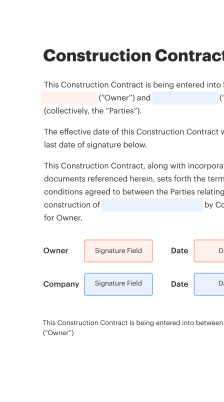
How an online billing format is completed and signed

Online workflows convert the billing template into a fillable document, collect client approvals, and store an auditable record.

  • Generate: Fill template with client data.
  • Review: Internal approvals routed automatically.
  • Sign: Client signs electronically on any device.
  • Archive: Signed copies saved with audit trail.
Collect signatures
24x
faster
Reduce costs by
$30
per document
Save up to
40h
per employee / month

Step-by-step: create a compliant billing document

Follow these steps to assemble a billing format that meets client expectations and regulatory needs.

  • 01
    Prepare header: Add company, client, and invoice ID.
  • 02
    Itemize services: List dates, descriptions, and unit amounts.
  • 03
    Specify terms: Include due date and payment methods.
  • 04
    Attach approvals: Include signatures and supporting files.

Audit trail setup and verification steps

Implement and verify audit trail settings to ensure each billing transaction records identity, time, and actions for compliance.

01

Enable logging:

Turn on immutable logs.
02

Capture signer identity:

Record authentication method.
03

Timestamp events:

Record all actions.
04

Store versions:

Keep historical copies.
05

Export reports:

Schedule audit exports.
06

Validate integrity:

Use checksums or hashes.
be ready to get more

Why choose airSlate SignNow

  • Free 7-day trial. Choose the plan you need and try it risk-free.
  • Honest pricing for full-featured plans. airSlate SignNow offers subscription plans with no overages or hidden fees at renewal.
  • Enterprise-grade security. airSlate SignNow helps you comply with global security standards.
illustrations signature

Typical workflow settings for billing automation

Configure these workflow settings to automate invoice generation, approvals, reminders, and retention for a consistent billing process.

Feature Configuration
Reminder Frequency 48 hours
Approval Routing 2 approvers
Template Enforcement Required
Payment Integration ACH and Cards
Retention Period 7 years

Supported devices and technical requirements

Billing document creation and signing typically work across modern desktop browsers, mobile browsers, and dedicated mobile apps with standard security controls.

  • Desktop browsers: Chrome, Edge, Safari
  • Mobile devices: iOS and Android
  • Minimum TLS: TLS 1.2+

For optimal performance, ensure browsers are up to date, enable JavaScript, and confirm network policies allow secure HTTPS traffic; apps may offer additional features like biometric authentication and offline signing that improve client convenience and security.

Security features to protect billing documents

Encryption in transit: TLS 1.2+
Encryption at rest: AES-256
Access controls: Role-based
Authentication options: Multi-factor
Audit logging: Immutable logs
Document redaction: Field-level

Real-world examples of billing formats in action

Two concise case examples show how firms structure billing packets to match client agreements, support audits, and accelerate collections.

Advisory Firm invoice setup

A regional advisory firm standardized invoices with a header that includes client ID, engagement dates, and a unique invoice number to simplify matching

  • Template enforces line-item service codes and hourly totals for each advisor
  • This reduces reconciliation time and client queries

Resulting in faster payment posting and clearer audit trails for year-end reviews.

Wealth manager retainer billing

A wealth manager implemented a recurring billing packet showing retainer allocation, monthly earned fees, and unearned balance disclosures to satisfy fiduciary documentation

  • The format includes itemization, tax treatment notes, and an electronic signature field
  • Clients receive a single PDF with payment instructions and ACH link

Leading to fewer disputes and improved client transparency during compliance audits.

Best practices for secure, accurate billing formats

Apply standardized design and controls to reduce disputes and support compliance while keeping client communications clear and professional.

Use clear service descriptions and codes
Adopt a controlled vocabulary for services and fees, pairing human-readable descriptions with internal service codes to speed reconciliation and reduce client queries while supporting accounting automation.
Include explicit payment terms and options
State due dates, late fees, accepted payment methods, and remittance instructions on every invoice to avoid ambiguity and expedite collections with consistent expectations.
Attach supporting documentation as needed
Include work logs, time entries, or transaction receipts with invoices so clients can verify charges quickly and teams can substantiate billings during audits or disputes.
Retain signed copies with an audit trail
Store executed invoices and related approvals with immutable timestamps and signer identity evidence to meet regulatory requirements and simplify internal and external audits.

Common questions and troubleshooting for billing formats

Answers to frequent issues that arise when creating, sending, and managing billing documents for financial services.

How leading eSignature vendors support billing formats

Compare core capabilities relevant to billing formats, with signNow listed first as a recommended option for cost-effective, compliant workflows.

Platform signNow (Recommended) DocuSign Adobe Sign
Templates support
HIPAA compliance
Bulk Send
API access REST API REST API REST API
be ready to get more

Get legally-binding signatures now!

Regulatory and operational risks to monitor

Compliance fines: Monetary penalties
Client disputes: Delayed payments
Data breaches: Regulatory exposure
Audit failures: Remediation costs
Retention lapses: Loss of evidence
Incorrect taxes: Late filings

Pricing and plan considerations across providers

Cost options vary by feature set and intended scale; signNow is listed first as a featured vendor for straightforward, lower-cost plans suitable for many financial teams.

Plans signNow (Featured) DocuSign Adobe Sign Dropbox Sign PandaDoc
Starting monthly price $8 per user $10 per user $14 per user $8 per user $19 per user
Free tier available Limited Trial only Trial only Limited Trial only
Bulk send included Yes on paid tiers Add-on Add-on Add-on Add-on
API access Included on plans Paid plans Paid plans Paid plans Paid plans
Enterprise features Advanced controls Full enterprise Full enterprise Enterprise Enterprise
walmart logo
exonMobil logo
apple logo
comcast logo
facebook logo
FedEx logo
be ready to get more

Get legally-binding signatures now!