Bill Pay Template for Product Management

See your invoicing process turn fast and smooth. With just a few clicks, you can complete all the required actions on your bill pay template for Product Management and other important documents from any device with internet access.

Award-winning eSignature solution

What a bill pay template for product management is and why it matters

A bill pay template for product management is a standardized digital document that captures invoice data, approval fields, payment authorization, and tracking metadata used by product and finance teams to process vendor charges, reimbursements, or internal chargebacks. Templates reduce manual entry, ensure consistent data capture across releases and suppliers, and integrate with workflows that route items for approval, signature, and payment. When combined with an eSignature and document workflow platform, templates improve auditability, reduce processing time, and centralize records for reporting and compliance within product operations.

Why teams adopt a bill pay template for product management

Using a repeatable bill pay template reduces errors, speeds approvals, and creates a single source of truth for product-related spending, making month-end reconciliation and audit processes simpler and more reliable.

Why teams adopt a bill pay template for product management

Common challenges addressed by bill pay templates

  • Inconsistent invoice fields lead to missing vendor or project codes and delayed payments.
  • Manual approval routing causes bottlenecks when product and finance stakeholders are misaligned.
  • Lack of standardized metadata reduces visibility into product spend and impedes reporting.
  • Paper or ad-hoc digital invoices increase risk of duplicate payments and lost records.

Representative user profiles

Product Manager

A product manager uses the bill pay template to submit vendor invoices related to feature development, attach release notes or receipts, and capture the correct project and cost center. They rely on template fields to ensure approvals follow the expected review path and to link spend to roadmap items for reporting.

Finance Administrator

A finance administrator reviews template submissions to validate GL codes, confirm vendor details, and schedule payments. The administrator uses predefined fields to automate reconciliation, enforce internal controls, and maintain a clear audit trail for month-end close and external audits.

Teams and roles that typically use these templates

Product teams, finance groups, procurement, and operations frequently rely on bill pay templates to coordinate approvals and payment details across departments.

  • Product managers tracking vendor invoices and release-related expenses for cost reporting.
  • Finance teams reconciling payments, applying GL codes, and preparing monthly close entries.
  • Procurement or vendor managers standardizing contract billing and ensuring compliant payments.

These templates bridge operational and financial workflows, improving handoffs and reducing time spent chasing missing information.

Additional features to consider for enterprise usage

For larger teams or regulated environments, these capabilities add control, scalability, and compliance support to bill pay templates.

Role-based access

Granular role-based access limits who can create, edit, submit, or approve templates, enabling principle of least privilege for sensitive financial processes and protecting payment workflows from unauthorized changes.


Conditional logic

Conditional fields and branching adapt the template to invoice types or amounts, ensuring only relevant fields are presented and automating which approvers are required based on thresholds.

Pre-built connectors

Pre-built connectors for common accounting and procurement platforms reduce integration time and help maintain synchronized vendor and payment data across systems.

Bulk processing

Bulk upload and Bulk Send capabilities allow teams to process multiple invoices or send template instances to many recipients, improving throughput during high-volume billing cycles.

Retention policies

Configurable retention settings enforce document lifecycle rules, aiding compliance and reducing storage costs while preserving required records for audits.

Reporting and analytics

Built-in reporting surfaces spend by product, vendor, and project, enabling stakeholders to monitor budgets and identify cost drivers that affect product economics.

be ready to get more

Choose a better solution

Core features that make templates effective

These four capabilities are fundamental to a reliable bill pay template used in product management workflows.

Custom fields

Custom fields let teams capture product-specific metadata such as release ID, feature tag, or sprint number, enabling accurate chargeback and reporting by linking payments directly to product activities and budgets.

Approval routing

Configurable approval routing ensures invoice submissions follow predefined hierarchies, allowing product owners and finance approvers to be included in parallel or sequential flows for quick, auditable approvals.

Integration hooks

Integration hooks connect templates to ERP, accounting, and ticketing systems so invoice data syncs automatically, reducing manual entry and improving reconciliation across product and financial systems.

Audit trail

A complete audit trail records every action, signer, and timestamp for each template instance, supporting internal reviews, compliance checks, and forensic analysis when payment questions arise.
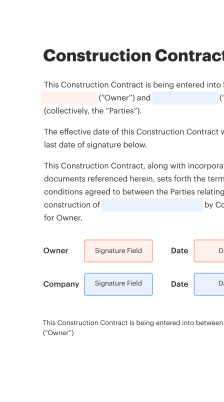
How the bill pay template process typically flows

A standard process moves a submitted invoice through validation, approval, signature, and payment scheduling with records stored for audit and reporting.

  • Submit: User fills template and uploads receipts.
  • Validate: System checks fields and required data.
  • Approve: Designated approvers review and sign.
  • Schedule payment: Finance schedules payment and archives.
Collect signatures
24x
faster
Reduce costs by
$30
per document
Save up to
40h
per employee / month

Quick setup steps to start using a bill pay template

Follow these steps to create a basic template that captures essential invoice and approval details for product-related spend.

  • 01
    Create template: Select a bill pay template and name it.
  • 02
    Add fields: Include vendor, invoice number, amount, cost center.
  • 03
    Set approvers: Define required signers and escalation order.
  • 04
    Publish and test: Run a test submission and confirm routing.
be ready to get more

Why choose airSlate SignNow

  • Free 7-day trial. Choose the plan you need and try it risk-free.
  • Honest pricing for full-featured plans. airSlate SignNow offers subscription plans with no overages or hidden fees at renewal.
  • Enterprise-grade security. airSlate SignNow helps you comply with global security standards.
illustrations signature

Standard workflow settings for bill pay templates

Configure these workflow settings to align template behavior with organizational approval, authentication, and notification policies.

Setting Name Configuration
Default signer authentication method setting Email OTP and SAML
Approval timeout and escalation setting 48 hours then escalate
Notification frequency and reminders setting Daily reminders until action
Auto-archive and retention schedule setting 90 days then archive
Invoice validation and duplicate check setting Enabled with checksum

Supported platforms and device considerations

Bill pay templates should be accessible via desktop browsers and on modern mobile and tablet apps to support approvers on the go.

  • Desktop browsers: Chrome, Edge, Safari supported
  • Mobile apps: iOS and Android native apps
  • Offline access: Limited offline capabilities

Testing templates across devices ensures field layouts render correctly, signature fields capture input reliably, and integrations trigger consistently before rolling templates into production.

Security and protection features for bill pay templates

Data encryption: AES-256 encryption in transit and at rest
Access controls: Role-based permissions and MFA
Authentication options: Email OTP, SMS OTP, and SAML
Document integrity: Tamper-evident audit hashes
Secure storage: Isolated cloud storage with retention controls
Audit logging: Immutable event logs for every action

Industry scenarios using a bill pay template for product management

Real-world examples show how templates standardize payments, approvals, and audit trails across product initiatives and vendors.

SaaS vendor invoices

A product team receives recurring SaaS invoices and uses a template to capture subscription details and project codes

  • Template auto-populates vendor and subscription fields
  • Finance approves with a single click, reducing processing time

Resulting in consistent chargeback records and faster reconciliation for the product budget.

Contractor expense billing

A product release includes contractor work billed per milestone, and the template collects milestone IDs and deliverable receipts

  • Approval rules route to the release owner and finance
  • Payments are scheduled after both approvers sign

Leading to transparent milestone payments and clear audit documentation tied to product releases.

Best practices for secure and accurate bill pay templates

Adopt these practices to reduce errors, strengthen controls, and keep audit records clean when using bill pay templates in product workflows.

Standardize required fields for every submission
Define a concise set of required fields—vendor name, invoice number, amount, GL code, and project or release ID—and enforce validation rules to prevent incomplete submissions and reduce back-and-forth with finance.
Use conditional logic to simplify forms
Apply conditional sections so users only see fields relevant to the invoice type, which reduces user error and speeds completion while ensuring all necessary data for processing is collected.
Implement multi-factor authentication for approvers
Require MFA and strong authentication methods for approvers on high-value payments to reduce fraud risk and ensure signatures are attributable to verified individuals in an auditable manner.
Keep templates version-controlled and documented
Maintain template version history and change logs so teams can track updates, revert if needed, and demonstrate to auditors and stakeholders when and why template changes occurred.

FAQs and troubleshooting for common issues

Answers to frequently asked questions and practical troubleshooting steps help teams resolve common template and signing issues quickly.

Feature availability comparison: signNow and peers

A concise comparison of common template and signing capabilities across major eSignature platforms to help evaluate fit for product-driven bill payments.

Feature signNow (Recommended) DocuSign Adobe Sign
Bulk Send
Conditional fields
SAML single sign-on
HIPAA-ready options Available Available Available
be ready to get more

Get legally-binding signatures now!

Compliance and operational risks to watch for

Late payment fines: Financial penalties and interest
Audit failures: Regulatory reporting deficiencies
Duplicate payments: Wasted budget and recovery costs
Data breaches: Exposure of vendor financial details
Contract disputes: Incorrect billing terms applied
Noncompliant signing: Invalid authorizations for key transactions

Pricing and plan comparison for template-enabled plans

High-level plan differences and entry-level pricing for select eSignature providers to illustrate cost and feature positioning for teams using bill pay templates.

Plan Name signNow (Recommended) DocuSign Adobe Sign HelloSign PandaDoc
Free tier available Yes Limited No Yes Limited
Entry price monthly $8/user/mo $10/user/mo $9/user/mo $15/account/mo $19/user/mo
API access included Yes Yes Yes Paid add-on Yes
Bulk Send support Yes Yes Yes No Yes
HIPAA compliance option Available Available Available Not standard Available
walmart logo
exonMobil logo
apple logo
comcast logo
facebook logo
FedEx logo
be ready to get more

Get legally-binding signatures now!