Billing in Excel for Operations Made Easy

Watch your invoice workflow become quick and effortless. With just a few clicks, you can perform all the necessary actions on your billing in excel for Operations and other crucial files from any gadget with internet access.

Award-winning eSignature solution

What billing in excel for operations entails

Billing in Excel for operations refers to the use of spreadsheet templates and digital workflows to prepare, verify, and distribute invoices or billing statements used by operational teams. It covers formatting rate tables, applying formulas for calculations, embedding reference data, and producing documents suitable for electronic signing and archival. When paired with an eSignature solution, the process moves from manual printing and mailing to secure digital transmission, authenticated signing, and a maintained audit trail that supports recordkeeping and downstream accounting reconciliation.

Why adopting digital billing with Excel matters

Using Excel-based billing with an eSignature workflow reduces manual errors, speeds approvals, and centralizes records while preserving legal validity under U.S. laws such as ESIGN and UETA when proper authentication and audit trails are used.

Why adopting digital billing with Excel matters

Common operational challenges with Excel billing

  • Manual data entry increases the chance of transcription and formula errors across monthly billing cycles.
  • Multiple document versions create confusion and complicate reconciliation of signed invoices.
  • Securing signed spreadsheets is difficult without encryption and controlled access processes.
  • Scaling approvals for high-volume batches requires automation features not native to Excel.

Representative user roles and personas

Operations Manager

An Operations Manager coordinates billing templates, reviews calculated totals in Excel, and verifies charge accuracy before routing documents for electronic signature. They require version control, role-based access, and clear audit trails to support month-end close and client disputes.

Billing Clerk

A Billing Clerk prepares line-item invoices in Excel using standardized templates, applies formulas for taxes and discounts, and sends documents for signature. They benefit from template reuse, batch sending, and simple integrations with CRM and accounting systems to reduce repetitive tasks.

Teams and roles that commonly use Excel billing workflows

Operations, billing, and finance teams use Excel-based bills combined with electronic signing to manage recurring invoices and ad hoc chargebacks efficiently.

  • Operations managers overseeing service-level billing and invoice verification responsibilities.
  • Billing clerks preparing itemized statements and applying rate schedules for client accounts.
  • Finance and accounts receivable staff managing approvals, reconciliations, and collections workflows.

Cross-functional coordination with procurement and accounts receivable ensures signed documents move into collections and accounting systems without delay.

Core features to enhance Excel billing for operations

These capabilities address accuracy, scale, and governance for teams using Excel to produce billable documents and manage approvals.

Templates

Reusable invoice templates preserve formulas and layout rules, reducing setup time and ensuring consistency across client and service types while supporting required fields for signing.


Bulk Send

Batch-sending capability allows operations to deliver large volumes of invoices with individualized fields, parallel signing, and grouped status reporting to accelerate billing cycles.

Conditional Fields

Logic-driven fields display or hide sections based on line items or account type, improving clarity and minimizing signer confusion while keeping documents compact.

Audit Trail

Comprehensive, timestamped records capture signer identity, IP, and action history to support dispute resolution and regulatory compliance.

Workflow Automation

Sequential and parallel routing, reminders, and escalation rules reduce manual follow-up and keep collections moving through defined operational steps.

API Access

Programmatic integration supports automated generation, sending, and retrieval of signed invoices into enterprise systems without manual export-import steps.

be ready to get more

Choose a better solution

Integrations that streamline Excel billing workflows

Connectors with document, CRM, and storage platforms reduce manual transfers and support centralized record management for billing documents.

Google Workspace

Sync spreadsheets, import customer data, and attach Google Drive files so invoice content updates automatically and the final signed PDF is stored alongside source spreadsheets for auditability.

CRM systems

Push invoice metadata to CRM records and pull account terms, enabling prefilled billing fields and automated status updates when documents are signed or payment is received.

Dropbox

Save signed invoices to predefined Dropbox folders, maintain folder-level permissions, and ensure backups are in place for retention and restoration workflows.

Accounting software

Export signed invoices and key fields to accounting systems to automate journal entries, reduce manual rekeying, and maintain consistent ledgers across finance operations.
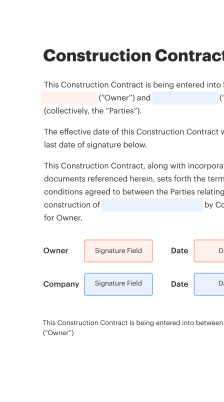
How the online Excel billing and signing process flows

This sequence outlines how an Excel invoice moves from preparation to signed record using a digital signature platform.

  • Create: Build invoice in Excel and finalize calculations.
  • Prepare: Convert to a sign-ready format and add fields.
  • Send: Route to recipients with signing order and reminders.
  • Verify: Capture signer authentication and store audit data.
Collect signatures
24x
faster
Reduce costs by
$30
per document
Save up to
40h
per employee / month

Quick setup: Excel billing workflow in four steps

Follow these four core steps to prepare an Excel billing file for digital signing and archival by operations teams.

  • 01
    Prepare template: Standardize headers, formulas, and reference tables.
  • 02
    Validate data: Run checks for totals, taxes, and anomalies.
  • 03
    Convert for signing: Export to PDF or apply document fields for signatures.
  • 04
    Send and archive: Transmit via signed workflow and store securely.

Managing audit trails for signed Excel invoices

Follow these steps to maintain a reliable audit trail for each billing transaction and support operational compliance.

01

Record creation:

Capture original file metadata and version.
02

Signer identity:

Authenticate signer using configured method.
03

Event logging:

Log timestamps for send and sign events.
04

Document snapshot:

Store immutable signed PDF copy.
05

Access history:

Track downloads and views per user.
06

Retention tagging:

Apply retention labels for archives.
be ready to get more

Why choose airSlate SignNow

  • Free 7-day trial. Choose the plan you need and try it risk-free.
  • Honest pricing for full-featured plans. airSlate SignNow offers subscription plans with no overages or hidden fees at renewal.
  • Enterprise-grade security. airSlate SignNow helps you comply with global security standards.
illustrations signature

Recommended workflow settings for Excel billing processes

Configure these workflow settings to balance security, efficiency, and operational needs for recurring or high-volume billing.

Setting Name Configuration
Reminder Frequency 48 hours
Signing Order Sequential
Authentication Type Email or SMS
Retention Policy 7 years
Bulk Send Limit 500 documents

Platform and device considerations

Ensure users can open the Excel source, view exported PDFs, and access the signing platform from supported devices.

  • Desktop: Windows or macOS
  • Mobile: iOS or Android
  • Browsers: Chrome, Edge, Safari

For best results, keep spreadsheet formulas simple, export stable PDFs for signing, and verify mobile responsiveness when signers will use tablets or phones to approve invoices.

Security controls relevant to Excel billing workflows

Encryption: TLS in transit; AES at rest
Access controls: Role-based user permissions
Audit logging: Immutable event records
Two-factor authentication: MFA for signers and admins
HIPAA support: Business associate controls
Data residency: Regional storage options

Industry examples of Excel-based billing workflows

Two concise case examples illustrate how Excel billing combined with eSignature improves routine operations and compliance in different environments.

Field Service Invoicing

A mid-sized field service firm generates itemized job invoices in Excel using standardized rate tables and automated formulas.

  • They attach job notes and equipment codes for each line item.
  • The signed invoices are sent to accounts receivable for payment processing.

Resulting in faster collections and clearer dispute resolution due to preserved context and an immutable audit trail.

University Auxiliary Billing

A university auxiliary unit issues billing statements for facility rentals prepared in Excel templates that include tax and fee calculations.

  • Signatures from department heads confirm approvals.
  • Documents are archived with student billing records and access logs.

Leading to compliant retention for FERPA considerations and streamlined financial reconciliation across departments.

Best practices for secure and accurate Excel billing

Adopt standardized controls and operational checks to reduce errors, support compliance, and speed collections when using Excel-derived billing documents.

Standardize templates and formulas
Maintain centrally managed invoice templates with locked formula ranges to prevent accidental modification. Use data validation and drop-downs for consistent codes and ensure a peer review before sending for signature.
Use sign-ready exports
Export finalized invoices to PDF or a sign-ready format and add explicit signature and date fields. Avoid sending editable Excel files as the final signed artifact to preserve document integrity.
Enforce role-based access
Limit editing rights to a small set of trusted users, segregate duties between invoice preparation and approval, and require MFA for administrative actions to reduce internal risk.
Retain signed records systematically
Apply retention labels and store signed invoices alongside accounting records for the required period, ensuring searchability and easy retrieval during audits or customer inquiries.

FAQs About billing in excel for operations

Common questions and practical troubleshooting guidance for Excel-based billing and eSignature workflows used by operations teams.

Feature availability: Signatures for Excel billing (selected vendors)

A concise feature availability snapshot showing common capabilities across selected eSignature vendors for Excel-derived billing workflows.

Feature criterion for eSignature comparison signNow (Recommended) DocuSign Adobe Acrobat Sign
Bulk Send
API Access REST API REST API REST API
HIPAA Support
Offline signing Limited Limited
be ready to get more

Get legally-binding signatures now!

Retention and backup timelines for billing documents

Define retention schedules and backup checkpoints to meet accounting, legal, and regulatory needs for signed billing records.

Minimum retention period:

7 years to meet common financial and tax requirements

Backup frequency:

Daily incremental backups with weekly snapshots

Archive schedule:

Move closed invoices to archive after 90 days

Legal hold process:

Immediate preservation when litigation risks arise

Access review cadence:

Quarterly permissions review for archived data

Operational and compliance risks to note

Compliance breach: Fines or sanctions
Data exposure: Client information leak
Invalid signatures: Legal disputes
Audit failures: Recordkeeping gaps
Billing errors: Revenue loss
Operational delays: Slowed cashflow

Pricing and plan comparison for signing vendors

Representative plan-level comparisons and common limits for teams using electronic signing with Excel billing. Prices and terms vary by contract and date.

Plan / Vendor Pricing Comparison signNow (Recommended) DocuSign Adobe Acrobat Sign Dropbox Sign PandaDoc
Starting monthly price (per user) $8 per user monthly billed annually $25 per user monthly standard $14.99 per user monthly $15 per user monthly $19 per user monthly
Free trial availability and terms Free trial available for new accounts Time-limited trial with feature access Free trial with limited features Free trial for basic plan Free trial for team plans
Bulk send limits on base plan Up to 500 per month depending on plan Limited bulk sends on entry tiers Basic bulk options available Bulk sending on paid tiers Bulk send in higher plans
API call limits and notes Moderate API quotas with scalable options High API throughput on enterprise API access included with tiers API available with paid plans API calls subject to plan limits
Enterprise contract and support Enterprise contracts with dedicated support Enterprise SLA and onboarding Enterprise agreements and advanced controls Enterprise add-ons and support Enterprise plans with customization
walmart logo
exonMobil logo
apple logo
comcast logo
facebook logo
FedEx logo
be ready to get more

Get legally-binding signatures now!