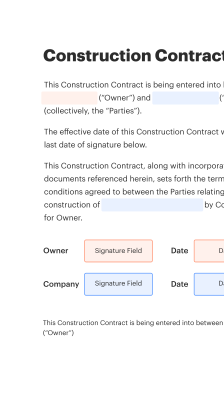
Certificate Authority Sign for Secure eSignatures

Insert an eSignature space for your PDF doc and edit it in just a few minutes. Send out your digital papers to customers and have the data files eSigned from any type of device and from anywhere.

Award-winning eSignature solution

What certificate authority sign means for electronic signatures

Certificate authority sign refers to attaching a digital certificate issued by a trusted certificate authority (CA) to a signed document or signing transaction. The certificate verifies the signer identity and binds cryptographic keys to that identity, creating a verifiable digital signature. In U.S. workflows governed by ESIGN and UETA, CA-backed signatures strengthen non-repudiation and authentication. Organizations use CA signatures to meet higher assurance requirements, integrate with public key infrastructures, and ensure long-term signature validity and verifiability across systems such as signNow and other enterprise eSignature platforms.

Why use certificate authority sign in your signing process

CA-backed signing increases signer assurance and cryptographic proof of identity, improving legal defensibility under U.S. electronic signature laws and meeting stricter regulatory or internal audit demands.

Why use certificate authority sign in your signing process

Common challenges when adopting certificate authority sign

  • Managing CA credentials and key lifecycle requires operational processes and secure key storage.
  • Integrating CA issuance with existing eSignature workflows can need API and configuration work.
  • User onboarding may require additional identity proofing steps, increasing initial completion time.
  • Long-term validation demands preservation of certificates, revocation lists, or timestamping evidence.

Typical user roles for certificate authority sign

IT Security Manager

Responsible for selecting CA providers, managing key storage policies, and integrating certificate issuance with the enterprise eSignature platform. They maintain system configurations, enforce cryptographic standards, and coordinate with compliance teams to ensure certificates are issued and revoked according to policy.

Compliance Officer

Oversees legal and regulatory requirements for electronic signatures and ensures CA-backed signatures meet ESIGN, UETA, and industry-specific obligations. They review audit trails and retention policies and approve certificate usage criteria for controlled documents.

Who typically uses certificate authority sign

Organizations that require high-assurance signatures and formal identity proofing adopt CA-backed signing for contracts, regulated filings, and critical approvals.

  • Financial services teams handling regulated agreements and customer onboarding documentation.
  • Healthcare administrators signing controlled records under HIPAA and institutional policy controls.
  • Enterprise legal and procurement groups requiring non-repudiation and long-term auditability.

CA-backed signing is also used by IT and security teams to enforce cryptographic controls while preserving an auditable trail for compliance and legal review.

Additional features that support certificate authority sign workflows

Beyond core capabilities, several advanced features improve usability, governance, and integration for CA-backed signing in enterprise contexts.

Role Templates

Predefined roles assign certificate requirements and signing order to streamline repetitive signing processes and ensure each signer receives the correct level of identity verification before certificate issuance.

Bulk Certificate Issuance

Automated provisioning for large user sets that maps identity sources to certificate templates and reduces manual steps for onboarding departmental signers.

Conditional Workflows

Logic-based routing and approval gates that require additional verification or CA-backed signatures for high-risk transactions before finalization.

Cross-platform Verification

Tools that allow external parties and relying systems to validate CA signatures independently, preserving trust across organizations and software stacks.

Revocation Monitoring

Active checks and alerts for revoked certificates, helping administrators respond quickly to compromised keys or changed access rights.

Compliance Reporting

Built-in reports and exportable logs that support evidence collection for audits and regulatory submissions concerning signed records.

be ready to get more

Choose a better solution

Core capabilities to look for with certificate authority sign

Effective CA-backed signing includes certificate lifecycle tools, strong authentication, detailed audit trails, and integration points for document management and APIs.

Certificate Lifecycle

Automated issuance, renewal, and revocation controls that integrate with existing identity systems and minimize administrative overhead while maintaining strong cryptographic hygiene across signing workflows.

Strong Authentication

Support for multi-factor authentication and identity proofing that ties a verified user identity to a certificate, reducing fraud risk and meeting elevated assurance requirements for regulated documents.

Audit and Evidence

Comprehensive, tamper-evident audit logs and embedded signature metadata that preserve chain-of-custody and cryptographic evidence required for legal review and compliance audits.

API Connectivity

REST APIs and connector support to integrate CA issuance and signature verification with CRM, document repositories, and business systems for automated signing workflows.

How certificate authority sign works in practice

The CA-sign process binds a cryptographic certificate to a signing event, producing a verifiable signature and associated audit data for legal and technical verification.

  • Identity Proofing: Verify signer identity against trusted credentials.
  • Certificate Issuance: CA issues a certificate tied to the signer.
  • Signing Event: Apply digital signature using the signer's private key.
  • Verification: Validate certificate chain and signature integrity.
Collect signatures
24x
faster
Reduce costs by
$30
per document
Save up to
40h
per employee / month

Quick setup steps for certificate authority sign

A straightforward sequence to enable CA-backed signing integrates certificate issuance, signer verification, and signature application in your eSignature platform.

  • 01
    Choose CA: Select a trusted certificate authority aligned with policy.
  • 02
    Configure Issuance: Set up certificate request and distribution processes.
  • 03
    Integrate Platform: Connect CA issuance to the eSignature API or platform settings.
  • 04
    Test and Rollout: Validate signing flows, audit logs, and revocation handling.

How to validate and audit certificate authority sign transactions

A practical checklist for verifying CA-backed signatures and preserving required evidence for audits or legal review.

01

Retrieve Certificate Chain:

Obtain full chain for validation.
02

Check Revocation Status:

Verify CRL or OCSP at signing time.
03

Verify Timestamp:

Confirm trusted timestamp authority usage.
04

Inspect Audit Log:

Review signer IP, actions, and events.
05

Export Evidence Package:

Bundle document, signature, and metadata.
06

Retain According to Policy:

Archive package per retention schedule.
be ready to get more

Why choose airSlate SignNow

  • Free 7-day trial. Choose the plan you need and try it risk-free.
  • Honest pricing for full-featured plans. airSlate SignNow offers subscription plans with no overages or hidden fees at renewal.
  • Enterprise-grade security. airSlate SignNow helps you comply with global security standards.
illustrations signature

Recommended workflow settings for certificate authority sign

A set of configuration settings to support CA-backed signing, focusing on authentication, evidence capture, and retention.

Setting Name Configuration
Primary Signer Authentication Method Email OTP and ID check
Certificate Issuance Trigger On demand during signing
Audit Evidence Capture Level Full metadata and logs
Revocation Check Frequency Real-time OCSP queries
Document Retention Policy 7 years or per law

Platform and device requirements for certificate authority sign

Ensure your eSignature platform and endpoints support PKI operations, OCSP/CRL checks, and secure key storage before enabling CA-backed signing.

  • Supported Browsers: Modern browsers with TLS support
  • Mobile Compatibility: iOS and Android modern versions
  • Server Requirements: Access to OCSP/CRL and HSM integration

Validate platform compatibility in a staging environment, exercise issuance and verification across devices, and document any OS or browser-specific constraints to ensure consistent signer experience and cryptographic validation.

Security controls tied to certificate authority sign

Public Key Infrastructure: Manages keys and certificates lifecycle.
Certificate Revocation: Enables invalidation of compromised certificates.
Hardware Security Modules: Protects private keys in tamper-resistant devices.
Timestamping Services: Provides proof of signing time integrity.
Multi-factor Authentication: Adds signer identity assurance layers.
Audit Logging: Records signature and certificate events.

Industry examples using certificate authority sign

Two concise examples show how CA-backed signing supports regulated workflows and improves trust for critical documents.

Financial Services Deployment

A regional bank integrated CA-signed eSignatures for loan agreements to ensure biometric identity verification during account opening

  • PKI certificates issued to verified customers
  • Reduced fraud and streamlined verification

Resulting in clearer audit evidence and faster regulatory reviews for consumer lending.

Healthcare Records Signing

A hospital system adopted CA-backed signatures for physician orders to meet internal policy and HIPAA protections

  • Certificates linked to institutional identity providers
  • Improved integrity and chain of custody for records

Leading to stronger defensibility in audits and more consistent clinical documentation practices.

Best practices for secure and compliant certificate authority sign

Follow established operational, technical, and legal practices to maintain trust, protect keys, and ensure signatures remain verifiable over time.

Verify signer identity before certificate issuance
Use government ID checks, institutional authentication, or trusted identity proofing services to ensure certificates link to the correct individual and reduce impersonation risk.
Store private keys in hardware security modules
Keep signing keys in FIPS-validated HSMs or equivalent secure modules to prevent extraction and limit exposure from server compromise or insider threat.
Maintain revocation and timestamping policies
Publish revocation status promptly and use trusted timestamp authorities to preserve long-term validation when certificates expire or when archival evidence is required.
Log and retain cryptographic evidence for audits
Capture certificate chains, signature digests, timestamps, and signer metadata in tamper-evident logs retained according to regulatory or organizational retention schedules.

FAQs and troubleshooting for certificate authority sign

Common questions and solutions for CA-backed signing, covering verification issues, certificate errors, and integration considerations.

Feature comparison: certificate authority sign support across vendors

A concise matrix comparing CA signing support and verification features offered by leading eSignature providers.

Certificate Authority Sign Feature Comparison Criteria signNow (Recommended) DocuSign Adobe Sign
PKI-backed Certificate Support and Validation
Embedded Certificate Authority Option Third-party CA integration DocuSign-certified partners Adobe CA integrations
OCSP/CRL Real-time Revocation Checks
Long-term Validation / Timestamping Supported Supported Supported
be ready to get more

Get legally-binding signatures now!

Retention and key timeline considerations for CA-backed signatures

Document and key retention schedules should align with legal requirements, business needs, and forensic verifiability.

Minimum retention period:

Follow statutory or contractual retention requirements.

Certificate expiry management:

Track expirations and renew certificates proactively.

Revocation record retention:

Store CRLs or OCSP responses for validation history.

Long-term archival format:

Preserve signed documents and metadata in standardized formats.

Legal hold procedures:

Suspend destruction for litigated or under-review records.

Risks and penalties associated with improper CA signing

Regulatory Fines: Monetary penalties.
Legal Challenge: Contract invalidation risk.
Data Breach: Key compromise exposure.
Reputational Damage: Loss of trust.
Operational Downtime: Service interruption costs.
Non-compliance Findings: Audit failures.

Pricing and licensing considerations for CA-backed signing

Pricing varies by vendor and by the level of certificate management, API access, and enterprise services required; compare tiers and support options carefully.

Starting monthly price and plan notes signNow (Recommended): Low monthly plans with enterprise options and additional CA services DocuSign: Higher entry price with broad ecosystem and enterprise tiers Adobe Sign: Included with Adobe Acrobat plans; enterprise options available Dropbox Sign: Competitive mid-tier pricing focused on SMBs PandaDoc: Pricing tailored to document workflow with optional signing integrations
Free tier availability signNow (Recommended): Limited free trial and low-cost plans DocuSign: Free trial; limited free features Adobe Sign: Trial via Adobe Acrobat Dropbox Sign: Free trial available PandaDoc: Free tier for basic document workflows
Enterprise contract and custom pricing signNow (Recommended): Custom enterprise contracts with CA integrations DocuSign: Extensive enterprise contracting and global support Adobe Sign: Enterprise licensing with Adobe enterprise agreements Dropbox Sign: Enterprise plans with SSO and admin features PandaDoc: Custom enterprise pricing for sales automation
API access and included allowances signNow (Recommended): API plans include generous call limits and CA integration options DocuSign: API with developer and enterprise tiers Adobe Sign: API included with paid plans Dropbox Sign: Developer API with usage limits PandaDoc: API access on higher tiers
Support level and SLA options signNow (Recommended): Business and enterprise support tiers with SLA options DocuSign: Platinum support and dedicated services Adobe Sign: Enterprise support via Adobe Care Dropbox Sign: Priority support on paid plans PandaDoc: Premium support for enterprise customers
Per-user discounts and volume pricing signNow (Recommended): Volume discounts and multi-year pricing available DocuSign: Volume discounts for large contracts Adobe Sign: Enterprise discounting via Adobe agreements Dropbox Sign: Discounts for annual commitments PandaDoc: Negotiated discounts for larger deployments

eSign and Manage Contracts Easily with airSlate SignNow

airSlate SignNow is indeed a robust, full-featured, and award-winning tool for eSigning and managing contracts both on personal computer and cell phone. A great deal of organizations, such as Xerox, CBS Sports, and Colliers already have experienced the key benefits of employing airSlate SignNow. Not only does it simplify and boost document turnover as nearly all eSignature software does, but it also provides versatility to the procedure of eSigning.

The distinguishing features of airSlate SignNow making it an exclusive and prevailing option over the competitors are as follows:

  • Upload existing forms or build templates via the on-line editor and reuse them later on.
  • Use handwritten, typed in, or scanned signatures. Before delivering a document out for verification, you can determine what kind of signature a receiver of the email can use.
  • Send out an agreement out for signing to one or several signers via email or link.
  • Configure an expiration date to get your document validated on time.
  • Stay updated with reminders. All users including the sender will receive notifications until each role is done (changeable in advanced settings).
  • Keep the signing procedure comfortable for users. Signees don't have to register or sign-up to execute the agreement.

airSlate SignNow's intuitive interface makes it practical for customers to share folders between teams, and build branded workflows. Using the apps for iOS and Android, managing and verifying agreements on the go is a reality.

Being compliant with major security standards, airSlate SignNow guarantees your data is safe. The embedded, court-admissible Audit Trail keeps track of every single change to your file, keeping every person accountable.

Sign up for a totally free trial and start creating efficient eSignature workflows with airSlate SignNow.


walmart logo
exonMobil logo
apple logo
comcast logo
facebook logo
FedEx logo
be ready to get more

Get legally-binding signatures now!