Commission Bill Format in Excel for Accounting

See your billing procedure turn fast and smooth. With just a few clicks, you can complete all the required steps on your commission bill format in excel for Accounting and other important documents from any gadget with internet access.

Award-winning eSignature solution

What a commission bill format in Excel for accounting includes

A commission bill format in Excel for accounting is a structured spreadsheet template designed to calculate, record, and reconcile commissions payable to agents or sales staff. Typical templates include fields for invoice or contract identifiers, payee name, sales or base amounts, commission rates, tiered percentages, calculated commission amounts, tax and deduction lines, and summary totals. Built-in formulas and validation reduce manual entry errors, and properly formatted Excel files can be exported, archived, or integrated with electronic signing and accounting systems for streamlined approval and payment workflows.

Why standardizing a commission bill format matters

Standardized Excel commission formats ensure consistent calculations, easier audits, and clearer communication between sales and accounting teams while reducing disputes and manual reconciliation time.

Why standardizing a commission bill format matters

Common challenges when managing commission bills in Excel

  • Manual formula errors can distort commission totals and require time-consuming reconciliations to correct.
  • Inconsistent templates across teams create mismatched columns and data entry differences that complicate aggregation.
  • Lack of version control leads to outdated commission rules being applied and payment disputes.
  • Delayed approvals and missing signatures slow disbursement and increase accounts payable cycle time.

Typical user profiles for commission billing

Sales Manager

Sales managers review commission bill spreadsheets to verify earned commissions against sales records, resolve exceptions, and approve payment runs. They rely on clear breakdowns by rep, territory, and period to support performance reviews and dispute resolution with minimal back-and-forth.

Accounting Lead

Accounting leads import finalized commission totals into the ledger, ensure tax and deduction calculations are applied correctly, reconcile against bank and GL accounts, and maintain retention policies and audit documentation for internal and external reviews.

Teams and roles that rely on commission bill formats

Finance, sales operations, and payroll frequently interact with commission bill templates to calculate and approve payouts.

  • Sales operations teams who define commission plans and track performance against targets.
  • Accounting and payroll staff who validate calculations, record liabilities, and issue payments.
  • Sales managers and executives who review summaries for budget and forecasting purposes.

Cross-functional use ensures commissions are accurate, auditable, and reflected in financial records promptly.

Essential Excel and workflow features for commission billing

These six capabilities address accuracy, scalability, and traceability for commission bill formats used in accounting.

Formulas

Prebuilt, auditable formulas for tiered rates and overrides reduce manual calculation and provide consistent outputs for GL posting and payroll integration.


Conditional formatting

Visual flags for exceptions and threshold breaches help reviewers quickly identify entries that require investigation before approval and payment.

Pivot reporting

Pivot tables and summary sheets allow fast aggregation by rep, region, product, or period, simplifying variance analysis and executive reporting.

eSign-ready fields

Designated signature and approval cells make it straightforward to convert an Excel file into a signed document using an eSignature platform while preserving calculation integrity.

Template management

Centralized template libraries enforce consistent structure, apply corporate branding, and reduce time spent creating new commission files for different teams.

Audit trail integration

Automatic capture of approver identities, timestamps, and version history ensures each finalized commission bill includes a verifiable record for compliance purposes.

be ready to get more

Choose a better solution

Integrations and features that improve Excel commission workflows

Connectors and features reduce manual handoffs and ensure commission files are signed, stored, and available for accounting ingestion.

Google Sheets

Two-way sync enables live updates between Excel exports and Google Sheets, allowing sales and finance teams to collaborate on the same dataset while preserving original file formulas for final calculations.

CRM integration

Linking the commission template to CRM records populates deal IDs and revenue figures automatically, reducing manual lookup and ensuring commissions reflect the authoritative source of truth for closed deals.

Cloud storage

Automated exports to Dropbox or other cloud storage preserve signed, versioned copies of commission bills and centralize retention for audit and compliance purposes.

Reusable templates

Template libraries store standardized commission formats for reuse across territories and periods, ensuring consistent column naming, formula logic, and approval workflows.
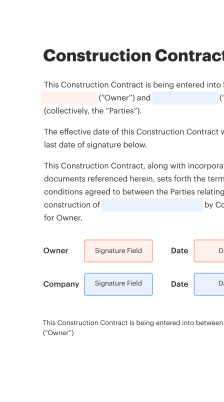
How to use an Excel commission bill with digital workflows

This overview explains how an Excel commission file moves through recording, approval, signing, and payment stages.

  • Prepare file: Populate template with finalized metrics.
  • Review: Managers verify and flag exceptions.
  • Sign and approve: Add signatures using an eSignature platform.
  • Archive: Store final copy with audit trail.
Collect signatures
24x
faster
Reduce costs by
$30
per document
Save up to
40h
per employee / month

Step-by-step: Build a basic commission bill format in Excel

Follow these essential setup steps to create a reliable commission bill template that is calculation-ready and audit-friendly.

  • 01
    Create header: Add company, period, and invoice fields.
  • 02
    Define columns: Include rep, deal ID, amount, and rate.
  • 03
    Add formulas: Use consistent formulas for commission calculations.
  • 04
    Validation: Add data validation and error checks.

Manage audit trails for commission bill transactions

Follow these steps to capture an auditable history for each commission bill, from creation through final payment.

01

Record creation:

Log author and timestamp.
02

Versioning:

Keep immutable versions.
03

Review notes:

Attach reviewer comments.
04

Approvals:

Capture approver identity.
05

Signature capture:

Store signed file.
06

Retention:

Apply retention policy.
be ready to get more

Why choose airSlate SignNow

  • Free 7-day trial. Choose the plan you need and try it risk-free.
  • Honest pricing for full-featured plans. airSlate SignNow offers subscription plans with no overages or hidden fees at renewal.
  • Enterprise-grade security. airSlate SignNow helps you comply with global security standards.
illustrations signature

Typical workflow settings for commission bill automation

Recommended default configurations accelerate approvals, notifications, and archival of finalized commission bills.

Setting Name Configuration
Reminder Frequency 48 hours
Approval Sequence Sequential
Auto-calculation Enabled
Template Library Centralized
Storage Location Secure cloud

Platform and device considerations for commission bill workflows

Ensure compatibility across desktop and mobile environments to support reviewers and approvers wherever they work.

  • Windows and macOS: Excel desktop
  • Mobile devices: View and sign
  • Browser support: Modern browsers

Use platforms that preserve file fidelity and provide secure signing and storage so approvals and archives remain consistent across devices.

Security controls relevant to commission bill spreadsheets

Encryption at rest: AES 256
Encryption in transit: TLS 1.2+
Access controls: Role-based
Audit logs: Immutable records
Two-factor auth: MFA enforced
Document watermarking: Optional overlays

How organizations use Excel commission bills in practice

Two representative examples show common implementations of Excel commission templates, including digital approval and archival workflows.

Retail sales commission

A regional retail chain tracks monthly store sales per associate in an Excel template, applies tiered commission rates to net sales

  • uses pivot summaries to group by store and pay period
  • exports totals to payroll with checks for anomalies flagged

Resulting in faster payroll calculation and fewer disputes during reconciliations.

Software reseller payouts

A software reseller firm records deal IDs, ARR, and rep allocations in a master Excel commission file

  • applies quota rules and accelerator percentages per product
  • generates itemized commission lines for each rep and period

Leading to transparent reporting and simplified import to the accounting system for payments.

Best practices for accurate and secure commission bill formats

Apply consistent controls and documentation to reduce errors, speed approvals, and maintain an auditable record of commission calculations and approvals.

Use consistent column headings and formatting across templates
Standard headings reduce mapping errors when consolidating multiple spreadsheets and simplify automated imports into accounting or payroll systems, improving reliability during month-end close.
Implement cell-level validation and locked formula cells
Protect calculation cells and use validation rules to prevent accidental overwrites, ensuring that only authorized fields are editable and formulas remain intact for accurate totals.
Document commission rules and update change logs
Maintain a versioned policy document describing rates, tiers, and special-case handling so reviewers can reconcile differences and auditors can trace calculation rationale back to documented rules.
Retain signed records and maintain an immutable audit trail
Archive final signed commission bills with timestamps and approver identities to support audits, compliance checks, and future dispute resolution with a clear chain of custody.

FAQs: Common issues with commission bill formats in Excel

Answers address frequent technical and process questions about building, validating, and preserving commission bill spreadsheets.

Feature comparison: signNow and other eSignature providers for commission bills

A concise feature availability table shows common capabilities for handling signed commission bill documents and integrations important to accounting teams.

Criteria signNow (Recommended) DocuSign Adobe Sign
ESIGN/UETA validity
Mobile signing
API access
Audit trail
be ready to get more

Get legally-binding signatures now!

Key dates and retention guidance for commission billing

Establish clear deadlines and retention windows to support payroll cycles, tax reporting, and audit readiness.

Monthly calculation cutoff date:

5th of month

Manager approval deadline:

7th of month

Payroll import window:

10th of month

Dispute submission period:

30 days

Document retention period:

7 years

Risks and penalties associated with poor commission handling

Contract disputes: Litigation risk
Tax reporting errors: Penalties possible
Failed audits: Regulatory findings
Data breaches: Notification costs
Noncompliance fines: Monetary fines
Payment delays: Reputation harm

Pricing and plan overview for signNow and competitors

High-level plan and pricing characteristics for vendors commonly used to sign and archive commission bill documents; signNow is listed first as a featured option.

Pricing Metric signNow (Recommended) DocuSign Adobe Sign Dropbox Sign PandaDoc
Entry-level plan name Business Personal Individual Starter Essentials
Typical starting price From $8/mo From $10/mo From $15/mo From $15/mo From $19/mo
API access included Yes Add-on Included Included Included
Template management Built-in library Built-in Built-in Limited Built-in
Enterprise features available Yes Yes Yes Yes Yes
walmart logo
exonMobil logo
apple logo
comcast logo
facebook logo
FedEx logo
be ready to get more

Get legally-binding signatures now!