Construction Invoice Format for Accounting Made Easy

Streamline your invoicing process with airSlate SignNow's easy-to-use eSigning solution. Save time and reduce costs while keeping your documents secure.

Award-winning eSignature solution

What a construction invoice format for accounting includes

A construction invoice format for accounting is a structured document used to bill labor, materials, equipment, change orders, retainage, and taxes for construction projects. It standardizes line items, unit rates, quantities, contract references, payment terms, and progress reporting so accounting systems can post transactions accurately. A well-designed format supports job cost tracking, progress billing, lien waiver attachments, and clear audit trails between contractors, subcontractors, and clients. Using consistent fields reduces reconciliation errors and accelerates accounts receivable processing while providing the documentation auditors and insurers expect for project-level accounting controls.

Why standardize your construction invoice format for accounting

Standardizing invoices improves accuracy, supports consistent job-cost reporting, and reduces manual reconciliation across accounting and project management systems.

Why standardize your construction invoice format for accounting

Common challenges when handling construction invoices

  • Inconsistent line-item descriptions cause mismatches between field reports and ledger entries, increasing reconciliation time.
  • Missing retainage or incorrect tax calculations can delay payments and complicate contract closeout.
  • Manual entry of long bills and change orders leads to transcription errors and late receivables.
  • Lack of standardized approvals and signed waivers increases exposure to lien claims and payment disputes.

Representative users and roles

Project Manager

Project managers prepare and review progress invoices to confirm work completed and authorized change orders. They verify quantities, milestone completion, and supporting documentation before routing invoices to accounting for posting and payment scheduling.

Staff Accountant

Staff accountants code invoice line items to job and cost codes, reconcile billed amounts to contracts, and ensure retainage and tax treatments are applied correctly for accurate financial reporting and compliance.

Who relies on a well-formed construction invoice format

Construction invoices serve multiple stakeholders across finance and project teams, each needing clear, consistent billing detail.

  • General contractors needing progress billing and retainage tracking for multiple projects.
  • Subcontractors submitting detailed labor, material, and equipment charges for payment.
  • Accounts payable and receivable teams reconciling invoices with purchase orders and payroll.

Aligning invoice fields to accounting and project workflows ensures timely posting, smoother approvals, and improved cash flow management.

Additional features to consider for construction invoices

Beyond core tools, these features add efficiency, control, and traceability for project billing and accounting.

Retainage

Automated retainage calculations and reporting

Change orders

Linked change order references and sequencing

Tax handling

Support for multiple tax jurisdictions and rates

Progress billing

Percentage or milestone-based progress invoicing

Recurring invoices

Templates for scheduled or recurring billings

Reporting

Exportable job-cost and aging reports

be ready to get more

Choose a better solution

Key tools for effective construction invoice formats

Choose tools that enforce structure, collect attachments, and provide secure approval paths while integrating with accounting systems.

Template Builder

A template builder lets you create invoice layouts with required fields, dropdowns mapped to cost codes, and conditional sections for retainage and change orders to ensure consistent data capture across projects.

Attachment Management

Attachment management allows upload and association of supporting documents such as field logs, receipts, certified payroll, and lien waivers so approvers and auditors have one consolidated record per invoice.

Approval Routing

Approval routing supports role-based sign-offs, sequential or parallel approval workflows, and configurable notification rules so invoices move through project and finance teams without manual chasing.

Accounting Integration

Accounting integration exports structured invoice data to GL, A/P, and job-costing modules, preserving mappings for accounts, cost codes, tax treatments, and payment terms to reduce manual journal entries.
How online construction invoice formats work in practice

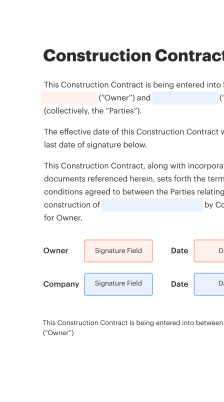
An online invoice template captures structured billing fields, collects attachments, and routes the invoice through approvals before posting to accounting.

  • Template creation: Build a template with required line-item and header fields.
  • Populating invoices: Field teams or subcontractors fill template data and attach documents.
  • Approval routing: Automatic routing sends invoices to project and accounting approvers.
  • Accounting export: Export standardized data to GL or ERP systems for posting.
Collect signatures
24x
faster
Reduce costs by
$30
per document
Save up to
40h
per employee / month

Quick steps to set up your construction invoice format

Follow these practical steps to define and implement a construction invoice format that integrates with accounting systems and supports audit-ready records.

  • 01
    Define fields: List required fields: job, cost code, phase, quantity, unit price.
  • 02
    Standardize descriptions: Use consistent item descriptions and code mappings for accounting.
  • 03
    Attach support: Require field reports, change orders, and lien waivers as attachments.
  • 04
    Approval flow: Set a documented, role-based approval and signature process.

Detailed steps: completing a construction invoice format

Use this grid-style checklist when filling out and approving invoices to ensure no required data or attachments are missing.

01

Project info:

Confirm project ID and contract reference
02

Line items:

Enter cost codes, quantities, and unit prices
03

Retainage:

Apply retainage percentage if required
04

Change orders:

Reference approved change order IDs
05

Attachments:

Upload supporting documents and photos
06

Approvals:

Route to project and finance approvers
be ready to get more

Why choose airSlate SignNow

  • Free 7-day trial. Choose the plan you need and try it risk-free.
  • Honest pricing for full-featured plans. airSlate SignNow offers subscription plans with no overages or hidden fees at renewal.
  • Enterprise-grade security. airSlate SignNow helps you comply with global security standards.
illustrations signature

Typical workflow settings for invoice routing and automation

Configure workflow settings to automate reminders, approvals, and handoffs so invoices progress reliably from submission to payment posting.

Workflow Automation Setting Name Header Row Default Configuration Value Column Header
Reminder Frequency Interval Setting (hours) 48 hours
Approval Escalation Threshold Setting (days) 5 days
Auto-approve small invoices threshold Under $250
Attachment requirement enforcement toggle Enabled
ERP export schedule and format setting Daily CSV export

Device and platform considerations for invoice processing

Ensure the invoice tool supports the platforms your teams use so field staff and accountants can access templates and approvals without technical barriers.

  • Desktop: Windows and macOS supported
  • Mobile: iOS and Android apps
  • Browser: Chrome, Edge, Safari compatibility

Choose a solution that offers responsive web access and native mobile apps for offline capture and photo attachments; verify compatibility with your accounting system and single-sign-on provider for secure, seamless operations.

Security controls relevant to invoice documents

Data encryption: AES-256 encryption
Transport security: TLS 1.2+
Access controls: Role-based access
Authentication: Multi-factor options
Audit logging: Detailed event logs
Backup retention: Redundant offsite copies

Industry examples using standard invoice formats

Two brief examples illustrate how consistent invoice formats streamline accounting and approvals on construction projects.

Municipal Infrastructure Project

A municipal contractor submits monthly progress invoices that align to contract pay items and retainage rules, with line-by-line quantities tied to field reports

  • Includes certified payroll and material receipts
  • Speeds approval by finance teams and ensures correct retainage withholding

Resulting in faster municipal drawdowns and clearer audit trails for grant compliance.

Commercial Tenant Fit-Out

A general contractor issues staged invoices for tenant improvement phases with separate equipment and labor lines

  • Attaches change order references and signed approval forms
  • Enables the landlord and tenant accountant to match charges to lease allowances and change order approvals

Leading to fewer payment disputes and accurate tenant billing reconciliation.

Best practices for secure and accurate construction invoicing

Implement controls and documentation standards that reduce errors and protect payment integrity across projects and accounting systems.

Use consistent job and cost code mappings across systems
Maintain a single source of truth for job and cost code definitions, update mappings centrally when project scopes change, and verify that templates only permit approved codes to minimize mispostings and simplify reconciliation.
Require supporting documentation for every invoice line
Mandate attachments such as timesheets, delivery receipts, change order approvals, and lien waivers where applicable so approvers and auditors can validate billed work quickly and reduce payment disputes.
Enforce role-based approvals and separation of duties
Configure workflows so project staff validate quantities and supervisors approve work, while finance posts payments, ensuring checks and balances to prevent fraud and accounting errors.
Keep an auditable trail of changes and approvals
Record timestamps, approver identities, and version history for each invoice; archived records should support forensic review and meet retention policies for audits and contract closeout.

FAQs About construction invoice format for accounting

Common questions and troubleshooting tips for preparing, submitting, and integrating construction invoices with accounting systems.

Feature comparison: signNow versus leading eSignature providers

Comparison of essential capabilities relevant to construction invoice formats and accounting integrations among major eSignature providers.

Feature or Capability Criteria Label signNow (Recommended) DocuSign Adobe Sign
ESIGN and UETA Legal Compliance Status
Audit trail and forensic logging Detailed Detailed Detailed
Bulk Send capability
API and developer support REST API REST API REST API
be ready to get more

Get legally-binding signatures now!

Key dates and retention guidelines for invoices

Track critical dates and retention requirements to support payments, audits, and legal compliance for construction documentation.

Invoice submission deadline per contract:

Within 30 days of milestone completion

Payment terms and due date tracking:

Net 30 or contract-specific terms

Retention and record-keeping period:

Keep records seven years minimum

Change order approval turnaround target:

Within 14 days of submission

Audit access window for supporting documents:

Maintain quick access for two years

Risks of poor invoice handling

Late payments: Cash flow strain
Lien exposure: Legal claims
Audit failures: Compliance gaps
Duplicate payments: Financial loss
Contract disputes: Delayed closeout
Record retention issues: Noncompliance fines

Pricing and plan comparison for eSignature options

High-level pricing and plan characteristics for signNow and comparable eSignature vendors relevant to construction accounting workloads.

Plan characteristic signNow (Recommended) DocuSign Adobe Acrobat Sign Dropbox Sign PandaDoc
Entry-level plan and trial availability Free trial; paid plans from $8/user/month Free trial; plans from $10/user/month Free trial; plans from $24.99/user/month Free trial; plans from $15/user/month Free trial; plans from $19/user/month
Bulk sending and templates included Included in business plans Included in business plans Included in higher tiers Included in business plans Included in business plans
API access availability Available with API plan Available with API plan Available with API plan Available with API plan Available with API plan
Integration ecosystem (CRMs, storage) Integrates with common CRMs, Google Drive, Dropbox Extensive enterprise integrations Deep Adobe ecosystem and Microsoft Dropbox and Google integrations CRM and payment integrations
Enterprise features and compliance Advanced admin controls, ESIGN/UETA compliance Advanced enterprise controls Enterprise-grade compliance and Adobe trust services Team and enterprise features Document analytics and workflow controls
walmart logo
exonMobil logo
apple logo
comcast logo
facebook logo
FedEx logo
be ready to get more

Get legally-binding signatures now!