Electric Bill Template for Real Estate

See your invoice workflow become quick and effortless. With just a few clicks, you can perform all the necessary actions on your electric bill template for Real Estate and other crucial documents from any gadget with web connection.

Award-winning eSignature solution

What an electric bill template for real estate covers

An electric bill template for real estate is a standardized document used by property managers, leasing agents, and owners to record and communicate tenant or owner responsibilities for electricity charges, meter readings, billing periods, and payment terms. It typically includes billing account details, service address, billing period, usage summary, rate breakdown, allocated charges for multi-unit buildings, and signature fields for acknowledgement or acceptance. When used with an electronic signature and document workflow platform, the template streamlines distribution, capture of approvals, and archival of executed records while preserving audit trails for compliance and dispute resolution.

Why standardized electric bill templates matter in real estate

Standardized templates reduce billing disputes, ensure consistent allocation of costs across units, and create an auditable record of tenant acknowledgements while saving administrative time and improving clarity for all parties involved.

Why standardized electric bill templates matter in real estate

Common operational challenges addressed by templates

  • Inconsistent billing formats make tenant comparisons and ledger reconciliation time-consuming and error-prone.
  • Manual distribution and signature collection causes delays and increases the risk of lost or incomplete authorizations.
  • Allocating shared meter charges across units often lacks transparency without a clear calculation method.
  • Maintaining retention schedules and audit trails is difficult when records are scattered across email and paper.

Typical user roles and responsibilities

Property Manager

Manages tenant billing cycles, applies unit allocations, reviews meter data, and oversees dispute resolution. They use templates to communicate charges and collect tenant acknowledgements, ensuring ledger accuracy.

Leasing Agent

Prepares electric billing disclosures at move-in and move-out, explains cost allocation methods to tenants, and ensures executed acknowledgements are stored with lease documentation for compliance.

Primary users of electric bill templates

Property administrators, property management firms, and on-site building staff use templates to standardize electricity billing and tenant acknowledgements.

  • Property managers handling portfolios with multiple tenants and shared utilities.
  • Leasing agents preparing move-in/move-out utility charge disclosures.
  • Facility managers reconciling submetering and common-area electrical allocations.

These groups rely on clear templates to reduce disputes, accelerate payment processing, and produce consistent records for accounting and compliance.

Advanced capabilities to consider for scaled operations

Larger portfolios benefit from template features that support batch processing, integrations, and programmatic administration of electric bill workflows.

Bulk Send

Ability to send individualized bills to hundreds of tenants from a single template, merging unique meter and tenant data for each recipient without manual edits.


API Access

REST API endpoints that enable programmatic generation, distribution, and retrieval of executed templates so billing can be integrated with property accounting systems.

Template Library

A central repository of approved templates with versioning and access controls to ensure consistent use across teams and properties.

Conditional Fields

Logic-based fields that show or hide sections depending on meter type, tenancy status, or billing scenario to prevent confusion on tailored bills.

Third-party Integrations

Connectors for accounting, CRM, and storage platforms to synchronize billing data and store executed templates in the correct tenant file.

Reporting

Exportable reports on sent, signed, and disputed bills to monitor collections and operational KPIs across properties.

be ready to get more

Choose a better solution

Essential features for effective electric bill templates

When selecting or building templates, prioritize features that ensure accuracy, legal validity, and administrative efficiency for real estate billing.

Custom fields

Template fields for account IDs, meter numbers, billing periods, and calculated allocation formulas allow consistent, automated population of each tenant's electric bill before distribution.

Calculation logic

Built-in formula support for prorations, submeter allocations, and percentage splits reduces manual math errors and ensures each unit's charge is derived from the same transparent method.

Signature capture

Electronically capture tenant or owner acceptance with an auditable signature field, timestamp, and IP or device metadata to strengthen enforceability and record integrity.

Audit trail

Comprehensive logs track template edits, send history, signer identity, and completed timestamps to support accounting, compliance, and dispute resolution needs.
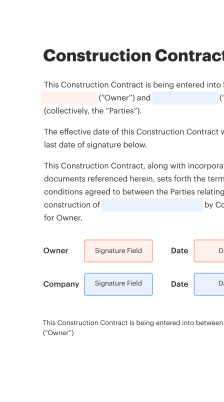
How an electronic template workflow operates

A concise flow describes how a template moves from creation to execution, preserving a chain of custody and delivering signed records to stakeholders.

  • Draft: Designer creates the template
  • Distribute: Send to tenant or owner
  • Sign: Recipient applies eSignature
  • Archive: Store executed copy and audit log
Collect signatures
24x
faster
Reduce costs by
$30
per document
Save up to
40h
per employee / month

Quick setup steps for an electric bill template

Follow these essential steps to create a practical electric bill template for real estate that supports clear billing and electronic acknowledgement.

  • 01
    Create header: Add property and account info
  • 02
    Define period: Specify billing start and end dates
  • 03
    Show usage: Include meter reads and consumption
  • 04
    Add signature: Insert eSignature and date fields

Audit trail checklist for executed templates

Maintain these audit elements to support enforceability and satisfy internal review or external audit requirements.

01

Signer identity:

Name and contact
02

Timestamp:

Date and time
03

IP/device:

Source metadata
04

Document version:

Template ID
05

Action log:

Sent and view events
06

Hash verification:

Integrity check
be ready to get more

Why choose airSlate SignNow

  • Free 7-day trial. Choose the plan you need and try it risk-free.
  • Honest pricing for full-featured plans. airSlate SignNow offers subscription plans with no overages or hidden fees at renewal.
  • Enterprise-grade security. airSlate SignNow helps you comply with global security standards.
illustrations signature

Suggested workflow settings for electric bill distribution

Configure automation and notification settings to ensure timely distribution, reminders, and archiving of executed electric bill templates.

Setting Name Configuration
Reminder Frequency 48 hours
Signature Authentication Method Email OTP
Auto-Archive Location Tenant Records
Notification Recipients Account Admin
Retention Policy 7 years

Device and platform considerations for signing

Electronic templates should be accessible and function consistently on desktop browsers, mobile devices, and tablets to accommodate varied signer preferences.

  • Desktop browsers: Modern Chrome/Edge/Safari
  • Mobile apps: iOS and Android native
  • PDF viewers: Supports standard PDF rendering

Verify responsiveness, test signature capture on each platform, and ensure authentication flows (email, SMS OTP, or app authentication) operate reliably across devices for a smooth signer experience.

Security controls relevant to electric bill templates

Access Controls: Role-based access
Data Encryption: At-rest and in-transit
Multi-Factor Authentication: Optional for accounts
Audit Logs: Comprehensive activity records
Document Locking: Prevent post-signing edits
Secure Storage: Redundant backups

Real estate scenarios using electric bill templates

Two practical use cases show how templates reduce disputes and speed up reconciliations in both single-building and multi-tenant settings.

Multi-unit allocation

A mid-size apartment building adopted a standardized electric bill template to allocate shared corridor and common-area charges using submeter data and a pro rata formula

  • Included a clear breakdown of usage, allocation method, and unit charge summary
  • Improved transparency reduced tenant queries and shortened accounting reconciliation time

Resulting in faster month-end close and fewer billing disputes.

Lease move-out reconciliation

A property management company used a template at move-out to document final meter reads and outstanding electric charges

  • Template captured the final reading, proration method, and tenant acknowledgement
  • Clear documentation reduced disagreement over final amounts and assisted security deposit reconciliations

Leading to quicker deposit returns and fewer contested charges.

Best practices for creating and using templates

Apply consistent formatting and clear language, align templates with lease terms, and combine automation with manual review for accuracy when sending bills to tenants.

Use explicit allocation methods in the template
Describe the calculation method and include worked examples. Stating the formula and inputs directly in the template reduces ambiguity and supports tenant understanding and trust.
Keep data fields standardized across properties
Standard field names and formats simplify bulk processing, importing to accounting systems, and comparing usage across units or properties for accurate reporting.
Preserve signed records with retention rules
Establish and document retention periods consistent with accounting and legal requirements, ensuring executed templates and audit trails are available for audits or disputes.
Validate meter reads before issuing bills
Implement a short verification step for outlier readings or missing data to prevent incorrect charges and subsequent reconciliation headaches with tenants.

FAQs and common troubleshooting for electric bill templates

This FAQ addresses frequent issues encountered during template creation, distribution, and signature collection and offers clear remediation steps.

Feature availability: signNow compared with DocuSign

A targeted comparison between signNow and DocuSign highlights common capabilities relevant to electric bill templates and real estate billing workflows.

Capability signNow (Recommended) DocuSign
eSignature Compliance ESIGN, UETA ESIGN, UETA
Mobile App
Bulk Send Included Limited
API Access REST API REST API
be ready to get more

Get legally-binding signatures now!

Timing and retention checkpoints

Set clear deadlines for bill issuance, payment windows, and record retention to maintain consistent operations and meet regulatory expectations.

Monthly bill issuance deadline:

Within 5 business days

Tenant acknowledgement window:

14 days

Payment posting grace period:

5 days

Record retention minimum:

7 years

Audit log preservation:

Retain alongside records

Legal and operational risks to monitor

Billing Disputes: Financial losses
Noncompliance: Regulatory fines
Data Breach: Liability exposure
Missing Records: Audit failures
Incorrect Allocations: Tenant claims
Invalid Signatures: Enforceability issues

Pricing snapshot for popular eSignature providers

This pricing snapshot compares entry-level commercial pricing and core capabilities across signNow and four major competitors to inform selection for real estate billing workflows.

Plan / Feature signNow (Featured) DocuSign Adobe Sign PandaDoc HelloSign
Starting price (per user/month) $8 $25 $30 $19 $15
Bulk Send support Yes Yes Yes Yes Yes
API access included Yes Yes Yes Yes Yes
Document retention controls Yes Yes Yes Yes Yes
HIPAA compliance options Available Available Available Limited Available
walmart logo
exonMobil logo
apple logo
comcast logo
facebook logo
FedEx logo
be ready to get more

Get legally-binding signatures now!