



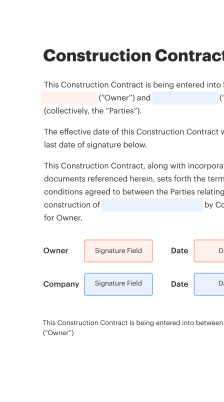
Electronic Bill Format for Management with SignNow

Empower your business with airSlate SignNow's seamless eSignature solutions and cost-effective document management tools.

Award-winning eSignature solution

What an electronic bill format for management is and why it matters

An electronic bill format for management is a standardized, digital invoice template and processing approach that organizes billing data, recipient details, payment terms, and workflow logic for efficient accounts receivable operations. It combines clear visual layout, machine-readable fields, and metadata to support automated processing, validation, and secure signatures. Properly designed formats reduce manual entry, shorten dispute cycles, and integrate with accounting systems and payment gateways. For organizations subject to recordkeeping rules, a consistent electronic bill format supports auditability and retention policies while enabling scalable billing operations across departments and third-party partners.

Why use a formal electronic bill format for management

A formal electronic bill format standardizes invoicing, reduces errors, and speeds collections while enabling automated workflows and audit trails for compliance.

Why use a formal electronic bill format for management

Common challenges when implementing electronic bill formats

  • Inconsistent field definitions across departments cause reconciliation errors and delay payment processing.
  • Legacy systems that do not accept structured invoice data require manual re-entry and human verification.
  • Poorly designed templates omit key compliance fields, increasing audit exposure and regulatory risk.
  • Lack of integration with payment processors or accounting software lengthens days sales outstanding and reporting cycles.

Representative user roles

Billing Manager

Oversees invoice template design, approval rules, and collection KPIs. Coordinates with accounting and customer service to reduce disputes and ensure invoices contain required legal language and payment links for faster processing.

IT Administrator

Implements format schema, maintains integrations with ERP and payment gateways, and enforces access controls. Responsible for system-level security, backups, and ensuring machine-readable invoice fields map correctly to downstream systems.

Teams and roles that benefit from an electronic bill format

Finance, billing, and revenue teams use standardized electronic bills to streamline collections and reporting.

  • Accounts receivable managers who need predictable payment flows and dispute reduction.
  • Finance operations teams requiring integration with ERP and accounting software.
  • IT and integration teams responsible for connecting billing formats to downstream systems.

Cross-functional teams, including legal and IT, rely on consistent formats for compliance and automation.

be ready to get more

Choose a better solution

Core features to look for in an electronic bill format for management

Effective billing formats pair template controls with automation, security, and integrations to reduce manual work and support accurate recordkeeping.

Template Library

Centralized templates let teams enforce field consistency, legal language, and branding while supporting multiple invoice types and locale-specific formatting to reduce errors and speed creation.

Automated Reminders

Configurable reminder schedules and escalation rules automatically nudge payers before and after due dates, reducing days sales outstanding and manual follow-up workload for collections teams.

Role-based Access

Granular permissions control who can edit templates, send invoices, or view financial data, supporting separation of duties and compliance with internal control policies.

Integration Connectors

Prebuilt connectors to common CRMs, ERPs, and payment gateways enable field-level mapping and automatic posting of payments to accounting ledgers for faster reconciliation.

How creation and delivery of an electronic bill format for management typically flows

A standard pattern moves from template creation to automated delivery, acceptance, and reconciliation for efficient billing operations.

  • Template authoring: Design fields, layout, and validation rules.
  • Automated delivery: Send invoices via email or portal automatically.
  • Recipient action: View, dispute, or pay using secure links.
  • Reconciliation: Match payments to invoices in accounting systems.
Collect signatures
24x
faster
Reduce costs by
$30
per document
Save up to
40h
per employee / month

Quick setup steps for an electronic bill format for management

Follow these concise steps to design and deploy a standardized electronic billing format that works with your finance stack.

  • 01
    Define fields: List required invoice and metadata fields.
  • 02
    Create template: Build a reusable, machine-readable invoice.
  • 03
    Map integrations: Connect fields to ERP and payment systems.
  • 04
    Test and deploy: Validate workflows and go live.
be ready to get more

Why choose airSlate SignNow

  • Free 7-day trial. Choose the plan you need and try it risk-free.
  • Honest pricing for full-featured plans. airSlate SignNow offers subscription plans with no overages or hidden fees at renewal.
  • Enterprise-grade security. airSlate SignNow helps you comply with global security standards.
illustrations signature

Typical workflow settings for electronic bill format automation

Use these common workflow settings to configure automated delivery, approvals, and reminders for electronic invoices.

Feature Configuration
Approval Sequence Two-step
Auto-reminders 48 hours
Late-fee Rules Enabled
Payment Links Embedded
Retry Attempts 3 attempts

Security controls and protection methods

Encryption at rest: AES-256 standard
TLS in transit: TLS 1.2+ protocols
Multi-factor authentication: Optional two-step login
SAML single sign-on: Enterprise SSO support
Audit logging: Comprehensive event trail
Document watermarking: Visible protection option

Industry examples using electronic bill formats

Two practical scenarios illustrate how standardized electronic bills reduce friction, enable automation, and support compliance across sectors.

Healthcare billing

A hospital submits structured electronic bills with CPT codes and payer identifiers to streamline claims processing

  • standardized code fields enable faster adjudication
  • reduces manual denials and resubmissions

Leading to faster reimbursements and lower administrative overhead.

Property management invoicing

A management firm sends tenants itemized electronic bills with lease-specific line items and automated late-fee rules

  • templates include tenant ID and pro-rata calculations
  • automated reminders cut missed payments

Resulting in improved rent collection rates and clearer tenant communication.

Best practices for accurate and secure electronic bill formats

Adopt these operational and technical practices to maximize reliability, compliance, and efficiency of your billing processes.

Standardize fields across systems and teams
Use a single authoritative schema for invoice number, customer ID, tax codes, and payment terms. Consistent fields reduce mapping errors and improve reconciliation between billing, CRM, and accounting systems.
Include clear dispute and payment instructions on every invoice
Provide explicit contact details, dispute submission steps, and accepted payment methods. Clarity reduces the volume of support inquiries and shortens resolution cycles for contested charges.
Enforce validation and automated checks before sending
Implement automated checks for required fields, tax calculations, and duplicate invoices. Preflight validation prevents avoidable rejections and manual interventions during processing.
Maintain retention and audit policies aligned with regulations
Define retention periods, secure backups, and audit logging processes consistent with tax and industry regulations. Ensure easy retrieval for audits while protecting sensitive data.

FAQs and troubleshooting for electronic bill format for management

Common questions and solutions focused on template issues, signature validation, integrations, and compliance when using electronic bill formats.

Feature availability: signNow compared with other eSignature providers

Compare key capabilities relevant to electronic bill formats and signing workflows across vendors.

Criteria signNow DocuSign Adobe Sign
Bulk Send Support
Mobile App iOS/Android iOS/Android iOS/Android
API Availability REST API REST API REST API
HIPAA-ready options BAA available BAA available BAA available
be ready to get more

Get legally-binding signatures now!

Regulatory and operational risks to consider

Noncompliance fines: Monetary penalties
Data breach costs: Liability and remediation
Invalid signatures: Contract disputes
Delayed collections: Cashflow impact
Reputational harm: Customer trust loss
Audit failures: Increased oversight

Pricing snapshot across eSignature platforms for billing workflows

A concise pricing overview for common plan attributes that affect electronic billing deployments and API access.

Plan Feature signNow DocuSign Adobe Sign Dropbox Sign PandaDoc
Starting Monthly Price $8/user/mo $10/user/mo $14.99/user/mo $15/user/mo $19/user/mo
Free Trial Yes Yes Yes Yes Yes
API Access Included (paid plans) Included (paid plans) Enterprise tier Included (paid plans) Included (paid plans)
Bulk Send Available Available Available Available Available
Enterprise Support Business SLA Enterprise SLA Enterprise SLA Enterprise SLA Enterprise SLA
walmart logo
exonMobil logo
apple logo
comcast logo
facebook logo
FedEx logo
be ready to get more

Get legally-binding signatures now!