eSignature Mobile SDK for Secure Document Signing

Try out a new feature - Mobile SDK. Put business processes on an automated drive and let airSlate SignNow take care of the paperwork for you.

Award-winning eSignature solution

What an esignature mobile sdk Is and When to Use It

An esignature mobile sdk is a software development kit that lets app developers embed electronic signing capabilities directly into native mobile and tablet applications. It exposes APIs and UI components to collect signatures, manage signing flows, and handle document uploads without redirecting users to external websites. In U.S. deployments, SDKs commonly support authentication options, audit trails, and document storage that help meet ESIGN and UETA expectations. Organizations use SDKs to keep users inside branded apps while automating verification, reducing turnaround times, and preserving evidentiary records for legal or regulatory reviews.

Why an esignature mobile sdk Can Matter for Your App

Embedding an esignature mobile sdk improves user experience by keeping signing inside your app, streamlines workflows, and preserves legal audit trails. It reduces friction for mobile-first customers while maintaining compliance controls and security features required for many U.S. industries.

Why an esignature mobile sdk Can Matter for Your App

Common Implementation Challenges

  • Ensuring legal consent collection across states and validating signer intent consistently.
  • Managing secure key storage and encryption for documents on devices and servers.
  • Balancing offline signing support with secure synchronization and conflict resolution.
  • Handling diverse device screen sizes and accessibility requirements for signature capture.

Representative Users of an esignature mobile sdk

Product Manager

Responsible for defining signing workflows and user experience goals, evaluating SDK capabilities for offline support, branding, and integration with backend systems. Works with security and legal teams to confirm compliance with ESIGN and organizational policies.

Mobile Engineer

Integrates the SDK into iOS or Android apps, implements authentication hooks, handles document rendering and local caching, and collaborates with backend developers on API credentials, webhooks, and audit-trail synchronization.

Who Typically Uses an esignature mobile sdk

Mobile-first product teams, field sales groups, and regulated organizations embed SDKs to streamline in-app signing and reduce paper handling.

  • Field service teams capturing signatures at point of delivery without printer access.
  • Healthcare apps collecting patient consent forms while maintaining HIPAA safeguards.
  • Financial services onboarding teams running account opening flows in-app.

These users prioritize secure, auditable signing integrated into native experiences, often requiring role controls and regulatory compliance features.

Essential Capabilities to Expect from an esignature mobile sdk

When evaluating SDKs look for capabilities that address UX, security, and enterprise manageability to support production apps across regulated U.S. environments.

Native UI Components

Prebuilt, customizable signing screens that follow platform conventions to minimize development effort while ensuring consistent capture of signature appearance and position across devices.


Offline Support

Local caching of documents and queued signatures for intermittent connectivity with secure sync and conflict resolution when the device reconnects to the network.

Custom Fields

Ability to place text, date, checkbox, and formula fields to capture structured data alongside signatures for easier data extraction and validation.

Multisigner Workflows

Support for sequential and parallel signing orders with routing rules and conditional recipients to match complex approval processes.

Audit Trail Generation

Automated capture of events, timestamps, IP addresses, and certificate details to create a tamper-evident record for legal admissibility.

Branding Controls

Options for customizing look-and-feel, email templates, and verification pages to maintain a consistent customer experience within the host app.

be ready to get more

Choose a better solution

Integrations and App-Facing Features in an esignature mobile sdk

Mobile SDKs typically offer built-in integrations or easy connectors for common platforms, helping apps sync signed documents with backend systems and cloud storage.

Google Workspace

Direct upload and retrieval of documents to Google Drive with consistent metadata mapping, enabling users to pull contracts from Drive and push signed versions back into the same folder structure for centralized record keeping and collaboration.

CRM Systems

Prebuilt connectors to map contact and transaction fields to signature templates, automating document generation and pushing signed copies and audit data back into CRM records for sales and compliance workflows.

Cloud Storage

Support for common storage providers lets apps archive signed documents to preferred repositories while maintaining retention metadata and access controls across cloud locations.

Webhook Notifications

Real-time event delivery to backend endpoints for signature completion, failures, and reminders so application servers can trigger downstream processing or archival actions automatically.
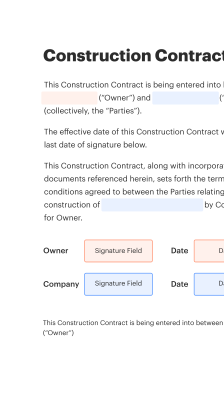
Typical Signing Flow with an esignature mobile sdk

A common flow moves from document generation through signature capture to storage and audit logging; SDKs provide UI and API hooks at each stage.

  • Document Prep: Create or import PDF, add fields
  • Signer Identification: Authenticate signer identity
  • Signature Capture: Collect handwritten or typed signature
  • Finalize & Store: Apply signature, record audit trail
Collect signatures
24x
faster
Reduce costs by
$30
per document
Save up to
40h
per employee / month

Quick Setup: Embedding an esignature mobile sdk

Follow these core steps to add signing to a native mobile app, covering developer setup, authentication, and simple signing flows.

  • 01
    Obtain Credentials: Register app and get API keys
  • 02
    Install SDK: Add native package and dependencies
  • 03
    Configure Auth: Implement OAuth or API key flow
  • 04
    Render Document: Load PDF and place signature fields

Audit Trail and Document Finalization Steps

Maintain a clear step sequence for finalizing signed documents and preserving evidentiary records that support enforceability.

01

Prepare Document:

Embed signature and data fields
02

Authenticate Signer:

Verify identity and consent
03

Capture Signature:

Record signature appearance
04

Record Metadata:

Log IP, time, device
05

Apply Tamper Seal:

Generate cryptographic seal
06

Archive Document:

Store final PDF and logs
be ready to get more

Why choose airSlate SignNow

  • Free 7-day trial. Choose the plan you need and try it risk-free.
  • Honest pricing for full-featured plans. airSlate SignNow offers subscription plans with no overages or hidden fees at renewal.
  • Enterprise-grade security. airSlate SignNow helps you comply with global security standards.
illustrations signature

Configuring Signing Workflows and Defaults

Recommended baseline workflow settings help ensure consistent behavior for reminders, expirations, and audit capture across production signing flows.

Feature Configuration
Reminder Frequency 48 hours
Signature Expiration 30 days
Default Authentication Method Email verification
Audit Trail Retention 7 years
Callback Webhook Enabled

Platform Support and Device Requirements for an esignature mobile sdk

Confirm supported OS versions, minimum device RAM, and required network capabilities before integrating an SDK into production mobile builds.

  • iOS Support: iOS 13 and later
  • Android Support: Android 8.0 and later
  • Network Requirements: TLS-capable connectivity

Validate performance on target devices, test offline signing flows, and ensure the SDK's dependencies do not conflict with app-level privacy or security policies before release.

Core Security and Authentication Elements

Transport Security: TLS 1.2 or higher required
At-Rest Encryption: AES-256 storage encryption
Authentication: OAuth 2.0 and API keys
Access Controls: Role-based permissioning
Audit Logging: Immutable event records
Data Segmentation: Per-tenant isolation options

Industry Examples Using an esignature mobile sdk

These concise case examples show practical deployments of an esignature mobile sdk across U.S. verticals, focusing on workflow, controls, and outcomes.

Field Service Delivery

Technician collects customer acknowledgment on delivery forms using an embedded SDK on a rugged tablet

  • Offline capture with queued sync
  • Preserves signed receipts and timestamps

Resulting in faster billing cycles and reduced paper handling, improving reconciliation speed and customer satisfaction.

Patient Intake in Clinics

Patient signs consent forms on clinic tablets before treatment using in-app signing

  • Identity verified via two-factor SMS
  • Signed forms automatically stored in HIPAA-compliant records

Leading to auditable consent records, reduced front-desk wait times, and consistent regulatory documentation.

Best Practices for Secure and Accurate esignature mobile sdk Integrations

Implement these recommended practices to improve security, compliance, and user experience when embedding an esignature mobile sdk into production applications.

Use Strong, Standardized Authentication Flows
Implement OAuth 2.0 with short-lived tokens and refresh tokens, and require multi-factor authentication for high-risk operations. Tie API credentials to specific application instances and rotate secrets regularly to reduce exposure from compromised keys.
Record Comprehensive, Tamper-Evident Audit Trails
Capture signer identity, authentication method, timestamps, IP addresses, and device identifiers. Store these event records immutably alongside the signed document and generate verifiable hashes to demonstrate integrity during audits or legal review.
Design for Accessibility and Legal Clarity
Provide accessible signing interfaces, clear consent language, and a visible confirmation page that summarizes obligations and data retention. Ensure the capture of explicit consent is straightforward on small screens to avoid disputes over intent.
Test Offline and Edge-Case Workflows Thoroughly
Simulate poor connectivity, concurrent signers, and interrupted sync scenarios. Verify that retries, conflict resolution, and queued telemetry preserve audit continuity and that signed artifacts remain consistent across retries and device restores.

FAQs About esignature mobile sdk

Common questions and concise answers to help developers and administrators address integration, compliance, and runtime issues when using an esignature mobile sdk.

Feature Comparison: Mobile SDK Availability and Capabilities

A concise vendor comparison focused on mobile SDK availability, supported platforms, authentication types, and basic retention or hosting options for U.S. applications.

Criteria signNow (Recommended) DocuSign Adobe Sign
Mobile SDK Availability
Supported Platforms iOS, Android iOS, Android iOS, Android
Authentication Options OAuth, SMS, Email OAuth, SMS, Email OAuth, Email
Hosted Storage Options Cloud storage Cloud storage Cloud storage
be ready to get more

Get legally-binding signatures now!

Potential Legal and Operational Risks

Invalid Consent: Loss of enforceability
Data Breach: Regulatory fines possible
Noncompliant Storage: Evidence gaps in audits
Misconfigured Auth: Unauthorized access risk
Retention Failures: Violation of record laws
Poor UX: Increased abandonment rates

Feature and Plan Comparison Across Leading SDK Providers

Compare plan-level availability of common features and APIs across selected vendors to identify which offerings align with app needs and compliance responsibilities.

Plan signNow (Recommended) DocuSign Adobe Sign Dropbox Sign PandaDoc
Free Plan Availability Free trial and limited free tier Trial available Trial available Free tier available Free trial only
API Access Included Available on Business and API plans Included on business plans API available with subscription API on business plans API on paid plans
Mobile SDK Included SDK available with API access SDK available for enterprise SDK available via developer program Not primary focus SDK available on higher plans
SSO and Enterprise Features SSO on enterprise plans SSO and advanced admin SSO via Acrobat Sign enterprise SSO on business tiers SSO for enterprise customers
Document Retention Controls Configurable retention and exports Retention policies and export tools Retention via Adobe admin console Retention controls available Retention and archiving features

Mobile SDK - How to Guideline

Mobile SDK feature gets to be quickly available whenever you make use of airSlate SignNow's complete eSignature platform. Make use of this solution for your business regardless of the field you’re doing the job in. The set of functions delivered by airSlate SignNow perfectly fits for individuals who attempt to make their company strategies more successful and streamline their workflow.

Be confident that your contracts will always be prepared correctly, filled out by the appropriate parties and signed digitally while using the electronic signature that complies with the ESIGN Act along with other governmental requirements. Include fillable fields to make any document interactive, gather signatures from several people and utilize receiver authentication to be certain that your document was received by the right person. All this you can do when doing work either from a desktop computer or from the mobile device to avoid wasting time and close critical deals on-the-go.


walmart logo
exonMobil logo
apple logo
comcast logo
facebook logo
FedEx logo
be ready to get more

Get legally-binding signatures now!