Itemized Line Items
Structured rows for commodity descriptions, units, quantities, rates, and line-level taxes so each charge can be reconciled against shipment events and proof-of-delivery records.



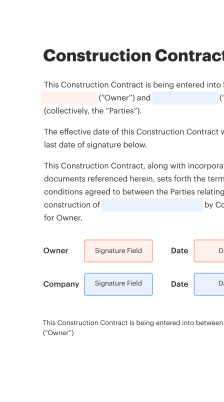
A shared Google Docs invoice template standardizes billing, reduces manual entry errors, and provides a central, editable copy accessible across the logistics chain while enabling export to PDF and integration with signature or accounting tools.

A Fleet Manager uses the template to consolidate dispatch records into billable invoices, ensuring mileages, fuel surcharges, and detention fees are accurately recorded for each delivery and verifying driver reports before submission to finance.
A 3PL billing specialist uses the template to aggregate multiple client shipments onto consolidated invoices, apply client-specific rates and discounts, and maintain a single source file for export to accounting or signature workflows.
Logistics teams, billing clerks, and carrier partners commonly use a Google Docs invoice template to standardize billing and speed approvals.
The template reduces ambiguity between operational records and financial documentation, improving payment predictability and audit readiness.
Structured rows for commodity descriptions, units, quantities, rates, and line-level taxes so each charge can be reconciled against shipment events and proof-of-delivery records.
Standardized charge and accessorial codes reduce ambiguity, simplify rate lookup, and enable automated GL mapping when exporting to accounting systems.
Dedicated fields for purchase order numbers, shipment references, and bill-of-lading numbers assist matching and speed accounts payable processing.
Embedded formulas for subtotals, taxes, and totals reduce manual math errors and maintain consistent totals across exports and signed PDFs.
A clearly labeled signature block prepares the document for eSignature placement and documents who approved or authorized the invoice.
A section for payment terms, remit-to details, late fee policies, and special client instructions clarifies expectations and supports dispute resolution.
Native Google Docs storage and Drive sharing allow collaborative editing, access controls, and version history, while Google Sheets can feed line‑item data into the template for batch invoice creation.
Integration with QuickBooks or other accounting packages streamlines posting invoices, mapping charge codes to chart of accounts, and reconciling payments against invoices.
Linking to CRM or Transportation Management Systems (TMS) lets invoices inherit customer billing rules, pricing agreements, and shipment details automatically for accuracy.
Dropbox or Drive archival keeps signed copies in a controlled repository for audit retention and easy retrieval by finance or compliance teams.
| Setting Name | Default Configuration |
|---|---|
| Reminder Frequency | 48 hours |
| Signature Order | Sequential |
| Template Assignment | By client account |
| Auto-fill Fields | TMS integration |
| Archive Retention | 7 years |
Confirm platform compatibility to ensure team members can edit, export, and sign invoices across devices.
For consistent results, use an up-to-date browser or official Google Drive mobile app; convert to PDF before signature to preserve layout and avoid rendering differences on different devices.
A regional carrier consolidated daily delivery logs into a single Google Docs invoice for each customer
Resulting in faster customer approvals and improved weekly cash forecasting.
A third-party logistics provider used client‑specific copies of the template for monthly consolidated invoices
Leading to lower reconciliation time and clearer client statements.
| Feature | signNow (Recommended) | DocuSign | Adobe Sign |
|---|---|---|---|
| ESIGN and UETA legal acceptance | |||
| Bulk Send capability for invoices | |||
| API access for automation | REST API | REST API | REST API |
| Mobile offline signing support | Mobile offline | Limited offline | Mobile offline |
Issue invoices within 7 days of delivery when possible.
Commonly Net 30, Net 45, or negotiated terms.
Send reminders at 7 and 14 days past due.
Retain invoices and supporting documents for seven years.
Log disputes within 30 days for timely resolution.
| Subscription Plan Overview | signNow (Recommended) | DocuSign | Adobe Sign | Dropbox Sign | PandaDoc |
|---|---|---|---|---|---|
| Entry plan and billing model | Business plan, per user monthly billing with team seats available | Personal/Standard monthly user plan with basic features | Individual monthly with core signing features | Standard monthly plan with Dropbox integration | Essentials monthly with document workflow focus |
| Core signing and templates included | Unlimited signing templates and basic automations included | Basic templates, limited bulk send | Templates and form fields included | Templates plus Dropbox file linking | Template library and content blocks included |
| API and developer access | Available with Business tiers and higher | Available via paid plans and developer account | Available on business subscriptions | API available on advanced plans | API access via specific paid tiers |
| Advanced workflow features | Conditional fields and Bulk Send; role-based teams supported | Advanced workflow builder on higher tiers | Integration with Adobe ecosystem for workflows | Basic workflow plus cloud file linking | Document generation and approval workflows |
| Compliance and enterprise controls | Audit trails, SOC-aligned controls, and enterprise settings available | Enterprise-grade controls with compliance features | Enterprise compliance with Adobe Sign integrations | Standard compliance controls; enterprise available | Higher-tier plans include advanced controls and SSO |