Donor/client details
Name, address, tax ID, and contact for receipts and ledger posting to donor or client records.



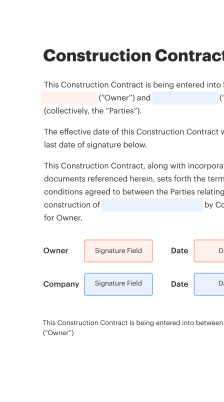
A standardized template reduces data entry errors, improves tracking for grants and restricted funds, and helps small nonprofit teams process billing efficiently while maintaining consistent recordkeeping practices.

Oversees invoice template configuration, reviews form response reconciliation, and ensures chart-of-accounts mapping matches nonprofit accounting rules. This role sets validation rules and approves integration settings with accounting software or document storage.
Uses the template to collect service fees and donor billing details, confirms grant codes, and initiates invoice generation. They monitor responses, follow up on missing data, and coordinate with finance for payment posting.
Small finance teams, program managers, and development staff often rely on templates to standardize billing and donor receipting workflows.
Using a template helps ensure consistent fields, easier reconciliation, and clearer audit trails for reporting to boards and funders.
Name, address, tax ID, and contact for receipts and ledger posting to donor or client records.
Itemized description, quantity, unit cost, discounts, and subtotal to support fund-specific billing and transparency.
Required fields for restricted funds, project codes, and award numbers to ensure correct allocation in accounting.
Fields to note tax-exempt status and apply applicable tax rules or exemptions where legal and appropriate.
Net terms, due date, invoice number, and preferred payment method for consistent receivable management.
Placeholders for authorized signatories and donor acknowledgments when required for contractual or grant conditions.
Use Google Docs as the invoice template engine to merge form responses into a formatted invoice, enabling layout control, organizational branding, and export to PDF for archival and distribution.
Connect responses to a donor or client CRM to populate contact records, track outstanding invoices, and associate billing with constituent records for stewardship and reporting.
Save signed invoices and original form responses to shared Google Drive or an external cloud repository to centralize backups and enforce retention policies for audits.
Route responses to Google Sheets to enable calculations, ledger exports, batch processing, and live dashboards for finance and program teams.
| Workflow Setting Name and Configuration | Integration connector and trigger mapping |
|---|---|
| Response destination sheet mapping | Map form fields to spreadsheet columns |
| Document template mapping | Link form fields to invoice template placeholders |
| Signature routing rules | Sequential or parallel signer order |
| Reminder Frequency for pending signatures | 48 hours after initial send |
| Archive and retention destination | Save signed PDFs to secure cloud folder |
Ensure staff can reliably access Google Forms, document generators, and eSignature tools on supported platforms for consistent invoicing.
For secure use across devices, keep browsers and apps up to date, enforce strong authentication, and document supported versions so staff know when to update or request IT assistance.
A local nonprofit uses a Google Forms invoice template to register attendees and capture billing info in one submission, including program codes and subsidy status
Leading to consistent receipts, simplified donor reports, and faster reconciliation with minimal manual entry.
A human services nonprofit collects client billing and grant allocation codes via a form that enforces required grant identifiers
Resulting in auditable records, clearer fund tracking, and easier compliance for grant reporting.
| Feature Comparison: Criteria and Vendors | signNow (Recommended) | DocuSign |
|---|---|---|
| ESIGN/UETA Compliance | ||
| Bulk Send support | ||
| Google Drive integration | Yes, native | Yes, add-on |
| API availability | Yes, REST API | Yes, REST API |
Issue invoices within contractually required timeframe.
Send reminders at 7 and 30 days past due.
Align invoice dates with grant reporting periods.
Retain financial records per policy and funder rules.
Retain 3 to 7 years depending on filing circumstances
Follow funder contract terms, often 3 to 7 years
Keep accessible records for recent five fiscal years
Securely destroy records after retention expires
Daily backups for financial databases and archives
| Pricing Plan Comparison | signNow (Recommended) | DocuSign | Adobe Sign | HelloSign | PandaDoc |
|---|---|---|---|---|---|
| Free tier or trial | Free trial available | Free trial available | Free trial available | Free trial available | Free eSign available |
| API access on plans | Available on business plans | API plans offered | Enterprise/API plans | API available | API available on paid plans |
| Google Workspace integration | Native Drive and Docs | Drive add-on available | Google integrations | Drive add-on | Drive and Docs connectors |
| Bulk sending capability | Bulk Send available | Bulk Send feature | Bulk sending supported | Batch send | Merge and send |
| Audit trail and logs | Comprehensive audit trail | Detailed audit logs | Full audit reports | Standard logs | Audit records included |
| HIPAA/BAA support | Available with BAA | Available with BAA | Available with BAA | Contact sales | Available with BAA |