Index Break Attestation with SignNow

Award-winning eSignature solution

What index break attestation means and when it applies

Index break attestation is a signed declaration that documents and record indexes contain intentional breaks or discontinuities, and that those breaks have been reviewed and verified. In practice this attestation records the responsible party, timestamp, and reason for any indexing interruptions, linking the declaration to the exact document version. It is used to preserve evidentiary integrity, support chain-of-custody, and document exceptions during records management or legal review. Proper attestation reduces ambiguity about missing pages, appended exhibits, or non-sequential indexing in regulated workflows.

Why an index break attestation matters for records integrity

An index break attestation documents intentional index gaps so auditors and legal reviewers can verify that missing or moved content was deliberate and accounted for.

Why an index break attestation matters for records integrity

Common challenges that make attestations necessary

  • Unclear pagination after redaction can lead to disputes over missing content and version control.
  • Manual index updates are error-prone when multiple teams modify records without coordinated logging.
  • Chain-of-custody gaps arise when index changes are not time-stamped or attributed to a user.
  • Regulated reviews require explicit evidence of why documents were re-indexed or segments separated.

Representative user roles and responsibilities

Compliance Officer

A Compliance Officer uses index break attestations to record and justify non-standard indexing decisions. They ensure each attestation references policy, cites the reason for the break, and is retained with the document to meet regulatory and audit requirements over the retention lifecycle.

Records Manager

A Records Manager applies attestations when physical or digital files are restructured. They connect attestations to version history, maintain searchable logs, and coordinate with legal or IT to preserve evidentiary context for future access and audits.

Who typically needs index break attestations

Organizations that manage regulated records, legal teams, compliance departments, and archival staff commonly require attestations for index anomalies.

  • Legal departments documenting exhibits and chain-of-custody during discovery and litigation.
  • Records and archives teams ensuring compliance with retention schedules and disposition rules.
  • Compliance officers tracking intentional deviations from standard indexing for audit readiness.

These attestations help teams demonstrate intentional handling of records during audits, litigation holds, or retention schedule exceptions.

Advanced capabilities that improve attestation workflows

Beyond basics, these capabilities reduce friction, improve defensibility, and align attestations with enterprise governance needs.

Template Library

Predefined attestation templates enforce consistent wording, required fields, and metadata capture so every index break attestation follows organizational standards and reduces reviewer ambiguity.


Bulk Attestations

Apply the same attestation across multiple documents or index ranges in a single operation to save time when batch processing archival migrations or mass redactions.

API Hooks

Programmatic endpoints let records systems automatically generate attestations when index changes occur, ensuring real-time capture and reducing manual entry errors.

Conditional Workflows

Rules can route attestations to different approvers based on document sensitivity, index range, or department to maintain appropriate oversight and separation of duties.

Search & Reporting

Comprehensive search, filtering, and export tools make it possible to locate attestations quickly for audits, legal discovery, or regulatory reporting.

Retention Labels

Attach retention policies and disposition holds to attestations so legal and records requirements persist regardless of storage location changes.

be ready to get more

Choose a better solution

Essential features to support index break attestations

Choose tools that provide provenance, secure signatures, and searchable attachments to ensure attestations remain reliable and discoverable.

Linked Audit

Automatic audit logs that associate the attestation to a specific document version, capturing user identity, timestamp, IP address, and action history for reliable forensics and compliance reporting.

Tamper-evident

Cryptographic sealing of the attestation and related document snapshot so any subsequent changes are visible, preserving evidentiary integrity and simplifying regulator or court review.

Role approvals

Configurable approval chains let organizations require multiple authorized signers, ensuring attestations reflect proper oversight and preventing a single user from unilaterally modifying indexed records.

Searchable metadata

Structured metadata fields for attestation reason, index range, and associated identifiers make retrieval straightforward during audits, legal holds, and routine records management tasks.
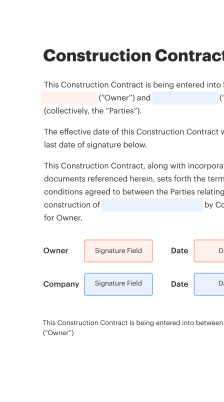
How an online attestation workflow typically operates

A standardized online workflow ensures attestations are captured, authenticated, and preserved alongside document versions.

  • Initiate: User flags index break in the system.
  • Populate: System captures metadata and break details.
  • Authorize: Designated approver reviews and signs.
  • Archive: Attestation stored with audit trail.
Collect signatures
24x
faster
Reduce costs by
$30
per document
Save up to
40h
per employee / month

Quick steps to add an index break attestation

Follow these concise steps to capture a compliant attestation and link it to the affected document.

  • 01
    Identify break: Locate the index gap and affected pages.
  • 02
    Record reason: Enter the rationale for the break in the attestation.
  • 03
    Sign attestation: Apply an authorized electronic signature with date.
  • 04
    Attach to record: Store the attestation with the document version.

Detailed workflow steps for creating an attestation

Use these procedural steps to standardize how attestations are prepared, authorized, and stored within an electronic records system.

01

Flag file:

Mark the document and index range that contains the break.
02

Enter details:

Describe the reason, affected pages, and reference IDs.
03

Select template:

Pick the standardized attestation template to use.
04

Assign approver:

Route to the designated approver or compliance reviewer.
05

Sign:

Apply the approved electronic signature with timestamp.
06

Archive:

Link the attestation to the document and store immutably.
be ready to get more

Why choose airSlate SignNow

  • Free 7-day trial. Choose the plan you need and try it risk-free.
  • Honest pricing for full-featured plans. airSlate SignNow offers subscription plans with no overages or hidden fees at renewal.
  • Enterprise-grade security. airSlate SignNow helps you comply with global security standards.
illustrations signature

Configuring automated workflows for attestations

Configure workflow settings to automate attestation creation, routing, and retention, reducing manual steps and ensuring consistent capture.

Feature Value
Trigger event Index change detected
Approval routing Two-step approval
Reminder frequency 48 hours
Retention label assignment Match record policy
Snapshot capture Auto on trigger

Supported devices and platform requirements

index break attestation workflows should work across modern desktop and mobile platforms to support field and office users.

  • Desktop browsers: Chrome, Edge, Firefox
  • Mobile devices: iOS and Android apps
  • Minimum OS: Windows 10+, macOS 10.14+, iOS 13+, Android 8+

Ensure users have current browser versions and secure network access; where regulated data is involved, enforce device policies, encrypted storage, and strong authentication to maintain compliance and data protection.

Core security and protection elements

Encryption at rest: AES-256 bit encryption
Encryption in transit: TLS 1.2+ secure channels
Access controls: Role-based permissions
Authentication methods: Multi-factor options
Document tamper logs: Immutable audit entries
Storage isolation: Segregated storage partitions

Practical use cases for index break attestation

Real-world scenarios show how attestations preserve clarity when records deviate from sequential indexing.

Court Exhibit Management

An evidence custodian records an index break when exhibits are separated from a parent file for inspection

  • Notation includes user, reason, and timestamp
  • Enables quick validation by opposing counsel and court clerks

Resulting in defensible chain-of-custody and reduced discovery disputes.

Medical Records Redaction

A health records team separates sensitive sections for privacy redaction and documents the index break with a signed attestation

  • Entry logs the clinician, redaction rationale, and version ID
  • This preserves continuity between public and redacted copies for audit

Ensures HIPAA-compliant handling and clear audit trails for patient records.

Recommended practices for accurate and defensible attestations

Implement consistent procedures to ensure attestations are clear, attributable, and stored with immutable context for future verification.

Use clear, standardized reason codes
Define a short controlled vocabulary for common index breaks such as redaction, exhibit removal, or pagination error. Standard codes reduce ambiguity and support automated reporting and filtering across large archives.
Require authenticated signers with accountability
Ensure attestations are executed by authorized personnel using multi-factor authentication and visible role designations so reviewers can verify that an appropriate custodian approved the change.
Capture a document snapshot with the attestation
Store a timestamped, read-only copy of the exact document version referenced by the attestation. This preserves content context and prevents later disputes about what was present at the time of attestation.
Integrate attestations into retention and disposition
Treat attestations as part of the record lifecycle by applying retention labels and disposition rules so attestations remain available for required audit periods and legal holds.

Frequently asked questions and troubleshooting

Common questions and issues when creating or validating index break attestations, with pragmatic answers to resolve them quickly.

Capability comparison for attestation support

A concise capability matrix comparing attestation support across leading eSignature vendors, focusing on core compliance and audit features.

Capability signNow (Featured) DocuSign Adobe Sign
Tamper-evident storage
Linked document snapshot
Template-based attestations
API automation
be ready to get more

Get legally-binding signatures now!

Key retention and timing considerations for attestations

Establish timelines for when attestations must be created and how long they should be retained to match regulatory and internal policy needs.

Attestation creation window:

Within 48 hours of index change

Retention with primary record:

Retain as long as the original document

Audit retention period:

Keep audit logs for minimum seven years

Legal hold override:

Preserve until hold is released

Periodic review schedule:

Annual compliance review recommended

Risks and compliance penalties to consider

Evidence loss: Missing attestations weaken proofs
Regulatory fines: Noncompliance may incur penalties
Litigation exposure: Disputed record integrity risks
Audit failure: Inadequate logs cause findings
Operational delays: Rework and investigations increase
Reputational harm: Stakeholder trust may erode

Pricing and plan differences for attestation workflows

High-level pricing and plan comparisons that reflect attestation-related capabilities and limits among major eSignature providers.

Feature signNow (Recommended) DocuSign Adobe Sign Dropbox Sign PandaDoc
Entry-level plan price $8 per user/mo $10 per user/mo $14.99 per user/mo $15 per user/mo $19 per user/mo
API access included Available Limited Available Available Available
Bulk operations Yes Yes Yes Yes Yes
Advanced audit logs Included Add-on Included Included Add-on
Enterprise workflow support Available Available Available Limited Available

How to Index break attestation For Free

Index break attestation feature gets easily available when you make use of airSlate SignNow's complete eSignature platform. Use this solution for your business irrespective of the sector you’re doing work in. The set of features presented by airSlate SignNow perfectly suits for people who attempt to make their enterprise strategies more productive and streamline their workflow.

Be assured that your contracts will always be organized properly, filled out by the appropriate parties and signed digitally using the digital signature that complies with the ESIGN Act and also other governmental requirements. Integrate fillable fields to make any document interactive, collect signatures from many persons and apply receiver authentication to make sure that the document was received by the appropriate individual. All this you are able to do when working either from the desktop computer or from the mobile gadget to save lots of time and close essential deals on-the-go.


walmart logo
exonMobil logo
apple logo
comcast logo
facebook logo
FedEx logo
be ready to get more

Get legally-binding signatures now!