Document templates
Customizable proposal templates with merge fields for donor and program data, built-in budget tables, and conditional content to tailor narratives by funder or campaign.
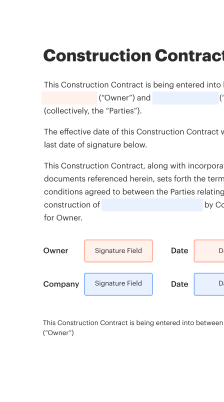
A dedicated proposal generator standardizes documents, reduces repetitive work, and improves accuracy while preserving audit trails required for funders and regulators.

Leads proposal creation, coordinates content from program staff and finance, and ensures documents follow funder guidelines. Uses templates and collaboration features to assemble narratives, attach budgets, and track submission status across multiple opportunities.
Prepares and verifies budget tables, projections, and supporting schedules. Reviews numeric consistency, applies accounting classifications, and approves financial sections before final sign-off to ensure audit readiness.
Nonprofit teams of varying sizes use proposal tools to coordinate fundraising, grant submissions, and investment outreach with consistent documents and sign-off paths.
Adoption typically spans development staff, finance teams, program managers, and executive leadership who need clear responsibility and traceable approvals on each proposal.
Customizable proposal templates with merge fields for donor and program data, built-in budget tables, and conditional content to tailor narratives by funder or campaign.
Automated population of contact, program, and financial data from CRMs or spreadsheets to minimize errors and speed up proposal assembly.
Configurable, role-based routing for sequential or parallel reviews that enforces required approvals before allowing final signature or submission.
Secure electronic signing with audit logs and signer authentication to capture approvals remotely while maintaining legal validity and traceability.
Comprehensive logs of edits, reviewer comments, and signature events that support audits and provide evidence of authorized approvals.
Built-in reporting for submission status, approval cycle times, and repository exports to support funder reporting and internal metrics.
Two-way connections with Google Docs and Sheets let teams prepare narrative sections collaboratively, pull budget figures from Sheets, and update documents without duplicating files across platforms.
Direct integrations with CRMs populate donor and contact fields into proposals, keep submission history attached to constituent records, and allow segment-specific template selection based on relationship data.
Integration with Dropbox or Google Drive stores signed proposals in organized folders, preserves attachments, and ensures backups are consistent with organizational retention policies.
Linking to accounting packages exports approved budgets into financial systems, prevents mismatched ledgers, and simplifies reconciliation after grant awards or investments are received.
| Setting Name Configuration Header Row | Default configuration values shown for common nonprofit workflows |
|---|---|
| Reminder Frequency for Proposal Follow-ups | 48 hours after send, repeat every 3 days |
| Approval Sequence and Escalation Rules | Sequential approvals, escalate after 5 days |
| Template Access and Editing Permissions | Editors for dev staff, viewers for others |
| Signature Authentication Requirements | Email link plus optional phone code |
| Retention and Auto-archive Policy | Archive after 2 years, delete per policy |
Confirm that proposal software supports the platforms your team uses so contributors can edit, review, and sign from their preferred devices.
Ensure the chosen solution offers responsive web access plus native mobile apps or optimized mobile pages for reviewers and signers; validate browser support, offline capabilities for field staff, and integration compatibility with your CRM and cloud storage to avoid workflow interruptions.
A regional nonprofit used templates and automated budget merging to compile complex grant applications quickly
Resulting in faster submission cycles and a clearer audit trail for funders.
A university foundation standardized investor pitch decks and legal exhibits using shared templates
Leading to accelerated approvals and documented authorization for capital disbursement.
| Feature Availability and Protocols Header | signNow (Featured) | DocuSign | Adobe Acrobat Sign |
|---|---|---|---|
| ESIGN / UETA Compliance | |||
| Bulk Send for multiple signers | |||
| API for custom integrations | REST API available | REST API available | REST API available |
| HIPAA-friendly options | Available | Available via plan | Available via plan |
Internal draft completed two weeks before submission
Budgets finalized one week before submission
Final sign-off three business days prior
Submit by funder deadline with buffer
Store drafts for 2 years after decision
Keep signed contracts for 7 years
Retain budgets and ledgers for 7 years
Annual review of audit materials
Review templates biannually for compliance
| Plan and Vendor Headers | signNow (Featured) | DocuSign | Adobe Acrobat Sign | OneSpan Sign | PandaDoc |
|---|---|---|---|---|---|
| Entry-level price per user | $8/user/month billed annually | $10+/user/month | $9.99+/user/month | Contact sales | $9+/user/month |
| Annual plan estimate | $96/user/year typical | $120+/user/year | $120+/user/year | Enterprise pricing | $108+/user/year |
| Nonprofit discount availability | Discount programs for nonprofits | Nonprofit pricing available | Discounts available on request | Case-by-case | Discounts available |
| API access in plans | Included in paid plans, generous limits | Available in mid-tier plans | Available in enterprise tiers | Enterprise only | Available with paid plans |
| Support and SLA | Email and business-hour support, paid SLA options | Tiered support with SLAs | Enterprise support and SLAs | Enterprise SLA focus | Email and priority support tiers |