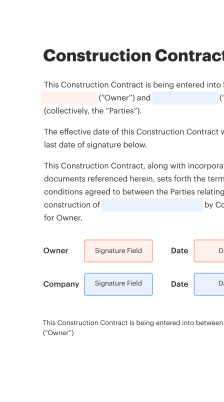
Job Work Invoice Format for Real Estate

Transform your invoicing process with airSlate SignNow’s seamless eSigning features and cost-effective solutions. Empower your real estate transactions with ease and efficiency.

Award-winning eSignature solution

Legal validity and compliance considerations for real estate invoices

Digital job work invoices are legally enforceable in the United States when they meet ESIGN and UETA requirements: clear intent to sign, association of the signature with the record, and reliable methods to capture signer identity and consent.

Legal validity and compliance considerations for real estate invoices

Common roles for managing job work invoices

Accounts Manager

The Accounts Manager prepares and reviews job work invoices, ensures templates are current, reconciles invoices to payments, and manages retention schedules; they coordinate approvals with property managers and accounting teams to maintain accurate financial records.

Property Manager

The Property Manager approves work and validates job details on invoices, confirms that services are complete, and routes invoices for payment; they act as the primary contact between vendors and owners for billing clarification and dispute resolution.

Core features to include in a real estate job work invoice format

Incorporate tools that speed data entry, secure signatures, and integrate with accounting and property management systems to ensure consistent invoicing across properties and vendors.

Custom fields

Allow property-specific fields, job codes, cost centers, and conditional line items so invoices capture the exact details needed for repairs, renovations, and subcontractor billing without manual form edits.

Calculations

Support automatic line-item calculations, tax rules, retainers, and discount logic to reduce manual errors and ensure totals align with accounting systems and payment requests from owners or managers.

Reusable templates

Enable template libraries for common job types—repairs, maintenance, renovations—so teams apply consistent formatting, terms, and field sets across multiple properties and contractors.

Audit trail

Capture signer identity, timestamps, IP addresses, and action history to preserve evidentiary detail for approvals, disputes, and regulated recordkeeping obligations.

Integrations

Connect invoices to CRMs, accounting packages, and cloud storage to auto-populate client data, push finalized documents to bookkeeping, and maintain synchronized property records.

Access controls

Configure role-based permissions for who can create, edit, send, or view invoices to maintain separation of duties and reduce risk of unauthorized changes.

be ready to get more

Choose a better solution

Integrations and templates that speed invoice workflows

Link invoicing templates to common document editors, CRMs, and storage to eliminate duplicate entry and keep property accounting synchronized.

Google Docs

Import or export invoice templates and content to and from Google Docs to maintain editable drafts, use collaborative editing for complex job descriptions, and generate finalized PDFs for signature capture without manual copy-paste.

CRM connection

Sync client, owner, and tenant contact information from a CRM so invoices are auto-populated with correct billing addresses, owner billing preferences, and contact approvals, reducing manual lookup and entry errors.

Dropbox integration

Save signed invoices automatically to designated Dropbox folders by property or account, enabling centralized storage, backup, and easy sharing with accounting or auditing teams without manual uploads.

Template library

Maintain a library of job work invoice templates for common scopes—emergency repairs, scheduled maintenance, and remodels—so teams reuse validated layouts and maintain consistent contractual language.

How the online job work invoice format for real estate operates

A standardized digital invoice template streamlines billing, approvals, and signature capture while maintaining consistent data for accounting and property files.

  • Template setup: Create reusable invoice templates with required fields and calculations.
  • Populate data: Auto-fill client, property, and job details from records.
  • Signature capture: Collect legally binding electronic signatures and timestamps.
  • Finalization: Generate an uneditable PDF with audit metadata for storage.
Collect signatures
24x
faster
Reduce costs by
$30
per document
Save up to
40h
per employee / month

Quick setup for a job work invoice format for real estate

Set up a job work invoice format for real estate quickly by preparing a template, defining fields, and establishing signing, approval, and secure storage processes for typical contractor and vendor billing.

  • 01
    Create template: Design invoice layout with property, client, and job details.
  • 02
    Add fields: Include line items, rates, tax, totals, and signature fields.
  • 03
    Send to signers: Route to contractors, property managers, and owners for signatures.
  • 04
    Archive record: Store final PDF with audit trail and retention tag.

Audit trail checklist for every invoice transaction

An audit-ready invoice record should capture signer actions, timestamps, and the document state at each stage to support compliance and dispute resolution.

01

Record creation:

Log creator and timestamp
02

Field edits:

Track changes and versions
03

Signer authentication:

Record ID method used
04

Signature time:

Capture precise timestamp
05

IP address:

Store network origin
06

Final PDF:

Archive immutable file
be ready to get more

Why choose airSlate SignNow

  • Free 7-day trial. Choose the plan you need and try it risk-free.
  • Honest pricing for full-featured plans. airSlate SignNow offers subscription plans with no overages or hidden fees at renewal.
  • Enterprise-grade security. airSlate SignNow helps you comply with global security standards.
illustrations signature

Workflow automation settings for invoice processing

Configure automated routing, reminders, and archival rules to ensure consistent approvals and timely payment while maintaining compliance with record-retention policies.

Feature Configuration
Approval sequence Two-step manager then owner
Reminder Frequency 48 hours
Template Assignment By property type
Webhook Endpoint Accounting system URL
Retention Period 7 years

Supported devices and technical requirements

Modern job work invoice formats for real estate work across web browsers, mobile devices, and tablets, requiring only an internet connection and an up-to-date browser or app.

  • Desktop: Chrome, Edge, Safari supported
  • Mobile: iOS and Android apps available
  • Browser requirements: TLS 1.2+, JavaScript enabled

For offline preparation, maintain editable templates in common formats, and ensure mobile users install the supported app for convenient signing; verify device clocks and user authentication to protect legal validity.

Security and document protection protocols

Encryption at rest: AES-256 encryption
TLS in transit: TLS 1.2+ connections
Access controls: Role-based permissions
Two-factor authentication: Optional MFA for users
Audit logging: Comprehensive action records
Document watermarking: Prevent unauthorized reuse

Real estate use cases for job work invoices

Practical scenarios show how standardized invoices reduce disputes and speed payment across property management, renovation, and contracting workflows.

Contractor billing

A property manager uses a standardized invoice template to bill multiple contractors across properties with consistent job codes and rate tables.

  • Template automation reduces data entry and calculation mistakes.
  • Faster approval and fewer reconciliation errors between contractor invoices and property ledgers.

Resulting in shorter payment cycles and clearer audit trails for owner accounting.

Maintenance requests

A maintenance vendor submits digital invoices tied to work orders and property IDs for recurring repairs.

  • Integration with property management software populates tenant and unit data automatically.
  • Approvers see line-item labor and materials linked to the original request for transparency.

Leading to reduced disputes and simplified monthly owner statements.

Best practices for secure and accurate job work invoice formats

Adopt standard templates, strict version control, and clear approval routing to reduce disputes and support reliable financial reporting across real estate portfolios.

Standardize templates and fields
Use consistent templates across properties, include required fields for property ID and job codes, and lock critical fields to prevent accidental edits; version templates and document changes to maintain traceability.
Apply role-based approvals
Define who can create, approve, and finalize invoices; require at least one manager sign-off for high-value work to maintain internal controls and separation of duties in accounting processes.
Keep detailed audit trails
Record every action including edits, views, and signatures with timestamps and IP addresses to support compliance, dispute resolution, and internal audits; store the audit log alongside the signed PDF.
Integrate with accounting systems
Push finalized invoices to your accounting or ERP system to avoid manual re-entry, ensure consistent ledgers, and accelerate reconciliation and payment cycles across properties and vendors.

FAQs and common troubleshooting for job work invoices

Answers to frequent questions about signer identity, compliance, template errors, and delivery issues encountered when using digital job work invoice formats.

Digital versus paper signing: quick capability comparison

A concise comparison of core capabilities shows how digital signing platforms differ from paper workflows in availability, automation, and audit features.

Criteria signNow (Recommended) DocuSign Adobe Acrobat Sign
eSignature legality ESIGN/UETA compliant ESIGN/UETA compliant ESIGN/UETA compliant
Mobile signing
Template automation
Audit trail detail Comprehensive Comprehensive Comprehensive
be ready to get more

Get legally-binding signatures now!

Document retention, backup, and legal deadlines

Establish retention timelines, backup cadence, and review dates to meet legal obligations and support financial audits for real estate invoicing records.

Retention policy length:

7 years recommended

Backup schedule:

Daily incremental backups

Archive review date:

Annual integrity checks

Dispute hold period:

Retain until resolution

Compliance audit window:

Document ready within 30 days

Risks and potential penalties for noncompliant invoicing

Invalid signatures: Contract unenforceable
Data breach fines: Regulatory penalties
Payment delays: Cashflow impact
Accounting errors: Restatement risk
Compliance audit failure: Remediation costs
Contract disputes: Legal exposure

Feature availability across common eSignature platforms

Feature-level comparison highlights which platforms include free tiers, API access, and enterprise capabilities important for real estate invoice automation.

Platform signNow (Recommended) DocuSign Adobe Acrobat Sign Dropbox Sign PandaDoc
Free tier availability Limited free plan for eSigning Trial-only major features 30-day trial available Limited free plan for individuals Free eSign plan available
API access REST API with SDKs Robust REST API REST API with SDKs REST API available REST API available
Bulk send capabilities Available on business plans Available on business plans Available Available Available with limits
Custom branding Supported on business tiers Supported on business tiers Supported on enterprise Supported on business tiers Supported on paid plans
Enterprise controls Role-based admin and SSO Advanced admin and SSO Enterprise SSO and DLP Admin controls and SSO Team and enterprise controls
walmart logo
exonMobil logo
apple logo
comcast logo
facebook logo
FedEx logo
be ready to get more

Get legally-binding signatures now!