Manage Contacts and Documents in a CRM with SignNow

Find all your signers’ contact details in one place and instantly view the documents you’ve exchanged with them. Control your eSignature workflows with greater efficiency and speed.

Award-winning eSignature solution

Legal validity and compliance considerations in the United States

Electronic signatures executed through integrated CRM workflows are generally enforceable under ESIGN and UETA when the signing intent is recorded and the platform maintains accurate audit logs; for regulated data, maintain access controls and appropriate business associate agreements for HIPAA-covered information.

Legal validity and compliance considerations in the United States

Typical user roles involved in CRM document workflows

Sales Manager

Sales Managers oversee template usage and approval routing within the CRM, verify that contact records are accurate before document generation, and review completed agreements to ensure they meet commercial terms and account-level commitments.

System Administrator

System Administrators configure the CRM integration, manage API credentials and single sign-on, assign user roles and permissions, and monitor sync logs to resolve connectivity or field mapping issues that affect document generation.

Essential features for managing contacts and documents in a CRM

Effective CRM document management combines field mapping, templates, role controls, search, automation, and audit capabilities so teams can create, send, and archive signed records directly from contact or opportunity pages.

Template Library

Store reusable templates that map CRM fields to document fields and reduce manual entry, enabling consistent contract language across teams while shortening document preparation time and minimizing data errors during population.

Contact Sync

Two-way contact synchronization keeps CRM records and the signing service aligned so updates to names, addresses, and emails propagate automatically, reducing duplicate records and maintaining accurate recipient information for audits.

Role Permissions

Granular access controls let administrators define which users can create templates, send documents, view signed copies, or manage retention policies, supporting separation of duties and compliance requirements across departments.

Search & Tagging

Full-text search and metadata tagging make it simple to locate documents by contact, contract type, or custom tags, which accelerates retrieval for renewals, audits, and customer service inquiries.

Automated Workflows

Set triggers to generate or route documents when CRM records change status, send reminders to signers, and escalate outstanding tasks to ensure timely completion and consistent process execution.

Audit Logs

Comprehensive, tamper-evident logs capture signer identity, timestamps, IP addresses, and document versions to support legal admissibility and internal review of completed transactions.

be ready to get more

Choose a better solution

Integrations and template management inside the CRM

Connectors to document editors, cloud storage, and the CRM allow teams to draft, store, and sign documents without leaving the customer record, while templates standardize content and reduce review cycles.

Google Docs Sync

Draft and maintain templates in Google Docs and push final versions into the CRM-linked signing flow, preserving formatting and enabling collaborative editing before signature collection; templates can be versioned and tracked per department for governance.

Cloud Storage

Automatically copy signed documents to cloud storage providers and the CRM attachment area to ensure backups, enable access controls, and centralize records for audit and archival purposes across teams and tools.

CRM Connector

A two-way connector synchronizes contacts and document metadata with the CRM, enabling generation of signature requests directly from records and ensuring that signed PDFs are attached to the correct account or opportunity for reporting.

Template Library

Create role-specific templates with embedded fields and signature placeholders, lock non-editable clauses for compliance, and allow authorized users to publish or restrict templates according to department needs and approval policies.

How document and contact workflows operate inside the CRM

An integrated workflow maps CRM fields into document templates, triggers document generation from record events, routes for signatures, and returns signed files to the contact’s record for central storage and reporting.

  • Field mapping: Automatic population of document fields from CRM contact data.
  • Trigger generation: Create documents when opportunities reach a specified stage or a checkbox is set.
  • Signature routing: Define signer order and authentication requirements per document instance.
  • Record storage: Save signed PDFs to the contact record and linked cloud storage.
Collect signatures
24x
faster
Reduce costs by
$30
per document
Save up to
40h
per employee / month

Quick setup for contact and document management in a CRM

Initial setup inside a CRM typically includes importing or syncing contacts, linking document templates to records, configuring user permissions, and enabling audit logging so all signed documents remain traceable and associated with the correct account.

  • 01
    Import contacts: Bulk import CSVs or map CRM fields to ensure accurate records.
  • 02
    Link templates: Attach reusable document templates to contact or opportunity records for faster document generation.
  • 03
    Set permissions: Define team roles to control who can send, edit, and view signed documents.
  • 04
    Enable logging: Turn on audit trails and version history to maintain evidentiary records.

Audit trail steps and record linkage

Maintain a clear audit chain by capturing signer details, timestamps, and system events that link the signed document to the CRM contact and transaction record.

01

Capture identity:

Record signer name and email
02

Timestamp events:

Log each signature action
03

Record IP:

Store originating IP addresses
04

Document versioning:

Archive prior versions
05

Link to contact:

Attach signed file to CRM record
06

Exportable logs:

Provide downloadable audit reports
be ready to get more

Why choose airSlate SignNow

  • Free 7-day trial. Choose the plan you need and try it risk-free.
  • Honest pricing for full-featured plans. airSlate SignNow offers subscription plans with no overages or hidden fees at renewal.
  • Enterprise-grade security. airSlate SignNow helps you comply with global security standards.
illustrations signature

Automation settings for CRM-based document workflows

Configuring workflow settings defines how documents are created, routed, and monitored from CRM events, enabling repeatable processes and predictable outcomes for sending and signing.

Setting Configuration
Trigger Event On record status change
Reminder Frequency 48 hours
Approval Routing Sequential approvers
Storage Location Contact attachment folder
Error Handling Notify admin and retry

Platform support and device considerations

Accessing contact and document features requires a modern browser or the provider’s native mobile app, a secure internet connection, and user credentials provisioned through the CRM or single sign-on system.

  • Desktop: Modern browsers supported
  • Mobile: iOS and Android apps available
  • Network: TLS-secured internet connection

Confirm minimum browser and operating system versions, test the CRM integration on representative devices, enable push or email notifications where supported, and validate role permissions so mobile and desktop users have consistent access and signing capabilities.

Security controls and document protection protocols

Data Encryption: AES-256 at rest
Transport Security: TLS 1.2+ in transit
Access Controls: Role-based permissions
Authentication Options: Email, SMS, SSO
Document Integrity: Tamper-evident seals
Audit Trails: Immutable event logs

Industry examples: CRM contact and document workflows in practice

Practical scenarios illustrate how linking CRM contacts to document templates reduces manual work and improves record-keeping across different sectors.

Sales Contract Workflow

A regional sales team configures CRM opportunities to auto-populate contract templates with customer and pricing data to avoid manual entry and reduce errors.

  • Feature point: automatic field mapping and template linking.
  • Benefit point: faster turnaround and fewer data mismatches.

Resulting in shorter sales cycles, centralized contract storage tied to each account, and clearer renewal tracking for revenue operations.

Student Records Processing

A university uses CRM contact records for students and parents to generate enrollment forms that prefill personal and course information, and routes documents for parent or guardian signatures where required.

  • Feature point: conditional signature routing and field prefill.
  • Benefit point: reduced administrative overhead and accurate record capture.

Resulting in auditable, centralized records that support compliance, faster processing, and reliable retention for institutional reporting.

Recommended best practices for secure and accurate CRM document handling

Adopt consistent processes and security controls to ensure reliable contact data, accurate document generation, and defensible retention of signed records.

Standardize template naming and version control
Use clear template naming conventions and retain older published versions for auditability; require approvals for template changes and store change history to demonstrate governance over contract language.
Validate field mappings before production
Test templates against representative CRM records to confirm correct field population and conditional logic; schedule periodic reviews after CRM schema changes to prevent data mismatches during document generation.
Restrict template editing rights
Limit template creation and editing to a small set of authorized users or managers to reduce accidental changes, and use locked fields for clauses that should not be modified by senders.
Maintain retention and backup policies
Implement documented retention schedules aligned with legal and operational requirements, ensure signed documents are backed up to secure storage, and routinely audit access logs for unusual activity.

FAQs and troubleshooting for CRM contact and document management

Answers address frequent problems and configuration issues encountered when syncing contacts, sending documents, or validating signed records within a CRM-integrated signing environment.

Feature comparison for CRM-based contact and document management

This concise comparison highlights availability and core capabilities across popular eSignature providers for CRM-integrated contact and document workflows.

Feature signNow (Recommended) DocuSign Adobe Acrobat Sign
CRM Integration Native Native Native
Bulk Send
Advanced Templates
HIPAA Support Yes (BAA) Yes (BAA) Yes (BAA)
be ready to get more

Get legally-binding signatures now!

Retention and backup schedule for signed CRM documents

Set clear retention timeframes and backup checkpoints so signed documents and associated contact data remain available for audits and business needs.

Retention baseline:

Retain contracts seven years

Backup frequency:

Daily backups to secure cloud

Archive policy:

Move inactive files annually

Deletion schedule:

Purge per legal hold rules

Audit checkpoints:

Quarterly retention reviews

Pricing overview and plan highlights for CRM document workflows

Basic pricing and plan features vary; the table below summarizes free tier availability, entry-level pricing, and API access across common providers to inform budgetary planning.

Plan/Provider signNow (Recommended) DocuSign Adobe Acrobat Sign PandaDoc HelloSign
Free Tier Availability Trial & limited free Trial only Trial only Trial only Free tier
Starting Price (monthly) From $8/user From $10/user From $14.99/user From $19/user From $15/user
Business Plan Price From $12/user From $25/user From $22/user From $29/user From $20/user
Enterprise Features Included SSO & API SSO & API SSO & API SSO & API SSO & API
API Access Included Paid add-on Included Included Paid add-on

How to manage signers and documents in the airSlate SignNow CRM

airSlate SignNow automatically saves the contacts you interact with to its brand new CRM. You can access the database anytime to view or edit signer contact information, review or download the documents you’ve exchanged, or quickly send another document for signature.

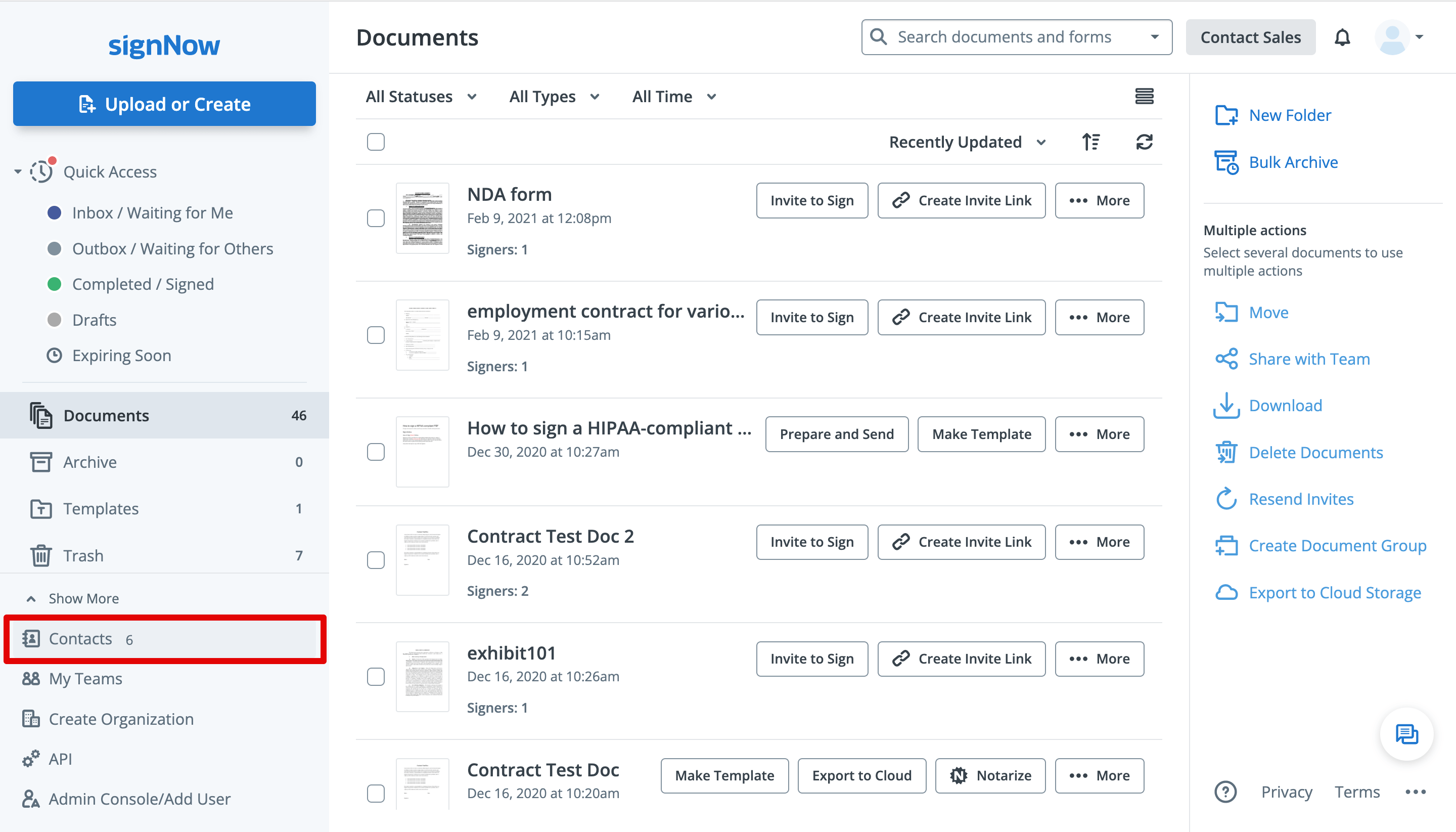
Access your contacts in one click

Click Contacts in the left-hand navigation menu to open the CRM and view your signer profiles.
fill-guide-illustration

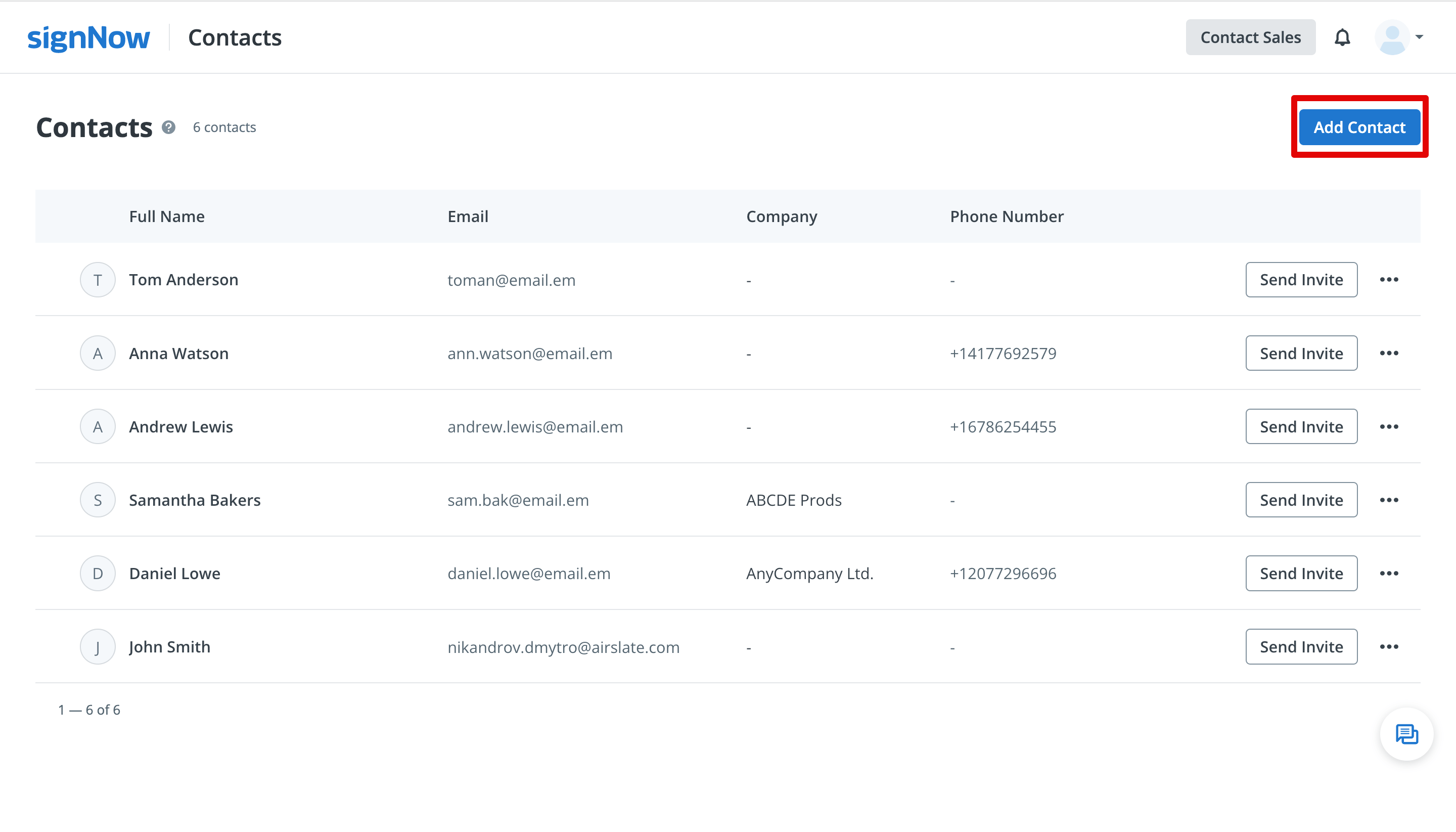
Add contacts to your database

Your contacts are automatically added to the CRM once a document transaction is initiated. However, you can also add a contact manually by clicking Add Contact.
fill-guide-illustration

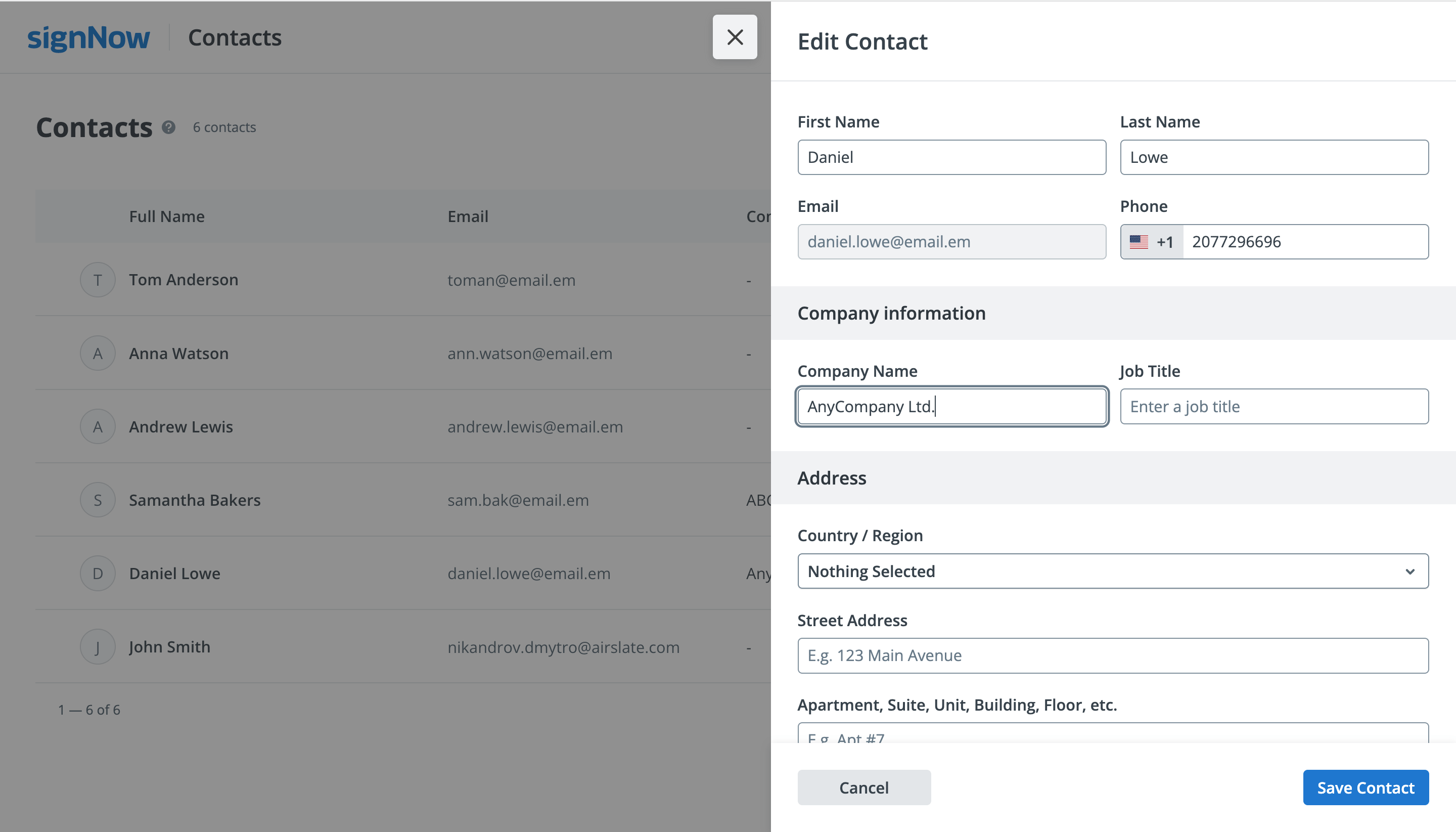
Edit contact details

Specify a signer’s name, phone number, company information, address, and additional details at any time.
fill-guide-illustration

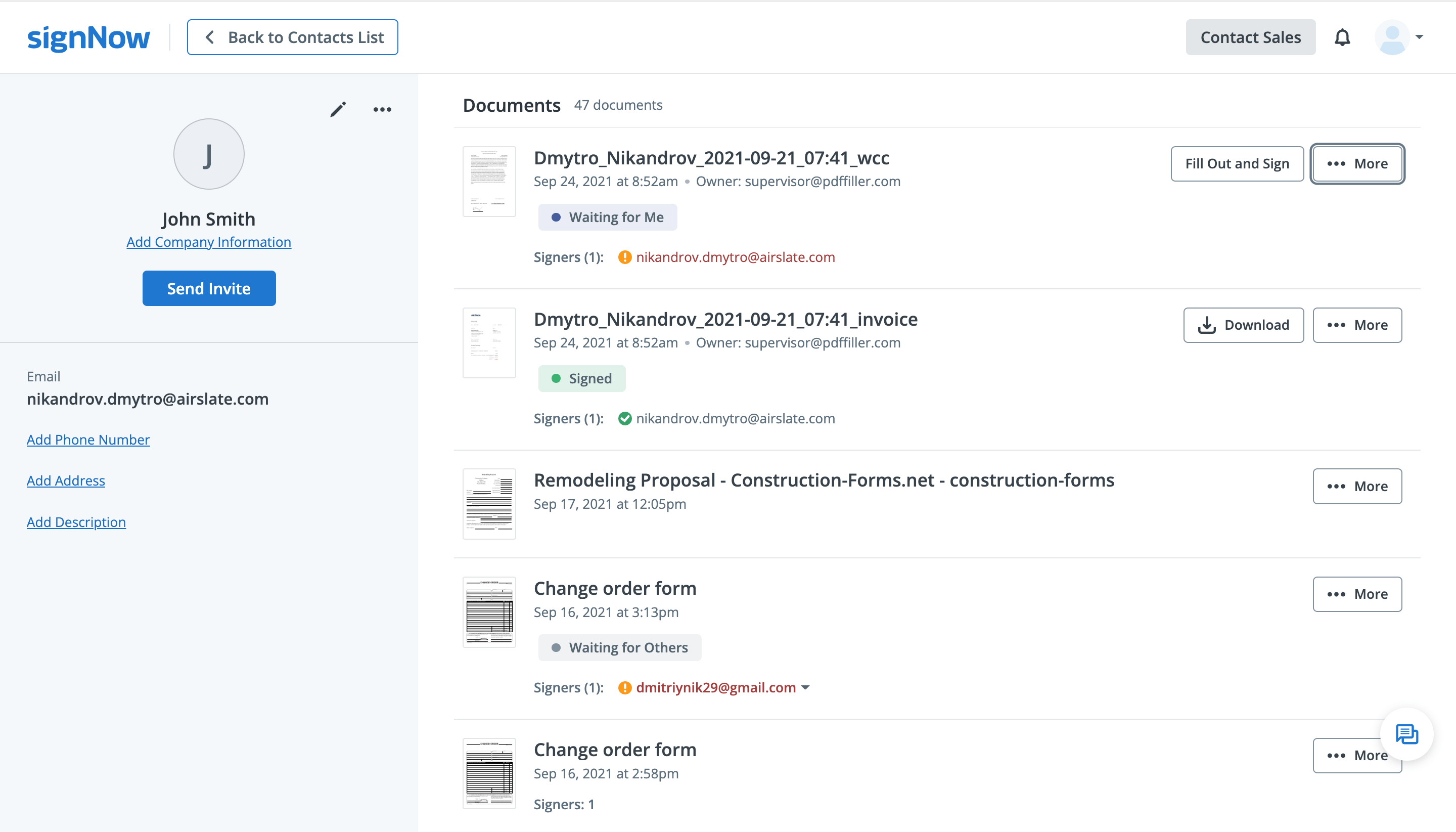
View document transactions

Once you select any of your existing contacts, you can view all the documents you’ve sent for signature or received from them. Having documents sorted by contacts makes it much easier to send documents for signature, track signatures, reply to other people’s signature invites, and manage document turnover.

fill-guide-illustration
walmart logo
exonMobil logo
apple logo
comcast logo
facebook logo
FedEx logo
be ready to get more

Get legally-binding signatures now!