Merge Several Documents and Sign with SignNow

Appropriate adjustment of the chain of automation processes optimizes business productivity essentially. Merge several documents and Sign the easiest way.

Award-winning eSignature solution

What merging several documents and signing means

Merging several documents and signing refers to combining multiple files into a single document package and applying signatures and required fields so the package can be executed as one transaction. This process typically involves consolidating PDFs, Word files, and images, arranging pages in the correct order, adding signature, initial, and date fields, and routing the combined document to recipients for signing. In eSignature platforms such as signNow the merged package preserves audit logs, signer order, and field positions so the final executed file and trail remain intact for recordkeeping and compliance.

Why merging documents before signing matters

Combining documents into a single signing packet reduces administrative steps, prevents lost pages, and ensures consistent execution across related materials. It simplifies storage, streamlines signer experience, and helps maintain a unified audit trail for legal or regulatory review.

Why merging documents before signing matters

Common challenges when merging documents and signing

  • Inconsistent formats and sizes require preprocessing to avoid layout shifts during merging and signing.
  • Missing or duplicated pages can lead to execution errors and require manual review before sending.
  • Incorrect field placement across merged files can confuse signers and delay completion.
  • Large combined file sizes may exceed attachment limits or slow upload and download times.

Representative users of merged signing workflows

HR Manager

An HR Manager prepares onboarding packets that combine tax forms, confidentiality agreements, and benefits enrollment forms. They use merged signing to present a single, organized packet to new hires and to maintain a single complete record for employee files and audits.

Sales Director

A Sales Director compiles proposals, pricing schedules, and master agreements into one signing package to speed deal closure. Using merged documents reduces back-and-forth and ensures all contract attachments execute together with the primary signature page.

Typical teams that merge documents and obtain signatures

Legal, HR, and sales teams often need to combine multiple agreements and exhibits into one signing packet before execution.

  • Human resources teams consolidating offer letters, policy acknowledgements, and benefit forms for new hires.
  • Sales and account teams combining proposals, contracts, and SOWs into a single document for signature.
  • Legal and compliance groups assembling multi-document agreements and attachments for complete execution.

Centralized workflows reduce handoffs and help maintain consistent records across departments and external partners.

Advanced features for high-volume merged signing

For organizations that frequently merge documents and collect signatures, advanced capabilities improve scalability, security, and integration with enterprise systems.

Bulk Send

Send a merged signing packet to many recipients at once while customizing recipient fields and preserving a separate audit trail for each execution instance.


API access

Integrate merging and signing into internal systems to automate document assembly, apply fields programmatically, and trigger signature workflows from business applications.

Role-based access

Control who can merge files, modify field placement, or send packets using granular team roles and permissions to reduce unauthorized changes.

Template support

Save merged document layouts and field maps as templates to reuse standard packets and accelerate preparation for repeatable agreements.

Conditional fields

Apply fields that appear or change based on signer responses or document data to keep merged packets concise and contextually relevant.

Document versioning

Track revisions of source files and merged packets so administrators can restore prior versions or verify which documents were combined at signing time.

be ready to get more

Choose a better solution

Core features to support merging and signing

Platforms that handle merged signing should provide robust file handling, flexible field placement, reliable audit trails, and multi-device signing to accommodate business and compliance needs.

File merging

Combine PDFs, Word files, and images into a single document while preserving page order, bookmarks, and attachments for a cohesive signing packet in one transaction.

Fields and tags

Place signature blocks, initials, checkboxes, and data fields across merged pages with fine-grained control over required fields and signer assignment.

Audit logs

Maintain an immutable trail that records uploads, field placements, signer actions, timestamps, and IP addresses for compliance and litigation readiness.

Cross-platform signing

Support signing via desktop, mobile browser, and native apps so recipients can review and sign merged packages from any device reliably.
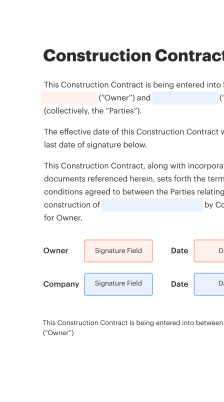
How merging and signing workflows operate

A merged signing workflow consolidates files, applies fields, enforces signer order, and records a single execution event with a preserved audit trail.

  • Prepare: Upload files and confirm formats.
  • Compose: Combine files into one document.
  • Tag: Add signatures and data fields.
  • Execute: Send for signing and complete transaction.
Collect signatures
24x
faster
Reduce costs by
$30
per document
Save up to
40h
per employee / month

Quick steps to merge several documents and sign

Follow these concise steps to combine multiple files into one signing package and prepare fields for execution.

  • 01
    Collect files: Gather all documents and verify versions.
  • 02
    Order pages: Arrange merged file page sequence correctly.
  • 03
    Add fields: Place signature, initial, and date fields.
  • 04
    Send: Route the merged packet to recipients.

Managing audit trails for merged signing transactions

Maintain a clear audit trail by capturing key events during the merge and signing process and by storing both source and final files.

01

Capture upload:

Log who uploaded each source file.
02

Record merge action:

Record timestamp and user who merged files.
03

Log field placement:

Save metadata for signature and data fields.
04

Track signer actions:

Record signatures, timestamps, and IPs.
05

Store final PDF:

Archive executed merged document securely.
06

Retain source files:

Keep originals for verification needs.
be ready to get more

Why choose airSlate SignNow

  • Free 7-day trial. Choose the plan you need and try it risk-free.
  • Honest pricing for full-featured plans. airSlate SignNow offers subscription plans with no overages or hidden fees at renewal.
  • Enterprise-grade security. airSlate SignNow helps you comply with global security standards.
illustrations signature

Suggested workflow settings for merged signing

Configure these settings to ensure consistent behavior when combining documents and collecting signatures in repeated workflows.

Setting Name Configuration
Default Merge Method Append files sequentially
Signer Order Enforcement Sequential signing enabled
Automatic Field Detection Disabled by default
Reminder Frequency 48 hours
Document Retention Period 7 years

Supported platforms for merging and signing

Merged signing typically works across major desktop browsers and mobile devices, with native apps providing improved performance and offline capabilities.

  • Desktop browsers: Chrome, Edge, Safari, Firefox
  • Mobile devices: iOS and Android mobile browsers
  • Native apps: iOS and Android apps available

Security and authentication elements for merged signing

ESIGN Act: Recognizes electronic signatures' legal validity.
UETA: Supports e-signature use within participating states.
Multi-factor authentication: Adds signer identity verification steps.
Audit trail: Records signatures, timestamps, and actions.
Data encryption: Protects documents in transit and at rest.
Access controls: Restricts who can view or modify documents.

Industry examples of merging documents and signing

Two concise examples show how merged signing accelerates workflows in HR and commercial contracting while preserving compliance and records.

Onboarding Packet

A human resources team combines offer letters, tax forms, and benefits enrollment documents into one packet to send to new hires.

  • Use of a single packet simplifies signer steps and reduces missing pages.
  • Consolidation ensures consistent execution and a unified audit trail for employee records.

Resulting in faster onboarding times and a complete, auditable employee file for compliance reviews.

Sales Agreement Package

A sales operations group merges a master services agreement, statement of work, and pricing schedule into one executable document.

  • The merged file keeps terms, exhibits, and signatures together for finalization.
  • This approach reduces contract negotiation cycles and avoids detached exhibits being signed separately.

Leading to clearer contract records and fewer post-signature disputes about missing attachments.

Best practices for secure and reliable merged signing

Adopt consistent procedures and checks before sending merged documents to reduce errors, preserve legal validity, and maintain efficient records.

Verify document versions before merging
Confirm that all included documents are the final approved versions and that there are no conflicting clauses across files to avoid post-signature disputes and corrections.
Standardize page order and naming
Use consistent file names and a standard page order to help reviewers verify content quickly and reduce signer confusion during the review and execution process.
Use clear field labeling and signer assignment
Label each signature and data field clearly, assign fields to specific recipients, and mark required fields to guide signers and reduce incomplete submissions.
Preserve audit trails and backup copies
Keep copies of the pre-merged source files, the final merged file, and the platform's audit record to support future verification and regulatory recordkeeping needs.

FAQs About merging several documents and signing

Common questions and troubleshooting points focus on file compatibility, signer issues, audit trail concerns, and legal validity when merging documents for signature.

Quick comparison: merged signing across solutions

A concise feature comparison shows common capabilities for merging documents and obtaining signatures across leading platforms and paper-based execution.

Criteria signNow (Recommended) Adobe Sign Paper
Supports merging multiple files
Audit trail included
Mobile signing support Limited
HIPAA compliance option
be ready to get more

Get legally-binding signatures now!

Risks and compliance concerns when merging documents

Invalid execution: May void agreement.
Missing consent: Could breach ESIGN requirements.
Data exposure: Leads to privacy violations.
Retention failure: Affects audit readiness.
HIPAA issues: Risks for health data.
State law conflict: Varies by jurisdiction.

Feature availability across eSignature providers

Feature-level availability differs by vendor and plan. The table below lists common capabilities across five providers to inform platform selection for merged signing workflows.

Feature / Vendor signNow (Featured) Adobe Sign DocuSign Dropbox Sign PandaDoc
API availability and limits Yes, REST API with generous quotas Yes, REST API available Yes, robust API access Yes, API for paid plans Yes, API available
Bulk sending capabilities Yes, bulk send included Yes, enterprise plans Yes, add-on available Limited bulk options Yes, team plans
Template management Template library and sharing Template management features Extensive templates and workflows Template reuse supported Template and content blocks
HIPAA and regulatory support HIPAA-ready options available Enterprise HIPAA options HIPAA-compliant offerings Business associate agreement possible HIPAA available on select plans
Storage and retention features Configurable retention and export Enterprise retention controls Archive and retention tools Retention via Dropbox integration Document storage with controls

How to Merge several documents and Sign?

Merge several documents and Sign with airSlate SignNow and enhance your competitiveness on the market.

Nowadays companies in the marketplace know about higher competitors hazards. Even though they provide special services and goods it still doesn’t guarantee a hitting success. The net profit may be accomplished only if your inner processes are perfectly structured along with the workflow is smooth. Therefore the companies more frequently go to opt for computer software that seek to perform routine duties, giving time to the personnel to focus on some innovative enhancements.

In case your enterprise includes putting your signature on documents using the clients, you are going to definitely start looking for the best revolutionary eSignature answer. One of those is airSlate SignNow - a unique platform with lots of features, which can easily be customized to the needs. Your consumers and installers will be able to sign other, agreements and deals papers on-line with less hard work, time and expenditures invested. Using the SigNow you are able to present simply how much you worry about your customers, mainly because it can certainly make a number of corporations faster and more practical.


walmart logo
exonMobil logo
apple logo
comcast logo
facebook logo
FedEx logo
be ready to get more

Get legally-binding signatures now!