Mobile Bill Format for Insurance Industry

Streamline your document processes with airSlate SignNow's user-friendly eSigning solution. Experience cost-effective efficiency that boosts your business productivity.

Award-winning eSignature solution

What mobile bill format for insurance industry means today

A mobile bill format for insurance industry defines how policy invoices, premium notices, and billing statements are structured, displayed, and delivered for signing or acknowledgment on smartphones and tablets. It covers file layouts, mandatory fields, signature placements, responsive design for small screens, and metadata required for downstream processing. For insurers, a consistent mobile bill format reduces processing errors, supports automated reconciliation, and preserves legal evidentiary elements such as timestamps and signer identity, while enabling secure delivery channels and simple review by policyholders on the device they use most.

Why adopting a mobile bill format matters in insurance

A standardized mobile bill format increases completion rates, shortens payment cycles, and reduces call-center inquiries by making invoices clear and mobile-friendly for policyholders.

Why adopting a mobile bill format matters in insurance

Common implementation challenges for mobile bill formats

  • Designing layouts that remain readable and functional across varied screen sizes and orientations.
  • Preserving legal and audit elements like signature placement, timestamps, and signer metadata on mobile displays.
  • Integrating mobile billing formats with legacy policy administration systems and disparate data feeds.
  • Ensuring secure delivery and consent capture while minimizing friction for mobile users.

Typical user roles for mobile billing workflows

Billing Manager

Manages invoice templates, schedules bill runs, and oversees reconciliation workflows. Works with IT and compliance to ensure mobile bills match regulatory requirements and integrate with the general ledger and policy systems.

Policyholder

Receives and reviews the mobile bill, confirms charges, and provides consent or signature using a mobile device. Expects clear itemization, simple actions, and secure, time-stamped confirmation.

Who in the insurance lifecycle uses mobile bill formats

Insurance teams from billing to claims rely on mobile bill formats to deliver timely premium notices and collect acknowledgments.

  • Policyholders accessing invoices and signing acknowledgments on smartphones.
  • Customer service and billing specialists reviewing mobile-submitted proof of payment.
  • Underwriting and compliance teams validating signed billing records for audits.

Consistent mobile bill formats support operational teams and regulators by providing reliable, auditable records of billing communications and signer actions.

Extended feature set for enterprise mobile billing

Larger insurers typically need additional capabilities for scale, compliance, and integrations when deploying mobile bill formats.

Template versioning

Track and revert invoice template changes with audit metadata to ensure consistent bill presentation and to support regulatory audits and historical reconstructions.


Bulk Send

Send the same mobile-optimized bill to large recipient sets with individualized pre-filled fields, scheduling controls, and per-batch monitoring for delivery and completion rates.

API-first integration

Programmatic endpoints to generate, send, and query mobile bills directly from policy administration and billing systems for automated workflows.

Advanced authentication

Support for identity verification methods including SMS OTP, knowledge-based authentication, and federated single sign-on for higher-assurance signatures.

Custom branding

Control over colors, logos, and messaging to maintain brand consistency and trust on mobile interfaces presented to policyholders.

Reporting and analytics

Detailed dashboards on delivery, open rates, completion times, and payment conversions to optimize billing operations.

be ready to get more

Choose a better solution

Core tools for an effective mobile bill format

Include essential features that make mobile bills clear, legally valid, and compatible with insurer systems.

Responsive template

A single-column, mobile-first invoice template that adapts text, tables, and signature blocks for small screens while preserving field order and required disclosures for regulatory compliance and downstream processing.

Signature capture

Support for simple electronic signatures, typed initials, and advanced authentication flows that generate auditable evidence including IP, timestamps, and user verification metadata for legal validity under ESIGN and UETA.

Pre-filled data

Auto-population of policyholder details, policy numbers, outstanding balances, and billing cycles from the policy administration system to reduce input errors and speed up acknowledgement.

Embedded payments

Secure, PCI-compliant payment integration allowing one-touch premium payments from mobile devices, with clear reconciliation metadata for accounting systems.
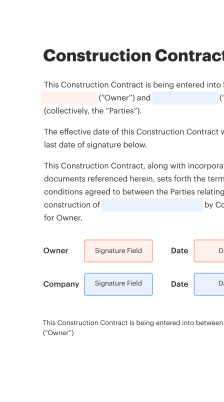
How a mobile bill flows from issuer to signer

A typical mobile bill workflow moves through preparation, delivery, signing, and archival with checkpoints for security and auditability.

  • Prepare: Generate invoice using policy data.
  • Deliver: Send via secure mobile channel.
  • Sign: Capture signature and consent.
  • Archive: Store signed record with audit trail.
Collect signatures
24x
faster
Reduce costs by
$30
per document
Save up to
40h
per employee / month

Quick setup: Implementing a mobile bill format

Follow these basic steps to define, test, and deploy a mobile bill format for insurance billing and signature capture.

  • 01
    Define fields: List mandatory invoice and policy fields.
  • 02
    Design layout: Create responsive single-column view.
  • 03
    Set authentication: Configure signer identity checks.
  • 04
    Test rollout: Pilot on real devices and iterate.

Operational steps to process a signed mobile bill

Operational teams should follow a clear sequence from receipt through reconciliation to maintain control and compliance.

01

Receive:

Capture signed document into repository.
02

Verify:

Confirm signer identity metadata.
03

Reconcile:

Match payment and policy records.
04

Archive:

Store with retention metadata.
05

Audit:

Provide logs to compliance.
06

Report:

Update billing dashboards.
be ready to get more

Why choose airSlate SignNow

  • Free 7-day trial. Choose the plan you need and try it risk-free.
  • Honest pricing for full-featured plans. airSlate SignNow offers subscription plans with no overages or hidden fees at renewal.
  • Enterprise-grade security. airSlate SignNow helps you comply with global security standards.
illustrations signature

Recommended workflow configuration for mobile billing

Suggested default settings and configurations for an automated mobile billing workflow used by insurers.

Setting Name Configuration
Reminder Frequency for Overdue Mobile Bills 48 hours
Default Signature Authentication Method SMS OTP
Document Retention Period for Billing Records 7 years
Bulk Send Batch Size Limit 1,000 per batch
Payment Reconciliation Callback Endpoint Webhook enabled

Device and platform considerations for mobile billing

Ensure supported platforms and minimum software versions are defined before rolling out mobile bills to customers.

  • iOS support: iOS 13+ supported
  • Android support: Android 8+ supported
  • Browser compatibility: Modern mobile browsers

Include device testing on common models, validate browser rendering, and provide fallback options such as optimized email PDFs for unsupported devices to reduce failed deliveries and ensure accessibility.

Security and authentication features to include

Encrypted transit: TLS 1.2+ for all data flows
At-rest encryption: AES-256 encryption for stored files
Multi-factor authentication: Optional MFA for signers
Access controls: Role-based permissioning
Audit logging: Immutable event records
HIPAA safeguards: BAA support where required

Practical insurance scenarios using mobile bill formats

Two real-world examples show how insurers use mobile bill formats to streamline billing, acceptance, and record-keeping.

Renewal Payment Notice

A regional property insurer sends a mobile-optimized renewal invoice with clear premium breakdown and due date.

  • The format includes a signature field, masked payment options, and an embedded policy summary.
  • This reduces confusion and increases on-time payments by simplifying choices.

Resulting in faster renewal collections and fewer follow-up calls for the billing team.

Claims Deductible Acknowledgment

An auto insurer delivers a mobile bill for an approved repair with an itemized deductible and repair estimate.

  • The bill format highlights the payable amount and includes a single-tap acknowledgment and signature control.
  • Policyholders complete acknowledgement on-device and receive a time-stamped receipt for their records.

Leading to clear acceptance of charges and reduced disputes during claims settlement.

Best practices for secure and accurate mobile bill formats

Follow operational and design best practices to ensure mobile bills are compliant, easy to use, and reliable.

Use concise, mobile-optimized wording and clear action buttons
Write short, plain-language descriptions for charges and due dates, place the action button prominently, and avoid dense tables; this reduces confusion and accelerates signer completion on small screens.
Include required legal disclosures and a visible signature block
Display any statutorily required language and make the signature or acknowledgement control obvious; capture contextual metadata like date, time, and device to support legal defensibility.
Validate data automatically and pre-populate known fields
Pull policy and billing data from authoritative systems to minimize manual entry; perform client-side and server-side validation to prevent common errors before submission.
Maintain an immutable audit trail accessible to internal teams
Record events such as delivery, view, authentication checks, signature capture, and payment settlement in an unalterable log so operations and compliance teams can reconstruct the transaction lifecycle.

FAQs and troubleshooting for mobile billing

Answers to common operational and technical questions about implementing and operating mobile bill formats for insurers.

Feature availability across major eSignature providers

Compare core capabilities relevant to mobile bill formats across leading eSignature vendors, with signNow listed first as the recommended option in this comparison.

Feature Availability and Technical Details signNow (Recommended) DocuSign Adobe Acrobat Sign
Mobile-optimized Forms
Bulk Send capability
Audit trail detail Full Full Full
HIPAA-compliant hosting
be ready to get more

Get legally-binding signatures now!

Timeline checkpoints for mobile billing implementations

Use a phased schedule with measurable milestones to implement mobile billing formats and capture stakeholder expectations.

Requirements gathering and compliance review:

2–4 weeks

Template and UI design sprint:

1–3 weeks

Integration and security testing:

3–6 weeks

Pilot rollout to controlled segment:

2–4 weeks

Full production deployment and evaluation:

1–2 weeks

Regulatory and operational risks to avoid

Noncompliance fines: Monetary penalties
Data breaches: Loss of customer data
Invalid signatures: Rejected claims
Contract disputes: Litigation exposure
Operational delays: Payment processing lag
Audit failures: Regulatory sanctions

Pricing and plan comparison for mobile billing use cases

A concise overview of entry-level plans, trial offers, API availability, and primary use cases for each provider to inform platform selection for mobile bill formats.

Service Providers Compared signNow (Recommended) DocuSign Adobe Acrobat Sign Dropbox Sign PandaDoc
Entry-level plan name Business Personal Acrobat Standard Standard Essentials
Typical starting price (monthly) Starts around $8/user/mo Starts around $10/user/mo Starts around $9.99/user/mo Starts around $15/user/mo Starts around $19/user/mo
Free trial availability 7-day trial 30-day trial 7-day trial 14-day trial 14-day trial
API access included Yes (available) Yes (available) Yes (available) Yes (available) Yes (available)
Primary use case for insurers Cost-effective signing and workflows Enterprise-grade signing and integrations Document cloud signing with Adobe apps Lightweight API and developer focus Document generation and sales workflows
walmart logo
exonMobil logo
apple logo
comcast logo
facebook logo
FedEx logo
be ready to get more

Get legally-binding signatures now!