Music Invoice for Staffing Made Easy with SignNow

Watch your invoicing process become fast and smooth. With just a few clicks, you can execute all the necessary steps on your music invoice for Staffing and other crucial files from any gadget with web connection.

Award-winning eSignature solution

What a music invoice for staffing is and why it matters

A music invoice for staffing is a billing document used by agencies, contractors, or in-house music production teams to record fees, hours, and expenses associated with providing personnel for recording sessions, live shows, or production work. It itemizes staff roles (engineer, session musician, producer), dates and times, hourly or flat rates, travel or equipment costs, and any applicable taxes or union fees. Accurate invoices support timely payment, simplify accounting, enable consistent budgeting for recurring staffing needs, and create an auditable record for both parties in the event of disputes or audits.

Benefits of digitizing music invoice for staffing

Digitizing the music invoice for staffing reduces manual errors, speeds approvals, and preserves an auditable record while integrating with payroll and accounting systems for consistent financial controls.

Benefits of digitizing music invoice for staffing

Common challenges when managing music invoice for staffing

  • Tracking multiple hourly rates and overtime across different session dates increases invoice complexity and error risk.
  • Reconciling travel, per diem, and equipment charges requires careful supporting detail and receipts.
  • Version control problems arise when invoices are edited by multiple team members without a clear workflow.
  • Delayed signatures and approvals extend payment cycles and can disrupt freelancer cash flow.

Representative user profiles

Session Musician

Freelance performers who bill per session or per hour often juggle multiple clients and need concise invoices that list time, role, and any equipment fees. Clear invoices reduce back-and-forth with clients and speed payment for short-term engagements.

Staffing Agency

Agencies place technical staff and creatives for projects across studios and live events and require standardized invoices that support batching, approvals, and integration with accounting systems to reconcile payments and manage contractor records.

Who typically uses music invoice for staffing

Music production teams, staffing agencies, and independent contractors commonly manage music invoice for staffing to ensure transparent billing and fast payment.

  • Independent session musicians and engineers who invoice hourly or by project for studio and live work.
  • Music-focused staffing agencies managing rosters, shifts, and multiple client billing requirements.
  • In-house production departments at labels and media companies handling recurring staff costs.

Organizations implementing digital workflows see reduced administrative overhead and clearer financial records for music staffing engagements.

Core features for professional music invoice for staffing processing

These features address accuracy, speed, and traceability for staffing invoices used in studios, agencies, and production teams.

Template builder

A drag-and-drop template editor that captures staff roles, rate tables, tax settings, and optional expense fields so invoices match internal billing policies and client expectations consistently.


Batch invoicing

Batch creation and dispatch let you combine multiple contractor entries into grouped invoices for a single client, reducing repetition and simplifying reconciliation for recurring engagements.

Automated reminders

Configurable reminders send follow-up messages to clients after set intervals, improving on-time payments without manual tracking by administrators or production managers.

Digital signatures

Embedded eSignature fields capture client and contractor approvals with timestamped records and identity verification to validate acceptance of billed items and terms.

Audit trail

A complete event history records creation, edits, views, and signatures so every action on a music invoice for staffing is traceable for compliance and dispute resolution.

Role permissions

Granular user roles restrict who can create, edit, approve, or view invoices, supporting internal controls and separation of duties across finance and production teams.

be ready to get more

Choose a better solution

Integrations and templates that simplify invoicing

Key integrations and customizable templates reduce repetitive work and keep music invoice for staffing aligned with accounting and file storage systems.

Accounting connectors

Prebuilt integrations with popular accounting platforms allow invoices to sync line items, taxes, and client records directly to bookkeeping systems so you avoid manual entry and preserve accurate financial ledgers.

Cloud storage

Direct connections with cloud file services enable automatic attachment of session files, receipts, and contracts to invoices, preserving supporting evidence alongside billing records without separate uploads.

Template library

Custom templates standardize how roles, rates, and expenses appear on every music invoice for staffing, ensuring consistent client presentations and faster creation by reusing approved formats.

CRM syncing

Two-way CRM integration updates contact and project fields on invoices, reducing duplicate data and aligning billing with client account records for better tracking of outstanding balances.
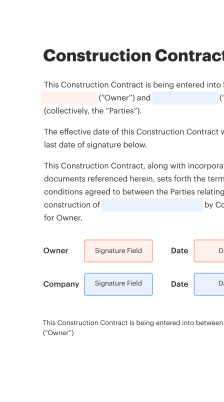
How to create and use music invoice for staffing online

An online workflow turns manual invoices into structured documents with fields, signature captures, and a tracked approval path for clients and contractors.

  • Template selection: Start from a standard staffing invoice template
  • Field mapping: Map line items and tax fields to the template
  • Approval routing: Set sequential or parallel approvers for sign-off
  • Delivery: Send via email with optional reminders
Collect signatures
24x
faster
Reduce costs by
$30
per document
Save up to
40h
per employee / month

How to prepare invoice documents for music staffing

Prepare clear, auditable invoice documents by standardizing fields and attaching supporting documentation before sending.

  • 01
    Standard header: Include business and client contact information
  • 02
    Rate table: Specify hourly or flat rates for each role
  • 03
    Expense lines: List travel, equipment, and per diem charges
  • 04
    Signature area: Add signer fields and dates for approvals

Completing and approving a music invoice for staffing

A clear approval flow shortens payment cycles; follow these practical steps for completion and sign-off.

01

Draft invoice:

Populate role, date, hours, and rates
02

Attach files:

Add timesheets, receipts, and contracts
03

Assign approvers:

Select client approver and internal reviewer
04

Request signatures:

Insert signature fields and send request
05

Track status:

Monitor views, reminders, and completions
06

Finalize payment:

Confirm payment and archive the invoice
be ready to get more

Why choose airSlate SignNow

  • Free 7-day trial. Choose the plan you need and try it risk-free.
  • Honest pricing for full-featured plans. airSlate SignNow offers subscription plans with no overages or hidden fees at renewal.
  • Enterprise-grade security. airSlate SignNow helps you comply with global security standards.
illustrations signature

Recommended workflow settings for automated invoices

These configuration settings support a reliable, automated flow for preparing and sending music invoice for staffing while preserving approval controls.

Feature Configuration
Default reminder frequency for signer notifications 48 hours
Maximum signature request retries before escalation 3 attempts
Default invoice numbering and prefix convention AUTO-SEQ
Approval routing requirement for amounts above threshold Manager review
Attachment retention policy for supporting documents 90 days

Device compatibility for creating and signing invoices

  • Desktop browsers: Chrome, Edge, Safari, Firefox
  • Mobile platforms: iOS and Android apps
  • Tablet support: Responsive web and native tablets

Ensure devices run supported OS versions and have secure network connections; enable biometric unlocking and passcodes on mobile devices to protect access to signed invoices and sensitive staffing information.

Security and protection features for invoices

Encryption at rest: AES-256 encryption for stored files
Transport encryption: TLS 1.2+ for data in transit
Access controls: Role-based permissions and SSO
Document watermarking: Optional static or dynamic watermarking
Audit logs: Comprehensive event history for actions
Data residency options: Selectable regional storage where available

Real-world examples using music invoice for staffing workflows

Two brief case examples show how different organizations handle music invoice for staffing and the outcomes they realize.

Independent Studio Billing

A small recording studio issues itemized invoices for engineers and session players to clients.

  • They include role, hours, and equipment fees for each session.
  • Clients receive PDF invoices with embedded approval fields for faster sign-off.

Resulting in faster payments and fewer disputes due to transparent line-item detail and retained attachments.

Agency Roster Management

A music staffing agency consolidates weekly time entries across contractors into batching invoices.

  • The process enforces rate cards and automated expense inclusion.
  • Approval routing is configured for client account managers before dispatch.

Leading to consistent billing cycles, simpler reconciliations, and reduced administrative time for payroll processing.

Best practices for secure, accurate music invoices

Follow these best practices to reduce disputes and protect financial records when issuing music invoice for staffing.

Use standardized templates with predefined fields for staffing line items
Standardized templates reduce manual entry errors by ensuring every invoice captures role, date, hours, rate, tax treatment, and required supporting documents in consistent fields to expedite review and auditing.
Require attachments such as timesheets and expense receipts with each invoice
Attaching primary evidence with the invoice lowers the likelihood of disputes, simplifies client review, and provides documentation for tax and payroll reconciliation when invoices are exported to accounting systems.
Enable role-based approvals and multi-step routing for higher-value invoices
Routing approvals for invoices above a set threshold ensures an added layer of review for compliance with internal budgets and contract terms, reducing the risk of payment errors and unauthorized charges.
Keep an immutable audit trail and archived copies for retention requirements
Maintain tamper-evident logs of edits, views, and signatures and apply retention policies that meet tax and contract obligations so records are available for audits and dispute resolution.

FAQs and common troubleshooting for music invoice for staffing

Answers to frequent questions and troubleshooting tips for common issues when creating, sending, and reconciling music staffing invoices.

Digital signing feature comparison (signNow first)

A concise feature availability comparison for common eSignature needs related to music invoice for staffing workflows.

Feature signNow (Featured) DocuSign Adobe Sign
ESIGN / UETA compliance
Bulk Send / batch signing
Native invoice template editor
Audit trail detail Full Full Full
be ready to get more

Get legally-binding signatures now!

Typical billing timeline for music staffing invoices

Standard timelines help set expectations from session completion to final payment for music invoice for staffing.

01

Session completion

Record hours and expenses

02

Invoice generation

Create invoice within 3 business days

03

Client review period

Allow 7–14 days for client approval

04

Payment due date

Net 30 or agreed terms

05

Automated reminders

Send after 7 and 21 days

06

Escalation

Notify finance at 30 days overdue

07

Dispute resolution

Open case within 14 days of billing

08

Record archival

Archive after payment cleared

Retention and backup schedule for invoicing records

A clear retention schedule ensures compliance and preserves necessary documentation for audits and financial records.

Immediate archival after payment confirmation:

Move to secure archive

Minimum retention for tax purposes:

Seven years recommended

Client-access retention period:

90 days shared access

Backup frequency for records:

Daily incremental backups

Long-term secure storage option:

Encrypted cold storage available

Risks and compliance considerations

Late payments: Cashflow disruption
Incorrect tax handling: Tax liability exposure
Unauthorized access: Data breach risk
Record retention gaps: Audit noncompliance
Missing signatures: Disputed invoices
Poor version control: Billing inconsistencies

Pricing and plan considerations for eSignature providers

High-level plan and pricing characteristics to evaluate when digitizing music invoice for staffing; signNow is listed first for comparison consistency.

Plan Type signNow (Featured) DocuSign Adobe Sign HelloSign PandaDoc
Free plan availability Limited free tier and trial Trial only No permanent free Limited free eSign Free eSign plan
Entry-level monthly cost Low-cost monthly plans Higher starting price Mid-range pricing Low to mid pricing Mid pricing with templates
Contracting for enterprises Custom enterprise contracts available Enterprise focus Enterprise agreements Enterprise options Enterprise plans
Template and bulk limits Generous template and send limits Tiered limits Tiered limits Basic limits Generous templates
Support and onboarding Standard and priority support tiers Premium onboarding available Enterprise support options Email support Dedicated support options
walmart logo
exonMobil logo
apple logo
comcast logo
facebook logo
FedEx logo
be ready to get more

Get legally-binding signatures now!