Data Validation
Robust validation rules detect out-of-range values and inconsistent entries before submission, reducing exceptions and downstream reconciliation work.



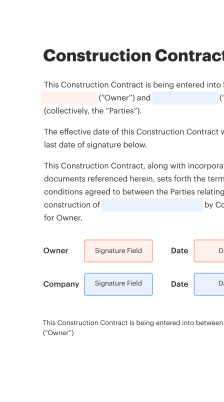
Standardized templates reduce errors by enforcing consistent fields and validation, speed approvals by pre-formatting calculations and payment triggers, and create a reliable audit trail for financial and quality reviews.

A QA Manager configures acceptance criteria and reviews inspection rows in the Excel template, annotating failures and approving shipments. They coordinate with procurement to set payment hold thresholds and provide rationale for releases, ensuring entries are complete before signatures are captured.
A Finance Analyst reconciles calculated payment amounts from the template against invoices and purchase orders, verifies signer identity, and logs approvals into the accounting system. They maintain retention records and prepare documentation for internal or external audits.
Quality, procurement, and finance teams frequently collaborate using payment templates to tie quality outcomes to payments and approvals.
Cross-functional access controls and clear role responsibilities help ensure the template is used correctly and reduces payment exceptions.
Robust validation rules detect out-of-range values and inconsistent entries before submission, reducing exceptions and downstream reconciliation work.
Track template revisions and maintain a history of approved formats so each payment references the correct acceptance criteria version for that contract.
Distribute the same template to multiple recipients in one operation to collect signatures and approvals from distributed sites efficiently.
Support multi-factor and identity verification options to improve signer trust and satisfy higher compliance requirements for payments.
Link template outputs to payment processors or AR/AP systems so authorized disbursements execute with recorded approvals and metadata.
Pre-built reports summarize pass rates, hold amounts, and aging payments to support finance forecasting and supplier performance reviews.
Custom named fields in the spreadsheet allow mapping inspection results directly to agreement clauses and payment triggers, ensuring consistent data flow into signing and accounting tools.
Direct import and mapping preserve formulas and validation rules, which reduces rework when converting spreadsheets into signed documents or when ingesting supplier-submitted Excel files.
Built-in formulas compute totals, hold amounts, and conditional payments so reviewers see clear payable amounts and finance teams receive reconciled figures for processing.
Conditional visibility and locking enforce which cells require input based on prior inspection results, reducing accidental edits and guiding users through required steps.
| Workflow Setting Name and Description | Default configuration values for this template |
|---|---|
| Reminder Frequency in Days Setting | 48 hours initial, then 72 hours follow-up |
| Auto-close Unsigned Transactions Setting | 30 days after initial send |
| Payment Field Validation and Tolerance Setting | Two decimal places, 0.5% tolerance |
| Excel Import Field Mapping Setting | Column-based mapping by SKU and lot |
| Audit Trail Retention Period Setting | Retain logs for seven years |
Ensure users have access to common desktop or mobile platforms and a supported browser to import and sign Excel-based templates.
For integrations with finance or document repositories, confirm API credentials and account permissions ahead of deployment to avoid delays when automating template ingestion and processing.
A plant uses an Excel template to capture first-article inspection metrics and acceptance flags for each lot, standardizing entries across lines
Leading to cleared payments only after validated quality, reducing rework costs and supplier disputes.
A buyer requires incoming component test results recorded in a template with serial-level traceability and binary pass/fail markers
Resulting in precise payment adjustments and a documented audit trail for warranty or recall scenarios.
| Criteria for eSignature Feature Comparison Table | signNow | DocuSign |
|---|---|---|
| Legally binding in U.S. | ||
| API access for automation | ||
| Bulk Send capability | ||
| HIPAA compliance options | Available | Available |
Seven years for financial and audit records
One year for most commercial disputes
Annual review of acceptance criteria and formulas
Verify signer identity at time of signing
Daily backup of signed records and logs
| Vendor Pricing and Features | Free tier | Starting price/mo | API access | Bulk send | Enterprise support |
|---|---|---|---|---|---|
| signNow (Recommended) Vendor | Free plan available | $8 per user | Included | Included | Standard SLA |
| DocuSign eSignature | Limited free trial | $10 per user | Available paid tier | Add-on available | Enterprise SLA options |
| Adobe Document Cloud | No free tier | $11.99 per user | API via paid plan | Available | Enterprise agreements |
| Dropbox Sign | Free trial only | $15 per user | API included | Basic bulk send | Business support |
| PandaDoc Platform | Free limited plan | $19 per user | API in higher plans | Included in advanced tiers | Priority support options |