Progress Billing Template for Retail Trade

Efficiently manage your billing process with our user-friendly solution. Enhance your workflow and drive profitability with seamless eSigning and document management.

Award-winning eSignature solution

What a progress billing template for retail trade is and why it matters

A progress billing template for retail trade structures invoices to request partial payments tied to milestones, shipments, or stages of a goods order. It standardizes line items, percentages, payment schedules, and retention amounts so retailers and suppliers reconcile deliveries and cash flow. In-store chains, wholesalers, and specialty retailers use these templates to reduce disputes, speed collections, and attach supporting documents such as delivery receipts, inspection reports, and signed acceptance forms to each billing event.

Why use a standardized progress billing template in retail

A consistent template reduces invoice errors, clarifies expectations for partial payments, and shortens reconciliation cycles, benefiting both buyers and sellers in retail supply chains.

Why use a standardized progress billing template in retail

Common challenges addressed by a progress billing template

  • Inconsistent milestone definitions lead to payment disputes and delayed receivables without clear progress metrics.
  • Manual calculations of retainage and staged percentages increase billing errors and reconciliation time.
  • Tracking supporting documents across email threads creates audit gaps and slows approval workflows.
  • Lack of role-based review causes duplicate invoices or missed approvals in complex vendor relationships.

Representative user profiles for progress billing in retail

Store Manager

Responsible for receiving shipments and confirming milestone acceptance, the store manager documents delivery condition and signs off on staged acceptance reports so that partial invoices can be issued and inventory is recorded correctly.

Accounts Receivable

Manages invoice creation and payment tracking using the progress billing template, matches shipments to milestones, follows up on partial payments, and maintains records for audits and reconciliation.

Typical teams and roles that use progress billing templates

Retail finance teams, procurement, and store operations rely on progress billing templates to coordinate staged payments and inventory acceptance.

  • Procurement managers who approve staged deliveries and enforce contract terms.
  • Accounts receivable staff who generate invoices and track partial payments.
  • Store operations teams who verify deliveries and confirm acceptance milestones.

Cross-functional coordination between these roles reduces disputes and maintains predictable cash flow across retail supply chains.

Core features to include in an effective progress billing template

An effective template combines clear milestone definitions, automated calculations, and integrated document controls to streamline staged billing in retail scenarios.

Milestone fields

Predefined sections for shipment, inspection, and acceptance with date and signer capture to align payments to verifiable events.


Automatic math

Automated retainage and percentage calculations reduce human error and ensure consistent partial payment amounts across invoices.

Attachment handling

Structured attachment slots for packing lists, delivery receipts, and inspection certificates keep supporting evidence linked to each billing stage.

Approval routing

Configurable multi-step approval flows with role assignments help enforce internal controls before invoices are released.

Version control

Track template changes and maintain historical versions for audits and contract compliance requirements.

Audit trail

Comprehensive event logging captures who viewed, edited, approved, and signed each billing document for traceability.

be ready to get more

Choose a better solution

Integrations and connectivity that support progress billing templates

Connect templates to common retail systems to reduce manual entry, ensure data consistency, and accelerate invoice generation and payment.

ERP and POS

Two-way integration with ERP and point-of-sale systems syncs order data, updates inventory, and auto-populates milestone and pricing information for staged invoices.

CRM linkage

Link customer and vendor records so billing templates reflect contractual terms, negotiated discounts, and contact approvals automatically, reducing reconciliation work.

Cloud storage

Automatic archival to providers like Google Drive and Dropbox centralizes documents and supports retention policies while enabling quick retrieval during audits.

Accounting tools

Integration with accounting platforms exports staged invoice lines and payment receipts to ledger entries, simplifying month-end close and reporting.
How to create and use the template online and in-app

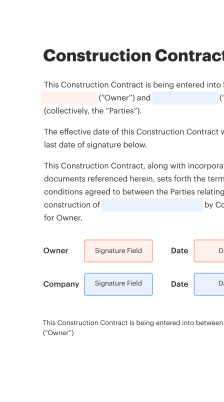
A digital progress billing template standardizes fields, automates calculations, and attaches required proofs to each staged invoice for consistent processing.

  • Create template: Use a standardized document with variable fields
  • Populate order: Import PO and schedule data into template
  • Route for approval: Send to approvers with role-based routing
  • Issue staged invoice: Generate partial invoice and include attachments
Collect signatures
24x
faster
Reduce costs by
$30
per document
Save up to
40h
per employee / month

Quick setup steps for a progress billing template in retail

Follow these concise steps to create a practical progress billing template for retail orders and staged deliveries.

  • 01
    Define milestones: List shipment, inspection, and acceptance events
  • 02
    Set percentages: Assign payment percentages to each milestone
  • 03
    Attach requirements: Specify required supporting documents and approvals
  • 04
    Automate approvals: Configure reviewer roles and routing

Audit trail and recordkeeping steps for staged invoices

Maintain a complete, searchable audit trail that links milestone evidence, approvals, and payment events to each progress billing instance.

01

Capture events:

Log views and edits
02

Record approvals:

Time-stamped signatures
03

Attach evidence:

Upload receipts and photos
04

Export logs:

CSV or PDF
05

Retention setting:

Set retention policy
06

Access review:

Regular permission audits
be ready to get more

Why choose airSlate SignNow

  • Free 7-day trial. Choose the plan you need and try it risk-free.
  • Honest pricing for full-featured plans. airSlate SignNow offers subscription plans with no overages or hidden fees at renewal.
  • Enterprise-grade security. airSlate SignNow helps you comply with global security standards.
illustrations signature

Recommended workflow settings for progress billing automation

Configure these workflow settings to automate reminders, approvals, and document attachments for staged invoices in retail operations.

Setting Name Configuration
Reminder Frequency 48 hours
Approval Timeout 72 hours
Required Attachments Delivery receipt
Notification Recipients Procurement team
Auto-generate Invoice On milestone completion

Device and browser guidance for using progress billing templates

Most template creation and signing tasks work in modern desktop and mobile browsers or dedicated mobile apps for convenience.

  • Desktop browsers: Chrome, Edge, Safari
  • Mobile OS: iOS and Android
  • Minimum requirements: Recent OS versions

For offline or low-bandwidth environments, mobile apps frequently cache documents and allow signing once connectivity resumes; verify that attachments like photos of deliveries are synced before finalizing staged invoices.

Security controls to protect progress billing documents

Data encryption: At rest and in transit
Access controls: Role-based permissions
Authentication: Multi-factor options
Audit logging: Full event trail
Document watermarking: Optional visibility control
Retention policies: Configurable schedules

How retail organizations apply progress billing templates

Two representative examples show typical retail scenarios where staged invoicing improves cash flow, clarity, and auditability.

Large Apparel Chain

A national apparel retailer implemented a progress billing template for seasonal bulk orders to capture shipments by distribution center

  • Template included percentage milestones and inspection checklists
  • Finance shortened reconciliations and reduced disputes during peak season

Resulting in improved vendor relationships and a measurable reduction in outstanding partial invoices by quarter end.

Specialty Electronics Distributor

A specialty electronics distributor used a progress billing template for high-value preorders with staged assembly milestones

  • Template attached assembly certificates and test reports to each invoice
  • The company improved visibility on parts usage and matched payments to verification steps

Resulting in clearer compliance records and faster turnaround on supplier payment approvals.

FAQs about progress billing templates for retail trade

Answers to common questions about creating, sending, and auditing progress billing templates in retail workflows.

Feature comparison for eSignature providers and progress billing support

A concise feature matrix comparing core compliance and security attributes relevant to progress billing templates in the United States.

Feature / Vendor signNow (Featured) DocuSign Adobe Sign
ESIGN & UETA Compliance
HIPAA BAA Available
API Availability REST API REST API REST API
Two-Factor Authentication
be ready to get more

Get legally-binding signatures now!

Risks of improper progress billing handling

Payment delays: Lost cash
Contract disputes: Legal exposure
Audit failures: Noncompliance
Data breaches: Regulatory fines
Inventory errors: Operational loss
Reputational harm: Customer distrust

Pricing and support comparison across providers

High-level pricing and support characteristics that affect total cost of ownership for progress billing template workflows.

Plan / Vendor signNow (Featured) DocuSign Adobe Sign HelloSign PandaDoc
Entry-Level Cost Affordable per-user plans with discounts for annual billing Consumer and small business tiers commonly start around ten dollars monthly Often bundled with Adobe Creative Cloud subscriptions Low-cost developer plans and pay-as-you-go options Tiered pricing focused on sales teams and templates
Billing Model and Terms Monthly and annual subscriptions with volume discounts Per-user subscriptions and enterprise contracts Per-user licensing or enterprise agreements Developer API pricing and per-user plans Subscription tiers with per-user and per-document limits
Enterprise Options and SLAs Enterprise packages include single sign-on and SLAs Advanced enterprise plans with global compliance features Enterprise licensing with advanced admin controls Enterprise plans available with SSO and support Enterprise onboarding and SLA options
Bulk Sending Availability Bulk send and mass-invite options with configurable limits Bulk send features and high-volume plans Bulk send available via admin tools Bulk send supported in team plans Bulk distribution and bulk send options
HIPAA / BAA Support BAA available for covered entities and workflows BAAs offered for qualifying customers BAAs available through enterprise agreements BAAs provided on request for eligible plans HIPAA support via enterprise arrangements
walmart logo
exonMobil logo
apple logo
comcast logo
facebook logo
FedEx logo
be ready to get more

Get legally-binding signatures now!