Template Management
Centralized template libraries with version control let administrators lock required content, prefill institutional data, and streamline consistent submissions across departments while minimizing manual formatting tasks.
Using proposal building software for education reduces administrative overhead, shortens approval cycles, and improves accuracy by reusing templates and automating repetitive tasks, which supports faster decision making and consistent documentation.

Manages proposal templates and tracks submission deadlines across departments, coordinates internal approvals from finance and compliance, and ensures required attachments and signatures are collected prior to external submission.
Oversees vendor proposal intake and contract approvals, sets standard terms templates, routes documents to legal and budget owners, and maintains an auditable record of approvals for institutional review.
Educational administrators, grant managers, procurement staff, and faculty engaged in sponsored projects commonly use proposal building tools to coordinate submissions and approvals.
These users benefit from template controls, role-based routing, and audit trails that make review cycles more transparent and auditable.
Centralized template libraries with version control let administrators lock required content, prefill institutional data, and streamline consistent submissions across departments while minimizing manual formatting tasks.
Configurable approval chains and conditional routing ensure proposals follow institutional review policies, route only to required approvers, and allow parallel or sequential sign-offs as needed.
Immutable logs capture timestamps, actor identities, and document actions to support compliance reviews, external audits, and dispute resolution with clear provenance for signed records.
Out-of-the-box or API integrations with SIS, CRM, cloud storage, and accounting systems reduce duplicate entry and keep proposal metadata synchronized across institutional systems.
Enterprise-grade encryption, access controls, and compliance frameworks (ESIGN, UETA) protect sensitive proposal content and help institutions meet FERPA and HIPAA obligations.
Native mobile functionality supports draft review and signing on the go while preserving authentication controls and audit logging for remote approvals.
Two-way integration allows exporting final proposals to Google Docs for collaborative drafting and then reimporting signed PDFs to centralized storage for records retention and sharing.
Connect to CRM platforms to populate organization and contact data into proposal templates, preserving institutional relationships and reducing duplicate entry during vendor or partner proposal creation.
Integrations with common cloud drives let teams save signed documents automatically to institutional folders, enforce retention policies, and back up records per institutional backup schedules.
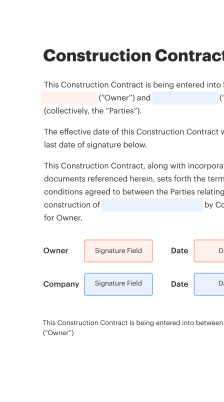
A managed template library ensures proposal consistency by locking required clauses, attachments, and approval rules while enabling local fields for project-specific details.
| Setting Name | Default Configuration Value |
|---|---|
| Reminder Frequency and Retry Policy | Send reminders every 48 hours up to three times |
| Signer Authentication Requirement | Email link by default; optional MFA for sensitive documents |
| Role-based Routing Order | Sequential approvals: author, budget, legal, final signatory |
| Template Auto-population Rules | Prefill school and project fields from SIS or CRM |
| Archive and Retention Period | Retain signed copies for seven years by default |
Modern proposal building platforms typically support current desktop browsers and native mobile apps to allow drafting and signing on common devices.
For reliable operation, keep browsers and mobile apps up to date, ensure network security for institutional Wi-Fi, and confirm integration credentials for connected systems such as Google Workspace or cloud storage providers.
A district teacher prepares a curriculum grant application using shared templates and prefilled school data
Resulting in faster submission windows and clearer provenance for auditors and funders.
A procurement officer assembles a vendor proposal using library clauses and approval tiers
Leading to consistent contract terms and an auditable chain of custody for compliance.
| Feature or Compliance Criteria for Platforms | signNow (Featured) | DocuSign | Adobe Acrobat Sign |
|---|---|---|---|
| ESIGN and UETA compliance | |||
| HIPAA support and BAAs | |||
| Bulk Send capability | Bulk Send available | Bulk Send available | Bulk Send available |
| API access for integrations | Full REST API | Full REST API | Full REST API |
| Plan and Feature Comparison Table | signNow (Featured) | DocuSign | Adobe Acrobat Sign | PandaDoc | HelloSign |
|---|---|---|---|---|---|
| Entry-level plan availability | Paid monthly plans; free trial available | Subscription tiers with free trial | Part of Adobe subscriptions; trial available | Free tier with limited documents | Free tier with limited features |
| API inclusion at plan level | API accessible on developer and higher plans | API available on elevated plans | API available with Acrobat Sign enterprise | API available on business plans | API available on business plans |
| Education or nonprofit discounts | Education pricing available on request | Discounts available for qualified institutions | Volume discounts and enterprise agreements | Institutional discounts possible | Nonprofit program available |
| eSignature types supported | Basic and advanced electronic signatures; audit trail | Basic and advanced signatures; eWitness options | Basic and advanced signatures; Adobe Sign workflows | Electronic signatures with templates | Electronic signature and simple workflows |
| Enterprise features and support | Scaled security, SSO, and dedicated support options | Enterprise-grade admin controls and support | Enterprise contracts and support | Enterprise onboarding and support | Enterprise onboarding available |