Proposal Making Software for Pharmaceutical

Experience effortless eSigning and document management with airSlate SignNow. Transform your proposal processes into a cost-effective solution that empowers your business.

Award-winning eSignature solution

What proposal making software for pharmaceutical means in practice

Proposal making software for pharmaceutical refers to specialized tools that streamline drafting, reviewing, approving, and tracking commercial and clinical proposals within life sciences organizations. These platforms combine document templates, clause libraries, version control, secure electronic signatures, and workflow automation to reduce manual tasks and preserve audit trails. Integration with CRMs, clinical project systems, and cloud storage helps keep pricing, regulatory language, and confidentiality terms consistent. In regulated U.S. environments, the software also supports role-based access, encryption, and tamper-evident records to meet compliance and record-retention obligations.

Why pharmaceutical teams adopt proposal making software

Using proposal making software for pharmaceutical reduces drafting time, enforces standardized regulatory language, and preserves secure audit trails so approvals and contractual commitments remain traceable and defensible.

Why pharmaceutical teams adopt proposal making software

Common challenges addressed by pharmaceutical proposal platforms

  • Inconsistent clause usage across departments leading to regulatory exposure and negotiation delays.
  • Manual approval handoffs that create bottlenecks and increase turnaround times for study or commercial proposals.
  • Difficulty maintaining secure, provable signature records aligned with HIPAA and ESIGN requirements.
  • Version proliferation and lack of centralized templates causing errors in pricing or confidentiality terms.

Representative user roles

Clinical Operations Manager

Responsible for coordinating study site contracts and proposals, the Clinical Operations Manager uses templates, approval routing, and audit trails to ensure each proposal contains required regulatory language and sponsor obligations. They rely on integrations with clinical trial management systems to populate study identifiers and timelines automatically.

Commercial Contracts Lead

Overseeing commercial and supply agreements, this role standardizes pricing, NDAs, and service-level terms across proposals. The Contracts Lead configures role permissions, maintains the clause library, and reviews signature logs to ensure proposals comply with internal policies and external regulations.

Typical users and teams who rely on these tools

Pharmaceutical commercial, clinical operations, legal, and procurement teams commonly use proposal making software to coordinate cross-functional approvals and preserve compliance.

  • Commercial teams preparing customer-facing study or supply proposals with standardized pricing.
  • Clinical operations teams coordinating sponsor, site, and vendor approvals for study contracts.
  • Legal and compliance teams enforcing required clauses and maintaining defensible audit logs.

Smaller biotech firms and large pharmaceutical enterprises use the same core features but configure templates, roles, and retention policies to match organizational risk and scale.

Key features to evaluate for pharmaceutical proposals

Look for features that combine security, compliance, automation, integration, and usability to support regulated proposal workflows across commercial and clinical functions.

Template Library

Centralized, versioned templates and clause libraries let legal and compliance teams maintain approved language, reduce drafting errors, and accelerate proposal creation while ensuring consistent regulatory phrases.


Workflow Automation

Configurable approval chains, conditional routing, and automated reminders minimize manual handoffs and shorten review cycles for study budgets and commercial contracts.

eSignature Support

Secure electronic signature capture with ESIGN/UETA-compliant records, time stamps, and signer authentication to ensure legal validity in the United States.

Audit Trail

Immutable logs of actions, timestamps, and signer authentication that support internal audits and regulatory inspections with clear chain-of-custody for documents.

System Integrations

Pre-built connectors and APIs for CRMs, clinical systems, and cloud storage to reduce manual data entry and ensure proposals reference accurate study and pricing data.

Security Controls

Role-based access, encryption, MFA, and tamper-evident records help protect PHI and commercial confidentiality while supporting HIPAA-conscious handling of sensitive materials.

be ready to get more

Choose a better solution

Important integrations and template capabilities

Integration and templating reduce repetitive work and keep proposal language synchronized with source systems and documents.

Google Docs Integration

Two-way synchronization with Google Docs enables drafting in familiar editors while preserving template control and allowing final proposal versions to be pulled back into the system for signing and archival.

CRM Connectivity

Bi-directional CRM connectors ensure customer, account, and opportunity data populate proposals automatically and that signed agreements update pipeline status for accurate forecasting.

Dropbox and Cloud Storage

Direct connections to cloud storage repositories let teams attach supporting files, maintain single-source documentation, and enforce retention policies consistently across proposal records.

Custom Template Builder

A configurable template builder with conditional fields and clause libraries reduces drafting errors, enforces regulatory language, and accelerates proposal authoring across teams.
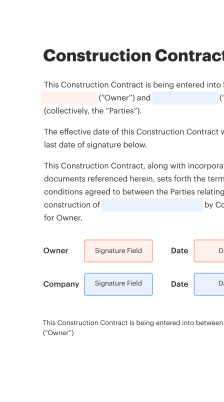
How proposals are created and completed online

A typical online proposal lifecycle uses templates, automated fields, review routing, and secure signature collection to finalize agreements.

  • Template selection: Choose a pre-approved template to start
  • Populate data: Auto-fill client and study data from systems
  • Review and approve: Route to stakeholders based on role
  • Sign and archive: Collect signatures and store with audit trail
Collect signatures
24x
faster
Reduce costs by
$30
per document
Save up to
40h
per employee / month

Quick setup: getting started with proposal software

Follow these initial steps to configure a proposal making software for pharmaceutical and begin using templates and workflows.

  • 01
    Create templates: Build standardized proposal and contract templates
  • 02
    Define roles: Set approver and editor permissions
  • 03
    Set workflows: Configure approval routing and reminders
  • 04
    Integrate systems: Connect CRM and document repositories

How to manage audit trails and document records

Maintain complete records and a clear chain of custody for every proposal to satisfy audits and legal reviews.

01

Capture signer metadata:

Record timestamp and IP
02

Store document hash:

Preserve tamper evidence
03

Log approvals:

Track reviewer identities
04

Archive signed copies:

Save PDF and metadata
05

Enable export:

Provide legal-ready bundles
06

Retention enforcement:

Automate deletion/retention
be ready to get more

Why choose airSlate SignNow

  • Free 7-day trial. Choose the plan you need and try it risk-free.
  • Honest pricing for full-featured plans. airSlate SignNow offers subscription plans with no overages or hidden fees at renewal.
  • Enterprise-grade security. airSlate SignNow helps you comply with global security standards.
illustrations signature

Recommended workflow and automation settings

Suggested default workflow settings help pharmaceutical teams balance speed and control while preserving auditability.

Setting Name Configuration
Approval Sequence Sequential or parallel
Reminder Frequency 48 hours
Escalation Rules After 7 days
Signature Order Defined per document
Retention Policy 7 years

Supported platforms and device considerations

Most modern proposal making software for pharmaceutical supports web browsers and native mobile apps, with responsive document viewers and signing experiences for tablets and phones.

  • Web browsers: Chrome, Edge, Firefox
  • Mobile apps: iOS and Android
  • Desktop support: Windows and macOS

Ensure that signers can authenticate and complete signatures on their preferred device; test document rendering, field placement, and multi-factor authentication flows on representative devices before broad rollout.

Core security and protection capabilities

Encryption at rest: AES-256 encryption
Encryption in transit: TLS 1.2+ encryption
Access control: Role-based permissions
Tamper evidence: Document hashing
Authentication: Multi-factor options
Audit logging: Immutable activity records

Real-world pharmaceutical use cases

Use cases show how proposal making software reduces risk and cycle time across commercial and clinical processes.

Clinical site budget proposal

A mid-size sponsor automated site budget creation using standardized templates and pre-approved cost items

  • Template-driven population of study ID, milestones, and site costs
  • Faster review cycles and consistent regulatory phrasing across sites

Resulting in reduced negotiation time and clearer audit trails for inspection readiness

Commercial supply agreement

A pharmaceutical supplier consolidated sales proposals into a single template governed by an internal clause library

  • Automated pricing calculations and approval routing for discounts
  • Enforced confidentiality and indemnity language to meet corporate policy

Leading to fewer redlines during negotiation and auditable sign-off records for compliance teams

Best practices for secure and compliant proposals

Adopt consistent processes and controls to ensure proposals are accurate, auditable, and compliant with U.S. legal and regulatory expectations.

Standardize templates and clauses
Maintain a controlled clause library and versioned templates reviewed by legal and compliance to reduce negotiation time and ensure regulatory language is consistent across proposals and contracts.
Enforce role-based approvals
Configure approval chains that require legal review for high-value or high-risk proposals, ensuring segregation of duties and clear accountability for contract terms and signature authority.
Use appropriate signer authentication
Align authentication strength with document sensitivity; implement multi-factor authentication for external signers on PHI-containing or high-value agreements, and log authentication events comprehensively.
Retain auditable records
Apply retention policies that satisfy corporate and regulatory requirements, archive signed documents and metadata securely, and ensure easy retrieval for audits or dispute resolution.

Common issues and frequently asked questions

Answers to typical questions about deployment, signatures, compliance, and integrations when using proposal making software for pharmaceutical.

Feature-level comparison for common signing requirements

A concise comparison helps evaluate availability and depth of capabilities across leading electronic signature providers for pharmaceutical proposals.

Feature and vendor capability comparison signNow (Recommended) DocuSign
HIPAA support and attestation
Audit trail completeness Full, immutable Full, immutable
Bulk Send capability
API and developer tooling REST API, SDKs REST API, SDKs
be ready to get more

Get legally-binding signatures now!

Regulatory and business risks mitigated

Noncompliance fines: Regulatory penalties
Contract disputes: Litigation exposure
Data breaches: Confidentiality loss
Operational delays: Revenue impact
Audit failures: Record-keeping issues
Reputation harm: Public trust loss

Pricing and plan comparison across providers

Compare typical entry-level pricing, trial availability, and enterprise support across signature providers to assess cost and alignment with procurement needs.

Pricing and plan comparison signNow (Recommended) DocuSign Adobe Sign OneSpan HelloSign
Starting price (monthly) $8/user/month (annual) $10/user/month (annual) $29.99/user/month Approx. $25+/user/month $15/user/month
Free trial availability Yes, 7-14 days Yes, 30 days Yes, 30 days Typically case-by-case Yes, 30 days
Enterprise features included Role controls, API, audit logs Advanced workflows, API Enterprise admin, SSO Strong security, enterprise controls Team management, API
HIPAA-ready offerings Available with BAAs Available with BAAs Offered on select plans Offered with contractual terms Available with restrictions
Support and onboarding Email and priority support tiers Phone and enterprise support Enterprise success plans Dedicated enterprise teams Email and priority support
walmart logo
exonMobil logo
apple logo
comcast logo
facebook logo
FedEx logo
be ready to get more

Get legally-binding signatures now!