



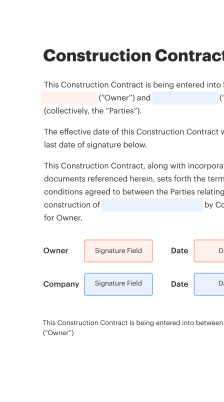
Notary Invoice Template for Organizations
What a notary invoice template for organizations is and why it matters
Why organizations adopt a notary invoice template
Standardized templates reduce billing errors, accelerate payment cycles, and create consistent records for compliance and audits across departments and branches.
Common challenges when implementing notary invoices
- Inconsistent fee entries across notaries leading to reconciliation delays and accounting discrepancies.
- Missing client or notary identification details that complicate audits and legal verification of services.
- Manual data entry increases the risk of human error and duplicate invoices for the same notarial act.
- Secure transmission and storage concerns when invoices contain sensitive personal or educational records.
Typical user profiles for template management
Office Manager
An office manager configures organization-wide templates, assigns tax and fee codes, and enforces approval workflows. They reconcile invoices with accounting records, manage billing schedules, and provide templates to decentralized teams while ensuring consistency across locations.
In-house Notary
An in-house notary populates the invoice with client details, service descriptions, and notary attestations. They ensure required identification and commission details are recorded, then route the invoice for approval and secure signature before submission to finance.
Organizations and roles that use notary invoice templates
Corporate legal, HR, and facilities teams commonly issue standardized notary invoices to centralize expense tracking and ensure consistent fee application across locations.
- Legal departments tracking notarizations for contracts, affidavits, and client matters.
- Real estate and title firms billing clients for document notarizations and travel fees.
- Universities and healthcare admins documenting notarized student or patient records for compliance.
Public institutions, title companies, and universities use templates to align billing with regulatory requirements and to preserve audit trails for compliance and reporting.
Choose a better solution
Integrations and features that streamline notary invoice workflows
Google Docs
Save your template as a Google Docs document to allow collaborative editing, version tracking, and easy conversion to PDF for signature collection while preserving organization metadata and revision history for audit purposes.
CRM integration
Link invoice templates to customer records in your CRM so contact data populates automatically, invoice history attaches to client profiles, and billing syncs with account and opportunity records for accurate client billing.
Cloud storage
Store executed invoices in centralized cloud repositories such as Dropbox or enterprise file systems, applying retention labels and access controls to meet corporate record-keeping policies and facilitate retrieval.
Accounting export
Export invoice data to accounting systems or spreadsheets in standard formats, enabling automated posting, reconciliation, and financial reporting without manual rekeying.
Creating and sending an invoice from a notary template
-
Generate: Select organization template and open a new invoice.
-
Populate: Enter client and service details, apply fee codes.
-
Sign: Collect notary and client signatures with authentication.
-
Route: Send finalized invoice to accounting or client email.
Step-by-step: preparing a notary invoice template for organizational use
-
01Define fields: List client, service, fee, date, and notary fields.
-
02Set rules: Enforce mandatory fields and fee schedules.
-
03Add controls: Include approval and access controls.
-
04Deploy template: Publish to teams and integrate with finance.
Why choose airSlate SignNow
-
Free 7-day trial. Choose the plan you need and try it risk-free.
-
Honest pricing for full-featured plans. airSlate SignNow offers subscription plans with no overages or hidden fees at renewal.
-
Enterprise-grade security. airSlate SignNow helps you comply with global security standards.
Common workflow settings when automating notary invoices
| Setting Name | Configuration |
|---|---|
| Reminder Frequency | 48 hours |
| Approval Chain | Two-step |
| Default Payment Terms | Net 30 |
| Invoice Numbering Pattern | ORG-YYYY-SEQ |
| Retention Tagging | 7 years |
Device and platform considerations for mobile and desktop use
Notary invoice templates should be accessible from modern desktop browsers and native mobile apps to accommodate field notaries and office staff.
- Desktop browsers: Chrome, Edge supported
- Mobile platforms: iOS and Android apps
- File formats: PDF recommended
Ensure your organization validates browser compatibility, mobile app versions, and PDF rendering for signatures and notary stamps; test workflows on representative devices before wide deployment to avoid processing delays.
How organizations use notary invoice templates in practice
Title Company Billing
A regional title company standardized invoices across 12 offices to include service code, travel, and expedited processing fees
- Template fields included commission ID and client escrow reference
- The billing team reduced disputes and reconciliation time
Resulting in faster closings and clearer audit evidence for lenders.
University Records Office
A university records office created a notary invoice template for notarized transcripts and enrollment verifications
- The template captured student ID, request purpose, and fee waiver fields
- Central finance matched invoices to purchase orders automatically
Leading to improved record retention and simplified FERPA-compliant reconciliation processes for auditors.
Best practices for secure and accurate notary invoices
FAQs About notary invoice template for organizations
- How do I ensure an electronic invoice is legally valid?
To support legal validity in the United States, ensure the electronic signature process complies with ESIGN and UETA where applicable, preserve an unalterable audit trail that records signer identity and timestamp, and include the notary’s commission details and any statutorily required language or seals.
- Can templates include personal or student information securely?
Yes—templates may contain sensitive data but should be handled under appropriate privacy controls. Use role-based access, encryption in transit and at rest, and institutional agreements such as BAAs for HIPAA or FERPA-sensitive records to limit exposure and meet compliance obligations.
- What if a signer cannot complete identity verification?
If identity verification fails, follow your organization’s escalation policy. You may require in-person notarization, additional ID documents, or a verified third-party identity service. Do not accept a signature without meeting your mandated identity criteria to avoid invalidation risk.
- How are invoice disputes best handled?
Establish a documented dispute process that includes dispute reason codes, supporting evidence submission, and defined timelines. Use versioned templates and audit logs to demonstrate the original invoiced amounts, notarial attestations, and any approvals or adjustments made during resolution.
- What are common template configuration errors to avoid?
Avoid mismatched fee codes, optional fields left unvalidated, and unclear approval chains. Missing notary commission numbers, ambiguous payment terms, or inconsistent client identifiers lead to processing delays and audit findings if not corrected at template level.
- How do I integrate invoice data with accounting systems?
Use structured data export options such as CSV, JSON, or direct API integrations to send invoice line items and metadata to your accounting system. Map template fields consistently to chart of accounts and automate posting to reduce manual reconciliation and posting errors.
Feature and compliance comparison for notary invoice templates
| Feature and Compliance Comparison Criteria | signNow (Recommended) | DocuSign | Adobe Sign |
|---|---|---|---|
| US Legal Validity and Standards | |||
| Remote Online Notarization Support | Limited state support | Partner integrations | Limited state support |
| HIPAA and FERPA Support | Optional Business Associate Agreement | BAA available | BAA available |
| Audit Trail and Tamper-Evident Reports | Comprehensive | Comprehensive | Comprehensive |
Get legally-binding signatures now!
Retention and deadline schedule for notary invoices
Initial invoice submission window:
Submit within 30 days of service
Finance reconciliation deadline:
Reconcile within 60 days
Audit record retention period:
Retain for 7 years minimum
Data export and archival schedule:
Export annually for long-term storage
Secure deletion review:
Review retention before deletion
Compliance risks and penalties to be aware of
Pricing and plan comparison for organizational invoicing needs
| Plan or Tier Detail | signNow (Recommended) | DocuSign | Adobe Sign | HelloSign | PandaDoc |
|---|---|---|---|---|---|
| Entry-level monthly cost per user | $8 per user per month | $10 per user per month | $15 per user per month | $15 per user per month | $19 per user per month |
| Notary and eNotary support availability | Notary features included or add-on | Add-ons/partners required | Add-ons/partners required | Limited integrations | Partner integrations |
| API access and call limits | Available with tiered limits | Available with paid plan | Available with enterprise | Available | Available with limits |
| Document storage and retention | Cloud storage included with admin controls | Storage included, tiered | Storage included, enterprise controls | Storage included | Storage included |
| Enterprise contracts and compliance | Enterprise agreements, SOC reports available | Enterprise agreements available | Enterprise agreements and certifications | Enterprise available | Enterprise options available |
Explore Advanced Features
- Add Conditional Fields to the Document
- Set Validation for Form Fields
- Type on PDF Document Easily with airSlate SignNow
- Write on PDF Document Easily with airSlate SignNow
- Add Text to Your Documents Easily
- Make Content Changes in PDF Editor
- Create PDF with Signature Fields
- Annotate PDF Document Easily and Securely
Discover More eSignature Tools
- Explore popular eSignature features: how to collect ...
- Explore popular eSignature features: how to creat an ...
- Enjoy Flexible eSignature Workflows: how to create a ...
- Try Seamless eSignatures: how to create an electronic ...
- Improve Your Google Experience: how to create a ...
- Explore popular eSignature features: how to create a ...
- Improve Your Google Experience: how to create a ...
- Try Seamless eSignatures: how to create a signature in ...
- Improve Your Google Experience: how to create a ...
- Enjoy Flexible eSignature Workflows: how to create a ...
- Explore popular eSignature features: how to create a ...
- Improve Your Google Experience: how to create an e ...
- Try Seamless eSignatures: how to create an e signature ...
- Explore Online Signature: how to create an electronic ...