Qvidian Demo for Administration

Empower your business to send and eSign documents effortlessly. Discover a cost-effective solution that streamlines your administrative processes.

Award-winning eSignature solution

What a qvidian demo for administration covers

A qvidian demo for administration is a controlled environment where administrators can validate configuration, user roles, templates, integrations, and security settings before wider rollout. The demo helps teams confirm reporting, workflow behaviors, and system performance with representative documents and user scenarios. Administrators typically use the demo to test role-based access, template governance, single sign-on, API connections, and audit logging. The goal is to identify configuration gaps and operational impacts, ensuring production deployments follow organizational standards and compliance obligations.

Why run a qvidian demo for administration

A focused administrative demo verifies governance, integration points, and compliance controls and reduces the risk of downstream rework during production deployment.

Why run a qvidian demo for administration

Common administrative challenges during demos

  • Complex role and permission matrices can produce unexpected access gaps when applied to real templates and users.
  • Integrations with CRM and storage often require staged credentials and mapping adjustments during the demo.
  • Template versioning and content library cleanup are frequently more time-consuming than anticipated.
  • Testing authentication methods like SSO and MFA may reveal certificate or identity provider configuration issues.

Representative user profiles for demo scenarios

Administrator

An Administrator configures system-wide settings, manages user provisioning, and enforces security policies. In the demo they test SSO, MFA, API keys, and template permissions to confirm expected behavior across roles and departments.

Power User

A Power User manages the template library, creates common response content, and runs reports. During the demo they validate content reuse, template locking, merge fields, and workflow triggers to assess efficiency gains.

Teams and roles that benefit from an administrative demo

Administrators, operations teams, and security reviewers use demos to confirm settings and simulate production workflows before launch.

  • System administrators validating permissions and integrations across departments.
  • Security and compliance officers reviewing audit trails and data handling.
  • Business process owners testing templates and approval routing for accuracy.

A short, focused demo reduces surprises and provides evidence for go/no-go decisions prior to production activation.

Administrative tools and features to review

A comprehensive demo should exercise management, reporting, security, and automation features that support enterprise administration and oversight.

Template Library

Centralized repository with version control, template tags, and role-based editing to reduce duplication and maintain consistent language across documents.


Role Management

Fine-grained permissions and group settings that map to organizational hierarchies, enabling least-privilege access for sensitive templates and workflows.

Workflow Automation

Conditional routing, approval steps, and scheduled triggers that automate routine tasks and enforce business rules across document lifecycles.

Audit Reporting

Built-in activity logs and exportable reports that track user actions, signature events, and document changes for compliance reviews.

API and Webhooks

REST APIs and webhook events for integration with external systems, enabling real-time updates and programmatic control of documents and workflows.

Analytics Dashboard

Usage metrics, bottleneck indicators, and template performance insights that help improve turnaround and reduce manual effort.

be ready to get more

Choose a better solution

Integrations and template features to test

During an administrative demo, focus on integration stability and template behavior to confirm end-to-end processing and content governance.

CRM Integration

Verify two-way sync, field mapping, and error handling with Salesforce or Microsoft Dynamics. Confirm that contact updates and opportunity linkages persist across template sends and post-signature updates.

Cloud Storage

Test connections to Google Drive, Dropbox, or SharePoint for document storage and retrieval. Ensure retention, folder mapping, and versioning behave as expected under automated workflows.

eSignature Plug-in

Validate the eSignature provider integration for authentication, field placement, and signature capture. Confirm that completed documents and signed certificates are archived with audit metadata.

Template Controls

Assess template permissions, reusable content blocks, merge fields, and conditional sections to ensure content governance and localization work correctly.
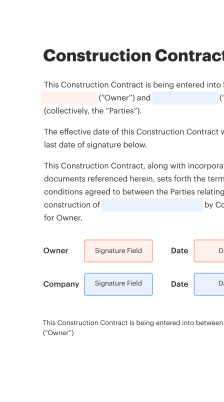
How the qvidian demo for administration operates

A demo environment mirrors production topology with sample data to let administrators exercise workflows, integrations, and security controls without impacting live records.

  • Environment Setup: Provision sandbox with representative data.
  • Role Assignment: Map users to realistic permission sets.
  • Workflow Simulation: Execute end-to-end processes with test documents.
  • Validation: Review logs, outputs, and integration responses.
Collect signatures
24x
faster
Reduce costs by
$30
per document
Save up to
40h
per employee / month

Basic administrative steps to complete the demo

Follow these core steps to set up a representative qvidian demo for administration, focusing on users, templates, integrations, and logging.

  • 01
    Provision Users: Create admin, power user, reviewer accounts.
  • 02
    Import Templates: Load representative templates into the library.
  • 03
    Configure Integrations: Connect CRM, storage, and eSignature systems.
  • 04
    Enable Auditing: Turn on detailed event logging.

Audit trail and signature record checklist

Follow these steps to validate audit trail integrity and signature evidence during the demo, confirming legal admissibility and traceability.

01

Enable Logging:

Turn on detailed event capture.
02

Generate Actions:

Execute signature and document edits.
03

Export Logs:

Export audit records for review.
04

Verify Timestamps:

Confirm consistent timestamp formats.
05

Check Certificates:

Validate signed certificate contents.
06

Retention Policy:

Confirm archival and retrieval rules.
be ready to get more

Why choose airSlate SignNow

  • Free 7-day trial. Choose the plan you need and try it risk-free.
  • Honest pricing for full-featured plans. airSlate SignNow offers subscription plans with no overages or hidden fees at renewal.
  • Enterprise-grade security. airSlate SignNow helps you comply with global security standards.
illustrations signature

Suggested workflow and automation settings for demos

Use these settings as a starting point when configuring automated workflows in a demo environment to mirror typical production behavior.

Feature Configuration
Reminder Frequency 48 hours
Default Expiration 30 days
Signature Order Sequential
Authentication Method Email + MFA
Document Retention 90 days

Device and platform compatibility for admin demos

Ensure the demo environment supports desktop, tablet, and mobile clients to validate cross-platform behavior and responsive templates.

  • Desktop: Windows and macOS supported
  • Mobile: iOS and Android apps
  • Browser Support: Recent Chrome, Edge, Safari

Run scenarios on representative devices and browsers to confirm layout, field rendering, integration callbacks, and authentication flows perform consistently across endpoints.

Key security controls to verify in the demo

Encryption: AES-256 at rest
Transport Security: TLS 1.2+ required
Authentication: SSO and MFA options
Access Controls: Role-based permissions
Audit Logging: Immutable event records
Data Residency: Region-specific storage

Illustrative administrative demo scenarios

Two practical examples show how an administrative demo can validate workflows and compliance controls for specific departments and integrations.

Public Sector RFP Team

A municipal procurement office ran a qvidian demo for administration to test standardized RFP templates and approval routing

  • Template locking with role-based editing
  • Reduced review cycles and fewer version conflicts

Resulting in faster bid submission and clearer audit trails for procurement reviews.

Healthcare Records Group

A hospital compliance team used the demo to validate document access, retention, and eSignature integrations

  • Integration with an eSignature provider under a business associate agreement
  • Ensured signatures and logs met HIPAA requirements

Leading to a documented, auditable process suitable for patient consent workflows.

Best practices for secure and accurate demos

Adopt consistent processes and documentation when running administrative demos to ensure reproducible results and clear handoff to production rollout teams.

Use representative data and cleanup procedures
Populate templates and workflows with anonymized but realistic data, and use scripts or documented steps to restore or purge demo data to maintain a clean environment for repeated testing.
Document configuration and test cases
Keep a central configuration record and test plan describing steps, expected outputs, and acceptance criteria so results can be reproduced and verified prior to production.
Include security and compliance reviewers early
Invite security, privacy, and legal stakeholders to review audit logs, retention settings, and integration contracts during the demo to catch compliance issues early.
Automate repetitive validation where possible
Use scripts, synthetic transactions, and automated checks for integration endpoints, certificate health, and webhook delivery to reduce manual testing time and detect regressions.

FAQs About qvidian demo for administration

Administrators commonly ask about setup, integrations, compliance, and troubleshooting; these FAQs address typical concerns with concise guidance.

Feature comparison for administrative demos

Compare core administrative capabilities across leading eSignature providers to understand what to test in a qvidian demo for administration.

Capability signNow (Recommended) DocuSign Adobe Sign
eSignature Legality Compliant Compliant Compliant
Multi-factor Auth
Advanced Workflows
Electronic Notary Limited
be ready to get more

Get legally-binding signatures now!

Operational risks if demo issues go unresolved

Compliance breaches: Regulatory fines
Data exposure: Customer data loss
Service downtime: Operational disruption
Integration failure: CRM sync loss
Contract disputes: Legal risk
User frustration: Adoption delays

Pricing and plan notes for common eSignature vendors

Pricing varies by feature set, user count, and compliance needs; use these starting points when modeling demo scenarios and expected production costs.

Plan/Feature signNow (Recommended) DocuSign Adobe Sign OneSpan Sign HelloSign
Starting Price From $8/user/mo From $10/user/mo From $15/user/mo Contact sales From $15/user/mo
Free Trial Yes, 7-day Yes, 30-day Yes, 14-day Yes Yes, 30-day
HIPAA Support Available (BAA) Available (BAA) Available (BAA) Available Available (BAA)
API Access REST API REST API REST API REST API REST API
Bulk Send Yes Yes Yes Yes Yes
walmart logo
exonMobil logo
apple logo
comcast logo
facebook logo
FedEx logo
be ready to get more

Get legally-binding signatures now!