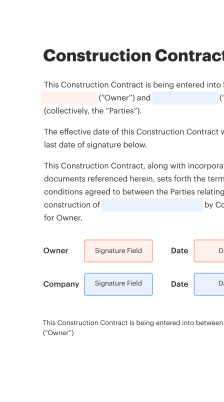
Remittance Slip Example for Secure Transactions

Empower your business to send and eSign documents seamlessly. Experience an easy-to-use, cost-effective solution for all your documentation needs.

Award-winning eSignature solution

What a remittance slip example is and why it matters

A remittance slip example is a sample payment stub used to communicate invoice details, payment amounts, account references, and contact information between a payer and a payee. Businesses attach remittance slips to payments—paper or electronic—so accounts receivable teams can reconcile funds quickly and match deposits to invoices. A clear remittance slip reduces manual research, accelerates cash application, and provides a standardized record for audits and internal controls. Digital remittance slips preserve the same fields while enabling automation, searchable storage, and secure transmission for modern payment workflows.


Why a remittance slip example helps your finance operations

A concise remittance slip example improves accuracy in cash application and shortens reconciliation cycles, lowering manual workload and reducing payment errors.

Why a remittance slip example helps your finance operations

Common challenges without a standardized remittance slip

  • Missing or incomplete payment references make matching receipts to invoices time-consuming and error-prone.
  • Paper slips can be lost or separated from payments, delaying reconciliation and account updates.
  • Inconsistent formats across suppliers require manual rekeying and create reconciliation bottlenecks.
  • Unclear payer information increases exceptions, triggering additional outreach and collection workload.

Typical users and their priorities

Accounts Payable

An accounts payable clerk uses remittance slip examples to ensure payments are posted against the correct vendor invoices. They prioritize concise payer references, invoice numbers, and payment amounts to minimize reconciliation exceptions and reduce manual data entry during month-end close activities.

Treasury Manager

A treasury manager monitors cash application and short-term forecasting; they rely on standardized remittance slips to aggregate receipts, validate deposit sources, and reduce days sales outstanding by improving the speed and accuracy of payment matching.

Organizations that commonly rely on remittance slip examples

Finance, billing, and treasury teams use remittance slip examples to standardize payment information and speed reconciliation.

  • Accounts payable teams reconciling multiple supplier payments each cycle.
  • Accounts receivable teams matching incoming payments to open invoices.
  • Treasury groups aggregating cash and forecasting short-term liquidity.

Standardized remittance slips reduce exceptions and support automated workflows across departments that manage receipts and disbursements.

Essential features for productive remittance slip examples

When implementing remittance slip examples, prioritize features that improve accuracy, automate matching, and integrate with accounting systems for auditable payment histories.

Template Library

A centralized library of remittance slip example templates enforces consistent field placement and required inputs across departments, allowing teams to select region- or customer-specific formats while preserving a common schema for reconciliation.

Data Extraction

Optical character recognition and structured-data capture extract invoice numbers and payment amounts from scanned slips or PDFs, reducing manual data entry and accelerating automated posting to the ledger.

Auto-Reconcile

Rules-driven auto-reconciliation matches remittance IDs, invoice numbers, and amounts against open receivables to clear payments automatically and flag exceptions for human review.

Custom Fields

Custom data fields allow embedding payer codes, project identifiers, and accounting dimensions directly on the remittance slip example for easier downstream posting and reporting.

Multi-User Workflow

Approval routes and role-based tasks let billing and treasury teams collaborate on exceptions, with comments and status changes visible in the remittance record for audit readiness.

Integration APIs

APIs connect remittance slip examples to ERPs, payment gateways, and eSignature platforms such as signNow to attach signed payer confirmations directly to payment transactions and maintain compliant records.

be ready to get more

Choose a better solution

Integrations that support remittance slip examples

Linking remittance slip examples to common business apps streamlines capture, storage, and reconciliation without rekeying information manually.

Google Docs

Use Google Docs templates for collaborative editing of remittance slip examples, then export finalized PDFs for attachment to payments or for ingestion by data extraction tools that feed accounting systems.

CRM Integration

Connecting remittance slip examples to CRM records ensures that payment references and client billing codes propagate to invoices and customer accounts, improving matching and customer service visibility.

Dropbox Storage

Automatic archival of completed remittance slip examples to Dropbox provides a searchable backup repository with version history and shared access controls for finance teams.

Template Management

Centralized template management enforces required fields and formatting for remittance slip examples, simplifying compliance and reducing exceptions across departments and locations.

How an online remittance slip example typically flows

Digital remittance slips move through a small, repeatable sequence that supports automation and auditability.

  • Generate: Create slip from template.
  • Attach: Link to payment instruction.
  • Transmit: Send with electronic payment.
  • Reconcile: Match deposit to invoices.
Collect signatures
24x
faster
Reduce costs by
$30
per document
Save up to
40h
per employee / month

Step-by-step: Filling out a remittance slip example

Follow these basic steps to complete a typical remittance slip example accurately before submitting payment.

  • 01
    Payer details: Enter payer name and contact.
  • 02
    Invoice numbers: List all invoice IDs included.
  • 03
    Payment amount: Indicate total remitted funds.
  • 04
    Reference code: Provide a unique remittance ID.

Grid: From slip creation to closed reconciliation

Use this compact grid to visualize the tasks and controls needed to take a remittance slip example from creation through reconciliation and archival.

01

Create:

Select template and populate fields.
02

Attach:

Link to payment or remittance file.
03

Transmit:

Send with payment instruction.
04

Match:

Auto-match to open invoices.
05

Exception:

Flag and route unresolved items.
06

Archive:

Store final record with audit log.
be ready to get more

Why choose airSlate SignNow

  • Free 7-day trial. Choose the plan you need and try it risk-free.
  • Honest pricing for full-featured plans. airSlate SignNow offers subscription plans with no overages or hidden fees at renewal.
  • Enterprise-grade security. airSlate SignNow helps you comply with global security standards.
illustrations signature

Key workflow settings for automated remittance slip examples

These configuration settings support consistent creation, transmission, and reconciliation of remittance slip examples in automated finance workflows.

Setting Name Configuration
Reminder Frequency 48 hours
Auto-Reconcile Rule Match by ID
Template Assignment Customer-specific
Authentication Method Email OTP
Storage Location Encrypted cloud

Device and browser requirements for using remittance slip examples

Most modern workflows for creating and submitting remittance slip examples support common desktop and mobile environments with standard browser capabilities.

  • Desktop browsers: Chrome, Edge, Safari
  • Mobile platforms: iOS and Android
  • PDF handling: Built-in viewer required

For optimal performance, ensure browsers are up to date, enable secure TLS connections, and use supported PDF viewers or mobile apps when attaching signed remittance slip examples to payments.

Security controls relevant to remittance slip examples

Encryption at rest: AES-256 encryption
Encryption in transit: TLS 1.2+ channels
Access controls: Role-based access
Multi-factor authentication: Second-factor login
Audit logging: Immutable event logs
Data retention: Configurable retention

Real-world remittance slip example scenarios

Two concise examples show how a remittance slip example resolves reconciliation and communication problems.

Utility Company

The company standardized a remittance slip example to include account number and invoice IDs to reduce misapplied payments.

  • It required a fixed layout for all customer payments.
  • The change reduced research time and manual posting.

Resulting in faster reconciliation and fewer billing disputes for customer accounts.

Accounting Firm

A mid-size accounting firm introduced a remittance slip example template for client retainer payments to capture client code and billing period.

  • The template enforced required fields with validation.
  • Staff used the structured data to automate ledger entries.

Leading to fewer coding errors and a more efficient month-end close workflow.

Best practices to make remittance slip examples reliable

Adopt consistent rules and checks so remittance slip examples provide clear, machine-actionable data for reconciliation and audits.

Validate payer and invoice information before submission
Implement front-end validation on remittance slip examples to require invoice numbers and payer account codes; this prevents incomplete submissions and reduces exceptions during automated matching and posting.
Standardize layout across business units
Use a single approved remittance slip example template for all similar transactions to reduce interpretation errors, simplify OCR mapping, and ensure consistency in data extraction and accounting entries.
Include unique remittance identifiers
Assign or require a unique remittance ID on each remittance slip example to enable deterministic matching against payments and to speed resolution of partial payments or short pays.
Retain audit trails for every remittance
Keep an immutable log of creation, edits, approvals, and attachments for each remittance slip example so auditors and finance staff can trace the history of any payment record.

FAQs — Troubleshooting remittance slip example issues

Answers to common questions about creating, submitting, and reconciling remittance slip examples, with practical troubleshooting steps.

be ready to get more

Get legally-binding signatures now!

Risks and potential penalties from poor remittance handling

Late fees: Supplier fines
Misapplied cash: Accounting errors
Regulatory fines: Compliance risk
Reputational harm: Client distrust
Data breaches: Security costs
Operational delays: Processing backlog
walmart logo
exonMobil logo
apple logo
comcast logo
facebook logo
FedEx logo
be ready to get more

Get legally-binding signatures now!