Rename a Document through a Signing Link with SignNow
Rename a document through a signing link using signNow's secure eSignature solution. Ensure compliance and efficiency in your document management process.
What renaming a document through a signing link means
Renaming a document through a signing link refers to the ability for the sender or an authorized signer to change the file name that appears in the signing session, the recipient notification, or the archived record without altering the document content itself. This capability can be applied when generating a public or private signing link, when a recipient accesses the link, or during post-signature processing to ensure internal naming conventions or client-facing file names are correct. In regulated U.S. environments, renaming should be tracked in the audit trail and preserved in retention copies to maintain evidentiary integrity and chain of custody.
Why controlled renaming matters for workflows
Controlled renaming ensures documents are clearly identifiable to recipients and administrators, supports consistent archival naming conventions, and reduces manual file management tasks across signing workflows.
Common challenges when renaming via signing links
Untracked name changes can create evidence gaps in audit logs and complicate compliance reviews.
Allowing unrestricted renaming opens risk of inconsistent records across teams and cloud storage.
Recipients may be confused by mismatched filenames between email notifications and downloaded documents.
Automated systems that rely on filenames for routing may fail if names change unexpectedly.
Typical user roles and activities
Compliance Officer
A compliance officer configures rules and oversight for renaming through signing links, ensuring any name changes are recorded in the audit trail, align with retention policies, and do not obscure document provenance during internal or external reviews.
Sales Administrator
A sales administrator customizes recipient-facing filenames to match client records and CRM attachments, streamlining post-signature processing and preventing manual renaming steps that introduce errors.
Who typically uses rename-through-link features
Legal and compliance teams maintaining evidentiary file names for audit readiness.
Sales and account teams tailoring filenames for clear customer delivery and tracking.
Operations and HR groups standardizing archival names for indexing and retention.
Organizations that require an audit-friendly, repeatable naming approach for electronic agreements benefit most from this feature.
be ready to get more
Choose a better solution
Primary tools that enable safe renaming through links
Key features let administrators balance convenience for recipients with the recordkeeping and security controls required for compliance and operational efficiency.
Configurable link settings
Set whether a signing link allows filename edits, choose who may rename documents, and define whether renamed files are reflected in notifications and archive copies to maintain consistency.
Audit trail capture
Every filename assignment and subsequent change is timestamped and recorded with actor identity and IP data, preserving evidentiary detail for audits and legal review.
Template naming rules
Apply pre-defined naming conventions to templates or link groups so files are automatically named according to standardized patterns that integrate with downstream systems.
Storage mapping
Control how renamed files are stored in cloud drives with folder rules and metadata mapping to prevent duplicate copies or misclassification during automated workflows.
How the rename behavior flows during signing
This overview explains when and where the filename is applied and recorded during a link-based signing session.
Link creation: Sender assigns initial display name
Recipient view: Name appears in the signing UI
Download copy: Downloaded file uses the display name
Audit record: Name changes are captured in logs
Collect signatures
24x
faster
Reduce costs by
$30
per document
Save up to
40h
per employee / month
Basic steps to rename a document via a signing link
Follow these concise steps to set or allow a controlled filename change when creating or using a signing link.
01
Open document: Select the file to be shared
02
Create signing link: Generate a public or private link
03
Set filename: Enter the desired display name
04
Enable tracking: Ensure audit logging is active
Audit trail steps to manage renaming records
Use these steps to ensure every name change is captured and retrievable for compliance or legal requests.
01
Capture event:
Log filename assignment action
02
Record actor:
Store user identity and role
03
Timestamp change:
Include precise time and timezone
04
Store prior name:
Preserve earlier filenames
05
Link to agreement:
Associate with envelope ID
06
Export for review:
Provide audit export option
be ready to get more
Why choose airSlate SignNow
Free 7-day trial. Choose the plan you need and try it risk-free.
Honest pricing for full-featured plans. airSlate SignNow offers subscription plans with no overages or hidden fees at renewal.
Enterprise-grade security. airSlate SignNow helps you comply with global security standards.
Configuring workflow options for renaming via links
Below are typical workflow settings to configure when allowing or enforcing filename behavior for signing links in an enterprise environment.
Workflow Feature and Setting Name
Configuration
Reminder Frequency for Signing Link
48 hours
Filename Override Permission Scope
Admins only
Post-signature Filename Sync Option
Enabled
Retention Filename Versioning
Versioned
Cloud Storage Destination Mapping
Drive folder
Supported platforms and device considerations
Desktop browsers:Chrome, Edge support
Mobile devices:iOS and Android apps
Cloud storage:Popular providers supported
Verify the intended filename behavior on target devices and storage destinations, test downloads in each environment, and document any platform-specific limitations before broad deployment.
Security controls relevant to renaming
Audit logging:Records name changes
Role restrictions:Limits who can rename
Link permissions:Controls access level
File integrity:Checksums verify content
Encryption at rest:Protects stored copies
TLS in transit:Secures data transfer
Industry scenarios showing how renaming is used
Practical examples show how renaming through a signing link improves clarity for recipients and administrators across sectors.
Healthcare patient forms
A clinic issues intake forms via a signing link labeled with the patient ID and visit date to simplify retrieval
The signing link preserves a friendly filename for the patient
Staff can quickly match the signed PDF to the patient record
Leading to faster filing and HIPAA-compliant retention without losing audit detail
University enrollment packets
An admissions office sends enrollment agreements through a public signing link and appends the student name for clarity
Short metadata is used in the filename for easier upload to the student information system
Office staff avoid manual renaming when importing signed files
Resulting in consistent archives and streamlined FERPA-compliant document handling
Best practices for secure and consistent renaming
Implementing renaming controls carefully reduces risk and ensures renamed files remain trustworthy and searchable across systems.
Define a naming convention across teams
Publish a concise naming standard that includes identifiers such as client ID, document type, and date. Ensure users follow the pattern to keep records uniform and searchable in archives and integrated systems.
Restrict renaming to authorized roles
Limit who can rename files through link settings or role permissions. This preserves chain of custody and prevents accidental or malicious changes that could complicate audits or legal discovery.
Record every change in the audit trail
Ensure audit logs capture prior and new filenames, actor identity, timestamps, and IP address. Include this metadata in retention exports so regulatory and legal teams can verify document history.
Integrate naming rules with downstream systems
Map signing link filenames to CRM, document management, and storage metadata fields to avoid duplicate records, enable automated routing, and reduce manual post-signature processing.
The recipient's browser or email client may display a cached or system-generated filename. Verify the signing link was created with the desired display name and confirm the recipient clears cache or downloads the file from the signing completion page where the assigned name is presented.
Yes, once a file is downloaded, local users can rename it on their device. However, local renames are not captured in the platform audit trail; only server-side filename assignments and changes recorded during the signing session are preserved.
Enable audit logging of filename changes, preserve prior names in version metadata, and configure retention exports that include the full audit trail. Maintain role-based controls so only authorized users can change names to prevent noncompliant alterations.
If downstream systems rely on exact filenames for ingestion, implement mapping or metadata-based routing instead of relying on display names. Test integration flows and update mapping rules to translate display names into expected storage keys.
Renaming via a public link is functionally similar to a private link from a security perspective, but public links expose the signing session URL to anyone with the link. Use link permissions and strong authentication controls for sensitive documents, and record all changes in the audit trail.
Some systems apply the stored filename at the time of archive capture rather than the UI display name. Confirm whether the platform applies the final assigned filename to archival copies or stores both display and archived filenames to avoid confusion.
Feature availability: renaming through signing links
A concise comparison of how select eSignature vendors support renaming behavior when documents are distributed via signing links.
High-level plan and pricing characteristics for signNow and commonly used eSignature competitors to help contextualize feature availability.
Pricing and Plan Comparison
signNow (Featured)
DocuSign
Adobe Acrobat Sign
HelloSign
PandaDoc
Free plan availability
Limited free trial available
No permanent free plan
Offers limited free features
Free trial only
Free trial available
Entry-level monthly price
Starts at approximately $8/month
Starts at approximately $10/month
Often bundled with Adobe products
Starts near $15/month
Starts near $19/month
Per-user billing option
Yes, per-user available
Yes, per-user available
Yes, per-user available
Yes, per-user available
Yes, per-user available
Enterprise contract support
Available with tiered features
Robust enterprise offerings
Enterprise licensing available
Enterprise plans available
Enterprise offerings available
Key integrations included
CRM and storage integrations
Extensive enterprise integrations
Adobe ecosystem integrations
Google and cloud integrations
CRM and sales workflow integrations
How to rename a document via a signing link with airSlate SignNow
If you need to customize the name of your document when sharing it via a signing link, you can do so without renaming the existing document template. All you need to do is edit the signing link itself.
Generate a signing link
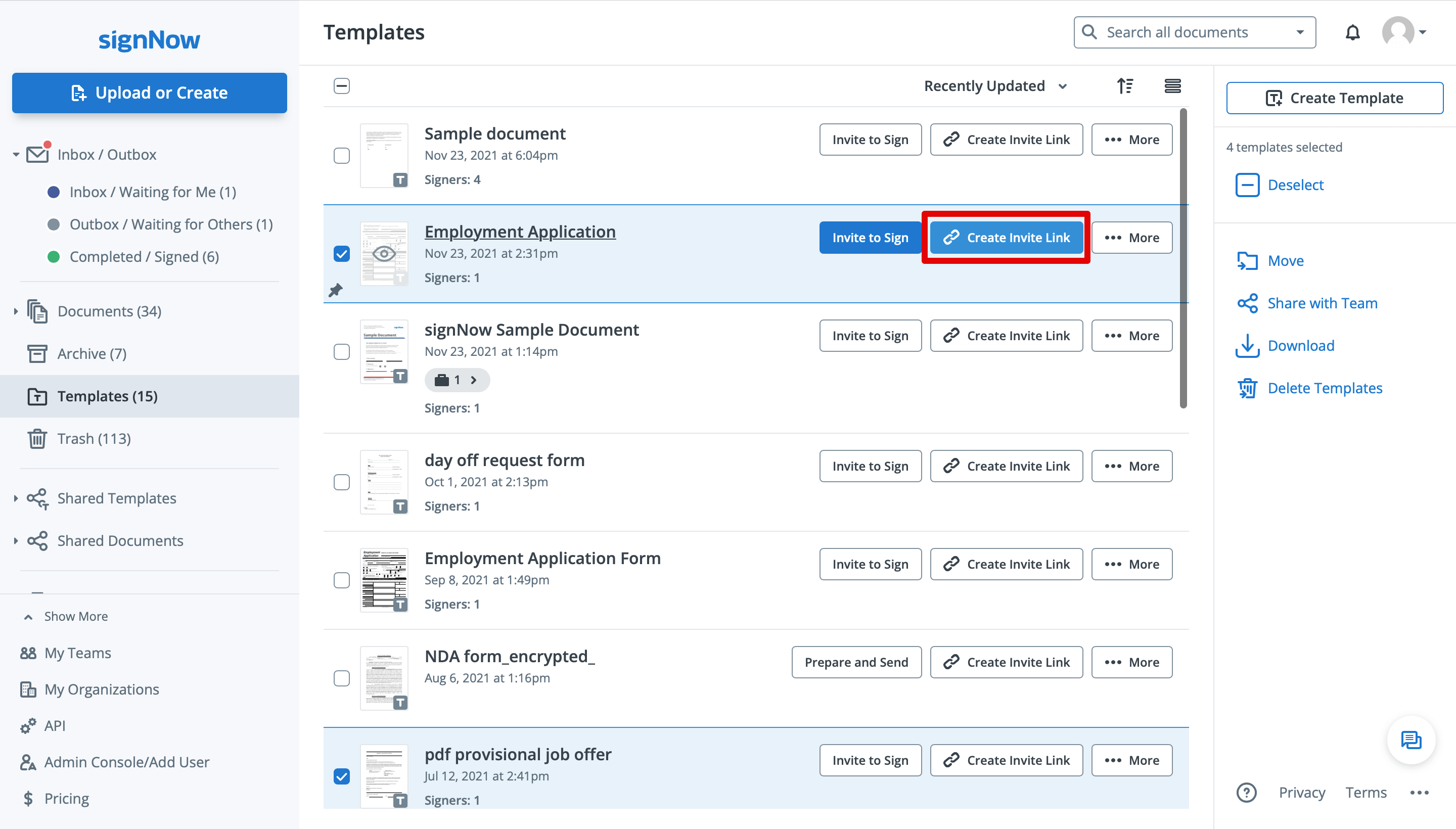
Go to your Templates folder in airSlate SignNow, select the template you need to share, and click Create Invite Link.
Copy your signing link
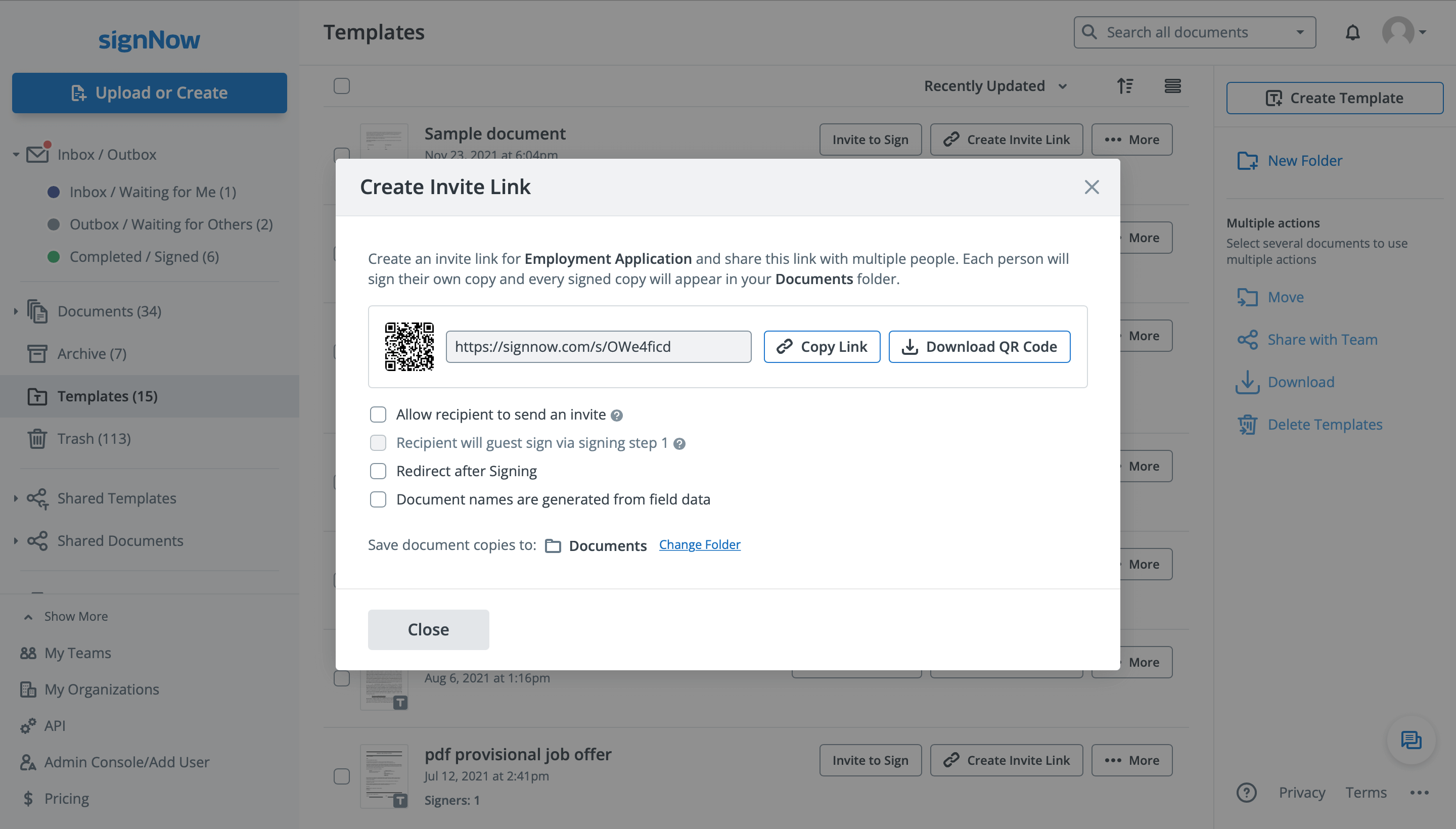
Your signing link appears in the pop-up. Copy the URL and paste it wherever you can make changes to it before sharing the link with a signer.
Modify the signing link
Add the following snippet at the end of your signing link: “?sgn_doc_name=” (no spaces or quotation marks required). Then, type the new document name after “=”.
Example:
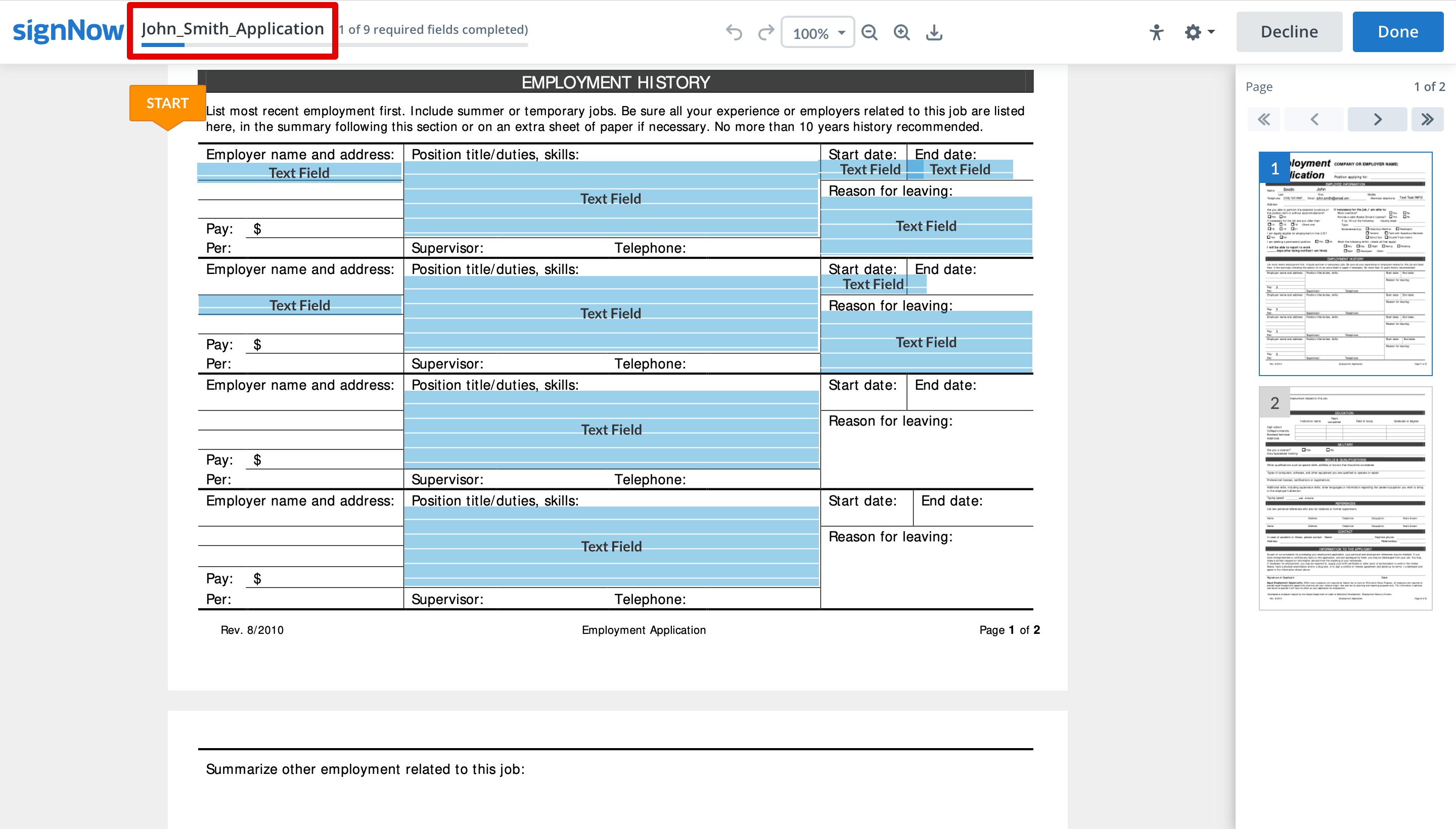
?sgn_doc_name=John_Smith_Application
Once your recipient follows the modified signing link, the document will open and it will have the name you’ve set.
Note: You can ask your IT department to set up a mail merge for this feature.
We use cookies to improve security, personalize the user experience, enhance our marketing activities (including cooperating with our 3rd party partners) and for other business use. Click here to read our Cookie Policy. By clicking “Accept“ you agree to the use of cookies. ... Read moreRead less