Formato De Factura De Restaurante En Excel Para La Industria Tecnológica

Streamline your billing process and enhance your efficiency with airSlate SignNow’s cost-effective eSigning solution. Empower your team to manage documents effortlessly and securely.

Award-winning eSignature solution

What the restaurant bill format in Excel for technology industry is

A restaurant bill format in Excel tailored for the technology industry is a structured spreadsheet template designed to record customer orders, itemized charges, tax calculations, discounts, and line-item metadata relevant to tech-sector dining and expense reporting. It typically includes standardized fields for project or client codes, chargeback categories, expense centers, hourly usage notes, and export-ready columns for integration with accounting and expense-management systems. Templates may include formulas for subtotaling, tax and tip calculations, and conditional formatting to flag noncompliant entries, improving accuracy for finance and procurement workflows.

Why using a tailored Excel bill matters for tech teams

A sector-specific Excel bill reduces reconciliation time and improves chargeback accuracy by capturing client, project, and department metadata alongside line-item restaurant charges.

Why using a tailored Excel bill matters for tech teams

Common challenges when using restaurant bill formats in Excel

  • Inconsistent item naming across receipts complicates automated reconciliation and reporting.
  • Missing project or client codes require manual follow-up and delay expense approval.
  • Incorrect tax or tip formulas can produce accounting discrepancies and reconciliation gaps.
  • Poor version control leads to duplicated entries and uncertainty about the authoritative record.

Typical user roles and responsibilities

Project Manager

Manages client and project codes on expense entries, ensures meals charged to the correct budget, and reviews aggregated monthly spend for scope and billing accuracy. They often require exportable CSVs compatible with billing systems.

Finance Analyst

Performs reconciliation, validates tax and tip formulas, and prepares documentation for internal audits. Analysts configure pivot tables and macros to standardize reporting across teams and months.

Who typically uses this Excel format

Technology teams, finance groups, and project managers use Excel restaurant bill templates to capture expense metadata and speed approvals.

  • Engineering teams tracking client-related meals for billable projects.
  • Finance and accounting conducting monthly reconciliations and audit prep.
  • Operations staff managing vendor or catered-meal expense pools.

Each group adapts fields and validation rules based on internal chargeback practices and reporting requirements.

Essential template features for technology companies

Include fields and automation that address client billing, departmental chargebacks, and export compatibility to streamline finance operations for tech organizations.

Client code

A dedicated column for client or project ID that maps to CRM records, enabling accurate chargebacks and simplified aggregation for client invoices and project profitability analysis.


Attendee list

Fields to record attendees, titles, and headcounts to distinguish internal meetings from client entertainment and to support per-person cost allocation and compliance checks.

Itemization

Separate rows for each menu item with quantity and unit price to maintain clear line-level detail required for auditing, expense classification, and tax calculations.

Tax/tip logic

Prebuilt formulas for local tax rates and optional tip calculations, adjustable per jurisdiction, to ensure correct totals and consistent recording across locations.

Approval fields

Columns for approver name, approval date, and signature reference to document managerial sign-off and integrate with electronic approval workflows for traceability.

Export mapping

A mapping section aligning spreadsheet columns with accounting import fields to ensure smooth CSV exports and accurate ledger posting.

be ready to get more

Choose a better solution

Integrations that improve accuracy and traceability

Linking Excel bills to document storage, CRM, and expense systems reduces manual entry and ensures receipts and approvals remain accessible for audits and billing reconciliation.

Cloud storage

Store templates and finalized bills in a controlled cloud repository such as Google Drive, Dropbox, or an enterprise content management system to centralize backups and access controls while preserving version history and shared links for reviewers.

CRM sync

Push client and project codes from CRM records into the Excel template to eliminate manual lookup, maintain consistent client identifiers, and enable direct aggregation of meal expenses against opportunities or accounts for accurate client invoicing.

Accounting export

Configure CSV or XLSX export formats that map directly to general ledger accounts and expense categories, reducing rekeying errors and enabling automated imports into systems like QuickBooks, Xero, or SAP Concur.

eSignature capture

Attach a finalized Excel bill or PDF conversion to an eSignature workflow so managers or finance approvers can sign off electronically, creating an auditable approval record linked to the expense file.
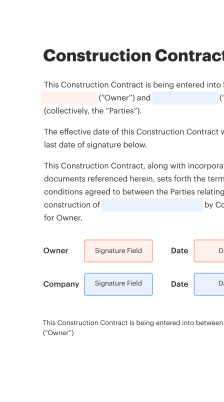
How to use the Excel bill online and in workflows

Integrate the spreadsheet with approval steps, optional eSignature capture, and automated exports to accounting or CRM systems.

  • Populate: Enter line items and metadata
  • Validate: Run checks and correct flagged entries
  • Export: Save CSV for accounting import
  • Archive: Store in secure cloud with retention rules
Collect signatures
24x
faster
Reduce costs by
$30
per document
Save up to
40h
per employee / month

Quick setup: create a usable Excel restaurant bill

Set up the template with required fields, formulas, and validation to ensure consistent data capture and simplify exports to accounting or eSignature workflows.

  • 01
    Define fields: Add columns for date, items, qty, price, tax, tip, subtotal, project code
  • 02
    Set formulas: Apply SUM and tax calculations for subtotals and totals
  • 03
    Add validation: Use data validation for project codes and categories
  • 04
    Protect sheet: Lock formula cells and set edit ranges

Step-by-step: complete and finalize the Excel bill

Follow these steps to validate data, obtain approvals, and archive the finalized restaurant bill for accounting and audits.

01

Enter data:

Populate required fields for each line item
02

Run validations:

Use macros or validation rules to check codes
03

Attach receipts:

Link or store scanned receipts with entries
04

Request approval:

Send for manager review and sign-off
05

Export file:

Generate CSV or PDF for accounting intake
06

Archive copy:

Move finalized file to secure storage
be ready to get more

Why choose airSlate SignNow

  • Free 7-day trial. Choose the plan you need and try it risk-free.
  • Honest pricing for full-featured plans. airSlate SignNow offers subscription plans with no overages or hidden fees at renewal.
  • Enterprise-grade security. airSlate SignNow helps you comply with global security standards.
illustrations signature

Recommended workflow settings for automated processing

Configure workflow and system settings to automate validation, approvals, storage, and exports for the restaurant bill template in Excel.

Setting Name Configuration
Reminder Frequency 48 hours
Approval Threshold Amount over $75
Export Format CSV mapping
Retention Period 7 years
Backup Schedule Daily

Device and platform considerations

Ensure templates and integrations work reliably on desktop, mobile, and cloud editors before rolling out across teams.

  • Desktop Excel: Full feature support
  • Cloud editors: Compatibility varies
  • Mobile apps: View-only in many cases

For consistent experience, standardize on supported platforms for editing and use cloud storage with versioning and access controls for cross-device consistency.

Key security and document protection controls

File encryption: At-rest AES encryption
Access control: Role-based permissions
Password protection: Optional workbook passwords
Audit logging: Change tracking available
Data masking: Masking for PII fields
Secure transmission: TLS for file transfers

Industry use cases and examples

Practical examples show how tech teams adapt Excel restaurant bills for billing, compliance, and integrations with accounting systems.

Client chargebacks

A startup records team meals with client project codes and receipts in a standardized Excel template

  • Template includes columns for client code, date, attendees, and per-person cost
  • Enables automated aggregation by project and reduces manual reclassification

Resulting in faster monthly client billing and fewer disputed charges.

Employee expense reporting

An engineering department uses an Excel bill layout to capture meal details and attach scanned receipts

  • The format enforces required fields like purpose and approver
  • It integrates with the corporate expense system through CSV exports and validation macros

Leading to streamlined approvals and clearer audit trails for internal compliance.

Best practices for secure, accurate restaurant bills in Excel

Follow consistent templates, validation rules, and retention policies to minimize errors and maintain compliance across teams and audits.

Enforce standardized project and client codes
Maintain a centrally controlled code list and use data validation to prevent free-text entry. This reduces reconciliation effort and prevents allocation errors when exporting or aggregating expenses by project or client for billing reconciliation.
Protect formulas and critical cells
Lock cells containing formulas and set sheet protection to prevent accidental overwrites. Use named ranges for key calculation areas and document formula logic so reviewers can verify totals during audits or month-end close.
Attach receipts and approval metadata
Include fields for receipt filename, approver name, and approval date, or store receipts in linked cloud folders. Keeping this metadata with the bill simplifies evidence collection for expense validation and internal controls.
Establish retention and archival rules
Define a retention policy that meets accounting and legal requirements, archive older records in read-only storage, and ensure backups are encrypted and accessible to authorized staff only for audit purposes.

FAQs About restaurant bill format in excel for technology industry

Common questions and solutions address template errors, integration issues, and compliance concerns when using Excel bills in tech environments.

Feature comparison: signNow versus other eSignature vendors

Compare core features relevant to signing and approving restaurant bills, including compliance, bulk sending, and API access for integration with Excel workflows.

Criteria and eSignature Vendors signNow DocuSign Adobe Sign
US legal compliance (ESIGN and UETA)
HIPAA support available
Bulk Send (standard)
API for Excel integration REST API REST API REST API
be ready to get more

Get legally-binding signatures now!

Typical document retention and reporting dates

Set clear retention, submission, and reconciliation deadlines to meet accounting, tax, and internal audit needs.

Expense submission deadline:

Within 30 days

Monthly reconciliation cut-off:

5th business day

Receipt retention period:

7 years

Quarterly audit review dates:

Quarter-end plus 15 days

Backup schedule:

Daily incremental

Risks and compliance penalties to consider

Incorrect tax reporting: Fines possible
Unauthorized access: Data breach risk
Retention failures: Audit penalties
Inaccurate billing: Client disputes
Noncompliant storage: Regulatory exposure
Missing audit trail: Evidence gaps

Pricing and plan comparison for eSignature providers

Approximate starting prices and plan characteristics for vendors commonly considered when adding electronic approvals to Excel-based restaurant bill workflows.

Vendor and plan comparison header signNow DocuSign Adobe Sign Dropbox Sign PandaDoc
Starting monthly price (approx.) $8 per user $10 per user $9.99 per user $15 per user $19 per user
Free trial or free tier availability Yes, limited Yes, limited Yes, limited Yes, limited Yes, limited
HIPAA-compliant plan option Available Available Available Available Available with BAA
API access included Included Included Included Included Included
Bulk send and templates Supported Supported Supported Supported Supported
walmart logo
exonMobil logo
apple logo
comcast logo
facebook logo
FedEx logo
be ready to get more

Get legally-binding signatures now!