Net 30 Invoice Template for Inventory Management

Streamline your billing process with airSlate SignNow's easy-to-use solution. eSign invoices effortlessly and save time while managing inventory costs.

Award-winning eSignature solution

What the net 30 invoice template for inventory is and why it matters

A net 30 invoice template for inventory is a standardized billing document that records goods shipped, inventory adjustments, unit prices, totals, and payment terms requiring settlement within thirty days. It streamlines accounts receivable for wholesalers, distributors, and retailers by consolidating itemized inventory details, SKU references, and quantities alongside payment terms, late fees, and contact information. Using a consistent template reduces billing errors, improves reconciliation, and provides auditable records for inventory movements, making it easier to track cash flow and maintain accurate stock valuation for accounting and operational teams.

Why use a net 30 invoice template for inventory in your workflow

A template enforces consistent itemization, payment terms, and inventory codes so invoices are accurate and payable within predictable timelines.

Why use a net 30 invoice template for inventory in your workflow

Common billing and inventory challenges addressed by templates

  • Manual invoice creation increases data-entry errors and mismatched SKU or quantity records.
  • Inconsistent payment terms cause disputes and delayed collections from B2B customers.
  • Lack of a clear audit trail complicates inventory reconciliation and month-end closing.
  • Poor template design can omit tax, shipping, or return terms leading to disputes.

Typical user roles and responsibilities

Inventory Manager

Responsible for ensuring SKU accuracy, recording stock movements, and verifying quantities prior to invoicing. This role coordinates with purchasing and shipping to confirm inventory availability and resolve discrepancies before the invoice is issued, reducing returns and disputes.

Accounts Receivable

Handles generation, distribution, and follow-up on net 30 invoices. This role monitors outstanding balances, applies payments, issues statements, and enforces late fees per agreed terms, maintaining ledger accuracy and cash flow predictability.

Who typically uses a net 30 invoice template for inventory

Small wholesalers, mid-market distributors, and in-house procurement teams commonly rely on net 30 inventory invoice templates to standardize billing and stock movement documentation.

  • Wholesalers managing B2B orders and periodic shipments of packaged goods.
  • Distributors reconciling inventory receipts with accounts receivable.
  • Retail chains coordinating vendor invoicing and stock replenishment cycles.

These groups use templates to reduce disputes, speed reconciliation, and maintain consistent payment expectations across customer accounts.

Essential features for effective net 30 invoice templates for inventory

Templates should include controls for accuracy, auditability, automation, and compliance to support scalable invoicing operations across inventory-driven businesses.

Line-level details

Include SKU, unit measure, discounts, tax treatment, and batch or lot number to ensure traceability and correct valuation across complex orders.


Payment terms

Explicit net 30 language, due date calculation, and late fee rules to standardize expectations and automate aging of receivables.

Conditional fields

Use conditional logic to show backorder notes, partial shipments, or drop-ship indicators depending on order status.

Template locking

Protect approved template structure from unauthorized edits while allowing permitted users to adjust non-critical fields.

Bulk invoicing

Support batch generation for many accounts to accelerate billing runs for recurring shipments and standing orders.

Audit trail

Record who created, modified, and approved invoices for compliance and post-transaction reviews.

be ready to get more

Choose a better solution

Integrations and template features to prioritize

Choose template tools and integrations that automate data flow between inventory systems, accounting ledgers, and document storage to minimize manual steps and errors.

Inventory sync

Two-way integration with inventory management systems ensures SKU counts and availability update automatically on invoices, reducing overselling and preventing misaligned stock levels between sales and warehouse records.

Accounting mapping

Built-in fields map invoice line items to chart of accounts and tax codes so exported invoices import cleanly into accounting software for faster month-end closing and fewer reconciliation exceptions.

Template variables

Dynamic placeholders for customer terms, shipping methods, and custom line-level metadata let teams produce accurate, context-aware invoices without manual edits for each transaction.

Document storage

Automatic saving to cloud repositories with standardized file naming preserves invoice history and supports retention policies required for audits and compliance reviews.
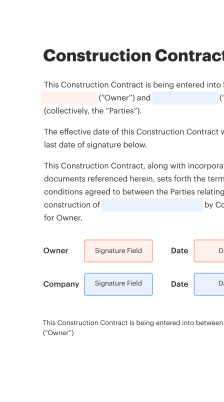
How the net 30 invoice template for inventory integrates into workflows

This sequence describes how data moves from order through invoicing to collection when using a standardized template.

  • Order capture: Sales order includes SKUs and quantities.
  • Delivery confirmation: Shipping updates inventory and confirms shipment.
  • Invoice generation: Template pulls order and shipment details automatically.
  • Payment tracking: AR monitors due dates and posts payments.
Collect signatures
24x
faster
Reduce costs by
$30
per document
Save up to
40h
per employee / month

Quick setup: create a net 30 invoice template for inventory

Follow these core steps to design and deploy a net 30 invoice template that captures inventory details and payment terms consistently.

  • 01
    Define fields: List SKU, description, units, and unit price.
  • 02
    Add terms: Specify net 30, late fee policy, and payment instructions.
  • 03
    Include totals: Provide subtotal, taxes, shipping, and grand total.
  • 04
    Test template: Generate sample invoices and confirm accounting mapping.

Audit trail steps for net 30 invoice template for inventory

Maintain a clear audit trail documenting invoice creation, edits, approvals, and delivery to support compliance and dispute resolution.

01

Create:

Record creator ID and timestamp.
02

Edit:

Log modifications with user notes.
03

Approve:

Capture approver and time.
04

Send:

Record delivery method and receipts.
05

Payment:

Log payment receipt and allocation.
06

Archive:

Store immutable copy with metadata.
be ready to get more

Why choose airSlate SignNow

  • Free 7-day trial. Choose the plan you need and try it risk-free.
  • Honest pricing for full-featured plans. airSlate SignNow offers subscription plans with no overages or hidden fees at renewal.
  • Enterprise-grade security. airSlate SignNow helps you comply with global security standards.
illustrations signature

Workflow configuration for net 30 invoice template for inventory

Set up workflow steps that ensure invoices pull accurate inventory and receive proper approvals before sending to customers.

Setting Name Configuration
Approval routing Manager review
Reminder Frequency 7 days
Late fee application Automatic after 30
Invoice numbering Sequential
Attachment policy Include packing slip

Device and platform considerations for template use

Templates should work reliably on desktop browsers, tablets, and mobile devices to support field sales and remote approvals.

  • Desktop: Modern browser supported
  • Tablet: Responsive interface
  • Mobile: Lightweight editing

Ensure your chosen invoice template system supports responsive design, offline data capture where needed, and secure synchronization so users can generate and review invoices across devices without risking data loss.

Key security controls for invoice templates and documents

Access Controls: Role-based limits
Encryption: Encryption at rest
Transport Security: TLS during transit
Authentication: Multi-factor options
Audit Logging: Immutable logs
Document Locking: Version protection

Industry examples: net 30 invoice template for inventory in action

Two concise use cases show how the template supports different inventory and billing workflows across industries.

Food Distributor

A regional food distributor issues net 30 invoices after delivery confirmation to track perishable inventory and lot numbers

  • Template fields include SKU, lot, expiration date, and pallet counts
  • Ensures traceability and reduces billing disputes by linking shipment evidence with charges

Resulting in faster reconciliations and fewer customer return claims due to clear documentation.

Industrial Supplier

An industrial parts supplier uses net 30 invoices to bill recurring shipments and bulk orders

  • Template includes part numbers, unit price breaks, and backorder flags
  • Improves purchase order matching and credit management through consistent terms and itemization

Leading to reduced order-to-cash cycles and improved inventory turnover for the supplier.

Best practices for secure and accurate net 30 invoice templates

Apply standardized controls, validation rules, and documentation practices to reduce errors, improve collections, and maintain reliable inventory records.

Standardize SKU and unit conventions across systems
Maintain a single authoritative SKU list and consistent unit-of-measure rules between inventory, order management, and invoicing systems so line items match and reconciliation is straightforward.
Validate pricing and tax logic before billing
Implement automatic checks for price tiers, discount approvals, and tax jurisdiction so invoices reflect correct charges and reduce back-and-forth with customers.
Preserve shipment proof with invoices
Attach delivery confirmations, packing slips, or carrier tracking numbers to invoices to support dispute resolution and to demonstrate fulfillment when customers query charges.
Keep retention and access policies documented
Define how long invoices and related inventory records are retained, who may access them, and ensure backups align with legal and audit requirements.

FAQs and common troubleshooting for net 30 invoice template for inventory

Answers to frequent questions and practical solutions for problems that occur when implementing net 30 inventory invoices.

Feature comparison: signNow and other eSignature providers

A concise comparison of common eSignature capabilities relevant to net 30 invoice template for inventory workflows.

Vendor / Feature signNow (Recommended) DocuSign Adobe Sign
eSignature compliance ESIGN UETA ESIGN UETA ESIGN UETA
Bulk Send Limited
API access
HIPAA support Limited Limited
be ready to get more

Get legally-binding signatures now!

Risks and penalties from incorrect invoicing

Late payment: Cash shortfall
Disputes: Revenue delays
Regulatory fines: Tax errors
Inventory inaccuracies: Stockouts
Reputational harm: Client trust loss
Operational costs: Manual rework

Pricing and plan comparison for popular eSignature platforms

Overview of typical starting prices and business features across leading eSignature providers to inform platform selection for inventory invoicing.

Plan / Vendor signNow (Recommended) DocuSign Adobe Sign Dropbox Sign PandaDoc
Starting Price (monthly) $8/user/month $10/user/month $14.99/user/month $15/user/month $19/user/month
Business Plan Features Templates, Bulk Send, API Templates, Advanced routing Templates, Adobe integration Templates, Dropbox sync Templates, Document analytics
API Included Available Available Available Available Available
Free Trial Yes Yes Yes Yes Yes
Enterprise Support Dedicated options Dedicated options Dedicated options Premium support Dedicated options
walmart logo
exonMobil logo
apple logo
comcast logo
facebook logo
FedEx logo
be ready to get more

Get legally-binding signatures now!