



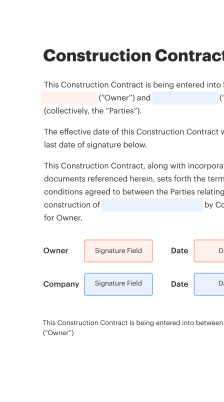
Retainer Invoice Example for Hospitality
What a retainer invoice example for hospitality looks like
Why use a standardized retainer invoice example for hospitality
Standardized retainer invoices reduce misunderstandings by documenting scope, payment terms, and deposit rules in a single, consistent format for hospitality contracts.
Common challenges when issuing retainers in hospitality
- Unclear scope leads to disputes over which services the retainer covers and when additional charges apply.
- Inconsistent application of deposits causes accounting errors and client confusion about refundable amounts.
- Late or partial payments disrupt vendor payments and inventory planning for events or group bookings.
- Manual invoicing increases errors and slows the booking-to-service workflow for seasonal hospitality operations.
Typical user profiles for a hospitality retainer invoice example
Hotel Manager
A hotel manager uses retainer invoices to reserve blocks of rooms for groups and conferences. The invoice documents deposit amounts, cancellation windows, and how retained funds apply to room charges or incidentals, enabling reliable forecasting and simplified group billing reconciliation.
Event Coordinator
An event coordinator issues retainers to secure venue time, vendors, and catering slots. The retainer invoice captures service scope, payment schedule, and vendor pass-through costs, reducing last-minute disputes and ensuring vendors receive timely partial payments.
Who typically issues and receives hospitality retainer invoices
Businesses and clients in hospitality use retainers to secure services and manage commitments before events or extended stays.
- Hotels and resorts securing group bookings and conference space with a deposit.
- Catering companies and event planners requesting a retainer to reserve date and resources.
- Corporate clients and travel managers prepaying retainers for recurring or high-value hospitality services.
Clear retainer invoices help both parties track obligations, protect deposits, and simplify reconciliation at final billing.
Choose a better solution
Key features to include in a retainer invoice template
Scope of Services
List specific services, dates, guest counts, and deliverables that the retainer secures, including any provisional vendor commitments or minimum guarantees to avoid ambiguity during final invoicing.
Payment Details
Specify retainer amount, accepted payment methods, payment deadline, and whether the retainer is refundable or applied to final charges; include tax handling and deposit allocation rules.
Cancellation Terms
State cancellation windows, forfeiture conditions, and any sliding scale for refunds tied to timing, which helps protect inventory and vendor commitments in hospitality contexts.
Application and Reconciliation
Explain how the retainer will be applied to the final invoice, including timing, itemization, and credits, plus dispute resolution and contact details for billing inquiries.
How an online retainer invoice example for hospitality works
-
Create Invoice: Draft terms, amounts, and scope in a template.
-
Send Securely: Deliver via secure email or eSignature platform.
-
Collect Payment: Accept retainer via integrated payment methods.
-
Record Application: Apply retainer to final invoice and archive.
Quick step-by-step: prepare a hospitality retainer invoice
-
01Identify Scope: Define services and dates covered by the retainer.
-
02Set Amount: Specify retainer sum and calculation method.
-
03Payment Terms: Include due date, methods, and late fees.
-
04Refund Rules: Clarify refundable or nonrefundable status.
Why choose airSlate SignNow
-
Free 7-day trial. Choose the plan you need and try it risk-free.
-
Honest pricing for full-featured plans. airSlate SignNow offers subscription plans with no overages or hidden fees at renewal.
-
Enterprise-grade security. airSlate SignNow helps you comply with global security standards.
Recommended workflow settings for retainer invoice automation
| Workflow Setting Name and Description Header | Configuration and default value |
|---|---|
| Automated Reminder Frequency and Interval | 48 hours before due |
| Payment Methods and Processor Integration | Credit card and ACH |
| Auto-apply Retainer to Final Invoice | Enabled by default |
| Signature Requirement and Authentication | Email + access code |
| Retention and Archive Policy Setting | 7 years encrypted storage |
Device and platform considerations for retainer invoices
Ensure the platform you use to create and send retainer invoices supports desktop and mobile workflows for on-site or remote signings.
- Desktop Browsers: Chrome, Edge, Safari compatible
- Mobile Apps: iOS and Android supported
- PDF Support: Fillable PDF and export
Verify that your chosen solution also integrates with accounting and payment processors, offers secure mobile signing, and meets U.S. compliance standards so hospitality staff can finalize retainers from any device.
Real hospitality examples using retainer invoices
Hotel Group Booking
A corporate client reserves 120 rooms for a three-day conference with a deposit equal to 25 percent of expected room revenue.
- Deposit holds the block and triggers vendor guarantees.
- The hotel applies the retainer toward master folio charges at checkout.
Resulting in streamlined settlement and fewer disputes at event closeout due to clearly documented deposit application and cancellation terms.
Catered Event Retainer
An event planner secures catering and staff for a 300-guest reception with a fixed retainer to cover initial food costs and staffing commitments.
- The retainer confirms date, menu selections, and minimum guest counts.
- It also offsets supplier deposits and last-minute menu changes.
Leading to predictable vendor payments and reduced no-show risk while ensuring adjustments are reflected in the final invoice.
Best practices for accurate and secure retainer invoices
FAQs and troubleshooting for retainer invoice examples in hospitality
- What should be included to make a retainer enforceable
Include a clear description of services, the retainer amount, payment terms, cancellation and refund rules, accepted payment methods, invoicing and application procedures, and signatures from authorized parties. Attach or reference the master contract or event order so the retainer invoice links directly to the binding agreement and reduces ambiguity if a dispute arises.
- How to apply a retainer to the final invoice
Record the retainer as a credit on the final invoice, list the original retainer invoice number, and itemize how the credit was applied across line items. Provide a reconciliation statement showing prior payments, applied credits, and remaining balance to ensure transparency for the client and the accounting team.
- What to do if a client disputes a retainer charge
Review the signed retainer terms and any attached agreements, confirm authorization and payment records, and provide a clear reconciliation showing services reserved and costs incurred. If retention rules are documented, follow the stated cancellation policy; otherwise, consider mediation or documented refund calculations to resolve the dispute efficiently.
- How to accept retainers securely online
Use a payment processor with PCI compliance, enable TLS encryption for transaction pages, require authenticated signatures or access codes, and maintain audit logs for payments and acceptance. Ensure the eSignature platform supports secure payment fields and stores only necessary payment token data, keeping full card data with the payment processor.
- Record retention period for retainer invoices
Follow accounting and legal guidance; retain financial records and signed agreements for at least seven years to meet U.S. tax and audit requirements. Longer retention may be necessary if contracts involve long-term liability or regulatory considerations.
- Why a template helps prevent billing errors
Templates standardize essential fields, reduce manual omissions, and embed consistent payment, refund, and application rules. They also speed processing through prefilled client data and integration with PMS, accounting, and CRM systems, lowering the risk of misapplied retainers.
Feature availability comparison for retainer invoice workflows
| Feature or Criteria for Comparison | signNow (Recommended) | DocuSign | Adobe Sign |
|---|---|---|---|
| Basic eSignature Support | |||
| Integrated Payments | Limited | ||
| Template Automation | |||
| HIPAA Compliance Options | Available | Available | Available |
Get legally-binding signatures now!
Risks and penalties from improper retainer handling
Pricing and plan comparison for retainer invoice use cases
| Plan Tier | signNow (Recommended) | DocuSign | Adobe Sign | HelloSign | PandaDoc |
|---|---|---|---|---|---|
| Free or Entry-Level | $0 limited | $10 trial | No free plan | $0 limited | $0 limited |
| Individual/Small Business | $8 per user/mo | $15 per user/mo | $14.99 per user/mo | $15 per user/mo | $19 per user/mo |
| Business / Team Plan | $15 per user/mo | $40 per user/mo | $26 per user/mo | $25 per user/mo | $30 per user/mo |
| Enterprise / Advanced | Custom enterprise pricing | Custom pricing | Enterprise quotes | Custom quotes | Custom quotes |
| API and Integrations | Available included | Paid add-on | Included with enterprise | Limited | Included enterprise |
Explore Advanced Features
- Expense Receipt Maker for Efficient Record Keeping
- Modèle de Facture Zoho
- Invoice Template for Cleaning Services
- Independent Contractor Invoice Template for Google Docs
- Catering Receipt Template for Streamlined Operations
- Sample Vendor Invoice PDF
- Shopify Invoice for Customer: Efficient eSignature
- Invoice HTML for Efficient eSigning