RFP Automated Response Software for Legal

Experience seamless document management with airSlate SignNow's user-friendly platform. Save time and costs while ensuring your legal documents are securely signed and processed.

Award-winning eSignature solution

What rfp automated response software for legal does and why it matters

rfp automated response software for legal automates the creation, review, and delivery of responses to requests for proposals and similar procurement documents used by legal teams. It centralizes reusable clauses and templates, applies conditional logic to include or exclude provisions, and populates responses with client- and matter-specific data. When connected to eSignature and document management systems it reduces manual assembly, enforces approvals, and preserves an audit trail suitable for compliance reviews. The result is faster, more consistent RFP responses with traceable review history and reduced administrative overhead for in-house counsel and law firm teams.

Why legal teams adopt automated RFP response workflows

Automating RFP responses reduces repetitive drafting, shortens response cycles, and helps maintain consistent legal language across bids while preserving compliance controls and auditability required by corporate and regulatory policies.

Why legal teams adopt automated RFP response workflows

Common challenges in manual RFP responses

  • Scattered clause libraries lead to inconsistent legal language across responses and increase review time.
  • Manual data entry into templates increases the risk of copying outdated or incorrect contract terms.
  • Lengthy approval cycles create missed deadlines and reduce competitiveness in procurement processes.
  • Poorly tracked changes and versioning create disputes about which response was authorized and signed.

Typical user profiles and responsibilities

Legal Operations Manager

Oversees template governance, configures approval workflows, and manages integrations with document storage and CRM systems. Responsibilities include maintaining clause libraries, setting permission levels, and auditing user activity to ensure consistent, compliant responses across matters.

Proposal Attorney

Drafts and reviews technical and legal responses, applies standard clauses from the library, and coordinates final approvals. They ensure the final RFP submission aligns with internal risk policies and client-specific requirements.

Teams and roles that benefit from RFP automation

Legal operations, procurement-facing counsels, and proposals teams commonly use automated RFP response tools to streamline document assembly and approvals.

  • In-house legal teams managing vendor contracts and procurement submissions.
  • Law firms preparing standard proposals and engagement letters at scale.
  • Proposal and sales operations coordinating multi-stakeholder approvals.

Cross-functional teams such as sales, compliance, and finance also rely on consistent outputs to preserve risk controls and speed responses.

Advanced capabilities that accelerate legal RFP workflows

Beyond basics, advanced features enable scale, integration depth, and stronger governance for enterprise legal teams handling many RFPs.

Bulk Send

Send multiple proposals or signature requests in a single batch to different recipients while tracking delivery and completion rates.


Team Templates

Organize templates by practice area or team with delegated management and access controls to maintain consistency at scale.

Role Permissions

Fine-grained roles determine who can edit templates, request approvals, or finalize RFP responses, protecting template integrity.

API Access

REST APIs enable integrations that automate population, submission, and storage directly from procurement systems and CRMs.

Mobile Signing

Secure mobile support for reviewers and signatories to approve and sign responses from mobile devices when away from desktop.

Template Analytics

Usage metrics show which templates and clauses are most used and where bottlenecks occur in the approval process.

be ready to get more

Choose a better solution

Core features to prioritize in RFP automation

Focus on features that reduce manual drafting, preserve legal consistency, and maintain a clear audit record across the response lifecycle.

Template Library

Centralized storage of preapproved clauses and templates with version control and tagging to ensure teams reuse consistent, vetted legal language across all RFP responses.

Conditional Logic

Rules-driven inclusion or exclusion of clauses based on selection fields and responses, reducing manual edits and tailoring outputs to each RFP’s requirements.

CRM Integration

Automatic population of customer and contract metadata from CRM systems so responses include accurate matter identifiers and reduce duplicate data entry.

Audit Trail

Comprehensive, timestamped record of edits, approvals, and signatures that supports internal audits and regulator reviews without manual reconciliation.
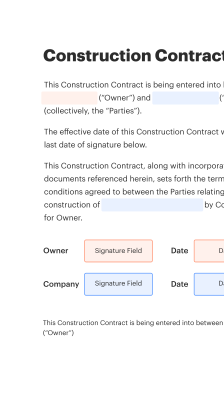
How to create and use automated responses online

An online creation flow typically combines template selection, data merging, review, and finalization with eSignature capability.

  • Select template: Choose the appropriate RFP template from the library.
  • Populate data: Pull client and matter fields from integrated systems.
  • Review and approve: Route to legal reviewers for comment and sign-off.
  • Send final: Deliver the signed RFP response and archive copy.
Collect signatures
24x
faster
Reduce costs by
$30
per document
Save up to
40h
per employee / month

Quick setup: configuring an automated RFP response workflow

Follow these primary steps to configure a basic automated RFP response process for legal teams.

  • 01
    Define templates: Create standardized response templates and clause blocks.
  • 02
    Set rules: Configure conditional logic and auto-population rules.
  • 03
    Approval flow: Map reviewers and approval steps for each template.
  • 04
    Integrate systems: Connect CRM, storage, and eSignature services.

Managing audit trails and post-submission tracking

A systematic grid helps capture required audit steps and retention actions for each submitted RFP response.

01

Capture metadata:

Record client and matter identifiers
02

Record approvals:

Log reviewer names and timestamps
03

Preserve versions:

Archive pre- and post-signature versions
04

Store signatures:

Keep signed PDFs with certificates
05

Monitor access:

Track document views and downloads
06

Schedule retention:

Apply deletion or archival rules
be ready to get more

Why choose airSlate SignNow

  • Free 7-day trial. Choose the plan you need and try it risk-free.
  • Honest pricing for full-featured plans. airSlate SignNow offers subscription plans with no overages or hidden fees at renewal.
  • Enterprise-grade security. airSlate SignNow helps you comply with global security standards.
illustrations signature

Recommended workflow configuration settings

Suggested default settings can accelerate implementation; tailor them to your approval policies and SLA requirements.

Setting Name Configuration
Reminder Frequency 48 hours
Default Approvers Two required
Signature Type Electronic signature
Retention Policy 7 years
Auto-archive On completion

Supported platforms and general requirements

Check compatibility and minimum software requirements before deploying an automated RFP response solution across desktops and mobile devices.

  • Desktop browsers: Recent Chrome, Edge, Safari
  • Mobile platforms: iOS 14+ and Android 10+
  • Bandwidth expectation: Stable 5 Mbps+

For enterprise rollouts, validate single sign-on (SAML/OIDC), mobile device management compatibility, and storage locations to meet corporate security and data residency policies.

Security and protection features to expect

Encryption at rest: AES-256 encryption
Encryption in transit: TLS 1.2+ protections
Access controls: Role-based permissions
Audit logs: Complete transaction trails
Data residency options: Regional storage choices
Compliance attestations: SOC 2 and HIPAA-ready

Real-world scenarios where RFP automation helps

Representative examples show how legal teams apply automation to improve accuracy and speed while keeping approvals auditable.

Mid-size law firm response

A mid-size firm received frequent RFPs for panel appointments and centralized responses using templates and conditional clauses to speed drafting.

  • Template library with clause tagging.
  • Reduced reviewer edits and faster submission.

Resulting in shorter turnaround and more consistent firm-wide proposals.

Corporate procurement legal team

A corporate legal team integrated RFP automation with its CRM to prefill contract and vendor data for responses.

  • CRM sync for client and contract metadata.
  • Fewer manual entries and fewer errors in submissions.

Leading to measurable time savings and simplified compliance documentation for audits.

Best practices for secure and accurate automated RFP responses

Adopt operational habits that protect data, maintain template quality, and streamline approvals for reliable responses.

Maintain a vetted clause library
Regularly review and version-control standard clauses with legal owners assigned for each clause to prevent outdated language and to ensure consistent, compliant responses across teams.
Limit editing permissions
Grant template editing to a small number of trained administrators while allowing broader teams to use templates for drafting; this preserves governance and reduces accidental changes.
Log approvals and changes
Require named approvals and maintain immutable audit logs for every RFP response to support legal defensibility and post-award audits by procurement or regulators.
Integrate with eSignature and storage
Connect responses to a compliant eSignature provider and centralized storage to ensure signed documents are preserved with metadata and retention controls.

FAQs: common issues and solutions for legal RFP automation

Answers to frequent questions about configuration, integration, signature validity, and compliance when using automated RFP response tools.

Feature availability: signNow and competing eSignature platforms

A concise comparison of common capabilities for RFP and legal response workflows across leading eSignature platforms.

Criteria signNow (Recommended) DocuSign Adobe Acrobat Sign
HIPAA compliant options
Bulk Send capability
API available REST API REST API REST API
On-prem or private cloud
be ready to get more

Get legally-binding signatures now!

Document retention and key timeline checkpoints

Define retention and review schedules that align with corporate policy and regulatory requirements for procurement and contract documentation.

Initial retention period:

Minimum seven years for procurement records

Review cadence:

Annual template review cycle

Approval deadlines:

Set internal cutoffs three business days before submission

Archival process:

Move finalized responses to long-term storage

Deletion schedule:

Purge per policy after retention term

Regulatory and commercial risks of poor controls

Noncompliance fines: Significant financial penalties
Data breaches: Sensitive exposure risk
Invalid signatures: Contract enforceability issues
Contract disputes: Legal contention possible
Audit failures: Regulator scrutiny
Reputational harm: Client trust erosion

Pricing snapshot and plan highlights

Representative pricing and plan details for common eSignature platforms relevant to legal RFP workflows; actual prices vary by contract and volume.

Pricing Item signNow (Recommended) DocuSign Adobe Acrobat Sign Dropbox Sign OneSpan
Starting monthly price From $8/user/month From $10/user/month From $14.99/user/month From $10/user/month Contact sales
Entry-level plan name Business Personal Pro Standard Standard Enterprise
Free trial Yes, limited Yes, limited Yes, limited Yes, limited Usually no
HIPAA support Available Available Available Available Available
API included Yes, in most plans Yes, in most plans Yes, in select plans Yes, in most plans Yes, enterprise only
walmart logo
exonMobil logo
apple logo
comcast logo
facebook logo
FedEx logo
be ready to get more

Get legally-binding signatures now!