Central Repository
A searchable, versioned store for RFPs, bids, and executed contracts that enforces retention policies and simplifies post-award reviews.



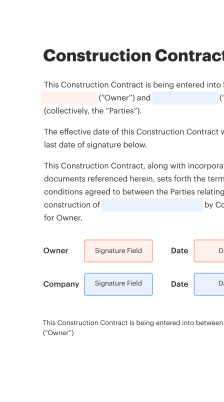
Centralizing RFPs and contract workflows reduces approval delays, improves traceability, and lowers risk by enforcing standardized templates and role-based permissions across product and procurement teams.

Product Managers use the system to collect vendor proposals, compare technical responses, and ensure contractual obligations match product roadmaps. They rely on templates and approval workflows to secure timely legal and procurement sign-off prior to vendor onboarding.
Procurement Leads organize RFP issuance, evaluate bids against commercial criteria, and manage negotiation rounds. They use role-based permissions, audit logs, and standardized templates to reduce cycle time and maintain procurement compliance.
Product, procurement, legal, and vendor management teams typically collaborate in RFP and contract workflows to align commercial and technical requirements.
Bringing those stakeholders into a single, auditable process reduces disputes and accelerates time to contract while preserving compliance records.
A searchable, versioned store for RFPs, bids, and executed contracts that enforces retention policies and simplifies post-award reviews.
Pre-approved RFP and contract templates with clause libraries reduce legal review time and maintain consistent commercial terms across projects.
Conditional routing, parallel reviews, and timed reminders remove manual handoffs and accelerate approval cycles for product milestones.
Immutable, timestamped records of edits, approvals, and signatures help demonstrate compliance for audits and dispute resolution.
REST APIs and prebuilt connectors synchronize contract status with CRM, procurement, and PLM systems to avoid duplicate data entry.
Dashboards and exportable reports show cycle times, bottlenecks, and contract spend to inform procurement decisions.
Two-way integration lets teams draft and collaborate in Google Docs, then push finalized versions into the contract repository with preserved version history and metadata for approvals.
Sync contract and vendor data with CRM records so sales and product teams see active terms, renewal dates, and billing details without switching systems.
Bi-directional file sync stores executed contracts in centralized cloud storage, preserving permissions while enabling easy access during procurement reviews.
Alerts and approval prompts in Slack reduce email delays and keep reviewers informed of pending actions linked to specific RFPs.
| Setting Name | Configuration |
|---|---|
| Approval Sequence | Sequential with parallel options |
| Reminder Frequency | 48 hours |
| Document Retention Policy | 7 years archival |
| Field Validation Rules | Required fields enforced |
| Signature Authentication Level | Email + 2FA option |
Ensure that your environment meets browser, OS, and network requirements before deploying an RFP contract management workflow.
Confirm SSO integration (SAML or OAuth), firewall rules for API endpoints, and any enterprise proxy settings to avoid interruptions during document submission and signing.
A product team issued a consolidated RFP to third-party integrators to meet a go-to-market deadline.
Resulting in a shortened launch schedule and clearer contractual obligations for ongoing support.
A procurement group evaluated vendors for patient-data integrations under HIPAA constraints.
Resulting in approved vendor contracts that met audit requirements and reduced legal review iterations.
| Feature Comparison and Availability Across Vendors | signNow (Recommended) | DocuSign | Adobe Sign |
|---|---|---|---|
| Bulk Send | |||
| Advanced Workflow Builder | |||
| HIPAA Support | Available | Available | Available |
| API Access | REST API | REST API | REST API |
Final vendor proposals due on specified date
Allow 5–10 business days for reviews
Standard 3–7 business days for signatures
Annual check for archival or deletion
Notify stakeholders 60–90 days before expiry
| Plan Header | signNow (Recommended) | DocuSign | Adobe Sign | Dropbox Sign | PandaDoc |
|---|---|---|---|---|---|
| Starting Price | From $8/user/mo | From $10/user/mo | From $9.99/user/mo | From $8/user/mo | From $19/user/mo |
| Included eSignatures | Unlimited signatures included | Varies by plan | Varies by plan | Varies by plan | Some limits by plan |
| API Access | Included in business plans | Available as add-on | Included in most plans | Add-on for some tiers | Included in business tiers |
| Bulk Send Capability | Available | Available | Available | Available | Available |
| Enterprise Support Options | Dedicated support for enterprise plans | Enterprise success plans available | Enterprise SLAs available | Enterprise offerings | Dedicated enterprise support |