RFP Machine Software for Insurance Industry

Streamline document management and eSigning with airSlate SignNow's user-friendly, cost-effective solution designed for insurance professionals.

Award-winning eSignature solution

What rfp machine software for insurance industry does and why it matters

rfp machine software for insurance industry streamlines the request-for-proposal lifecycle for carriers, brokers, and third-party administrators by consolidating document creation, distribution, responses, and approvals into a single digital workflow. It reduces manual data entry, standardizes submission formats for underwriters, and preserves an auditable record of each interaction. When combined with secure eSignature and role-based access controls — for example via solutions such as signNow (Featured) — organizations can shorten procurement cycles while retaining compliance with ESIGN and UETA requirements for electronic contracts.

Why insurance teams adopt rfp machine software

Centralizes RFP authoring and response tracking to reduce cycle time and manual errors while supporting regulatory recordkeeping.

Why insurance teams adopt rfp machine software

Common RFP challenges in insurance operations

  • Fragmented templates across departments lead to inconsistent responses and missed data fields.
  • Manual routing causes approvals to stall and increases total procurement cycle time.
  • Version control gaps create conflicting terms and expose insurers to contractual risk.
  • Poor audit records complicate compliance reviews and slow regulatory reporting processes.

Representative user profiles

Procurement Manager

Manages sourcing, evaluates vendor proposals, and enforces contract standards across product lines. Uses RFP machine software to compare bids, enforce template compliance, and maintain audit logs required for internal controls and regulator inquiries.

Commercial Broker

Prepares consolidated RFPs for carriers, tracks proposal deadlines, and coordinates signatures from multiple insureds. Relies on template libraries and bulk send functions to maintain consistent submissions and faster turnaround.

Teams and roles that benefit from RFP automation

Insurance procurement, underwriting, broker operations, and vendor management teams commonly use rfp machine software to coordinate responses and approvals.

  • Procurement managers coordinating vendor evaluation and contract timelines.
  • Underwriters standardizing data intake for risk assessment and pricing.
  • Broker operations teams preparing bundled submissions for carriers.

Implementation typically reduces back-and-forth communications and improves traceability across multi-stakeholder RFP events.

Six feature areas to evaluate for insurance RFPs

Assess these six capabilities to ensure the solution supports scale, compliance, and the specific needs of underwriting and broker workflows.

Template Management

Centralized control over RFP forms, conditional fields, and versioning that enforces data completeness, reduces rework, and simplifies governance across distributed teams.


Bulk Send

Ability to dispatch identical or parametrized RFPs to many recipients with individualized field values, improving efficiency during renewals and high-volume submissions.

Workflow Automation

Conditional routing, auto-reminders, and escalation rules that keep approvals moving while preserving required review steps for legal and actuarial oversight.

API & Integrations

Robust REST APIs, webhooks, and prebuilt connectors to CRMs, policy administration systems, and document repositories for synchronized data and status updates.

Advanced Authentication

Support for MFA, SAML/SSO, and certificate-based signing to meet higher assurance levels needed for sensitive underwriting agreements.

Mobile Access

Fully functional signing and review on mobile devices to accommodate remote agents and field brokers without sacrificing security or auditability.

be ready to get more

Choose a better solution

Four essential features for insurance RFP workflows

The right feature set reduces touchpoints, enforces consistency, and ensures legal compliance across the RFP lifecycle.

Template Library

Centralized, version-controlled templates let teams standardize questions, required disclosures, and underwriting fields so every RFP follows the same structure and reduces missing or inconsistent information across submissions.

Bulk Send

Batch distribution sends the same RFP or proposal to multiple recipients with individualized fields, saving time during renewals and large placement efforts while preserving per-recipient tracking.

Workflow Automation

Automated routing, conditional branching, and reminder schedules reduce manual follow-up and ensure approvals occur in the correct sequence for underwriting or legal review.

Audit Trail

Detailed signing logs capture timestamps, IP addresses, and status changes to support ESIGN/UETA compliance and internal audit requirements without manual recordkeeping.
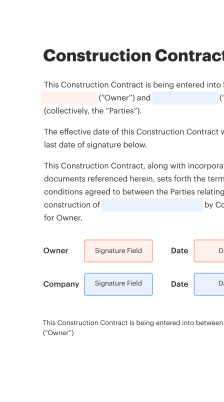
How the RFP machine process flows

A typical document flow covers template selection, data population, multi-party reviews, signing, and archival with auditability at each step.

  • Template selection: Choose a preapproved RFP template.
  • Data population: Merge insured and policy data automatically.
  • Review routing: Sequential or parallel approver routing.
  • Execution: Signatures applied and logged.
Collect signatures
24x
faster
Reduce costs by
$30
per document
Save up to
40h
per employee / month

Quick setup: Deploying rfp machine software for insurance teams

Follow a staged rollout to align templates, permissions, and signing methods with existing compliance controls.

  • 01
    Inventory templates: Collect current RFP forms and clauses.
  • 02
    Define roles: Map approvers and editors.
  • 03
    Configure workflows: Set routing, reminders, and deadlines.
  • 04
    Test and train: Run pilot scenarios with stakeholders.
be ready to get more

Why choose airSlate SignNow

  • Free 7-day trial. Choose the plan you need and try it risk-free.
  • Honest pricing for full-featured plans. airSlate SignNow offers subscription plans with no overages or hidden fees at renewal.
  • Enterprise-grade security. airSlate SignNow helps you comply with global security standards.
illustrations signature

Typical workflow configuration settings

Common settings balance responsiveness with governance; configure defaults to align with internal SLAs and compliance requirements.

Setting Name Configuration
Approval Sequence Sequential or parallel
Reminder Frequency 48 hours
Expiration Period 30 days
Signature Method Electronic signature
Retention Policy 7 years

Platform and device compatibility for RFP workflows

Confirm supported browsers, mobile OS versions, and minimum network requirements before deployment to avoid access issues during RFP cycles.

  • Desktop Browsers: Chrome, Edge, Safari
  • Mobile Platforms: iOS 14+ and Android 10+
  • API Protocols: REST with JSON

Ensure that internal IT policies allow necessary outbound connections for API calls, webhooks, and cloud storage access; document approved versions and testing deadlines so integrations proceed smoothly with existing insurance systems.

Core security and protection features

Encryption: AES-256 at rest
Transport Security: TLS 1.2+ in transit
Access Controls: Role-based permissions
Authentication: Multi-factor options
Audit Trails: Immutable signing logs
Data Residency: Region-based storage

Practical insurance use cases

Concrete examples illustrate how rfp machine software for insurance industry shortens cycles and improves accuracy across typical scenarios.

Carrier Procurement

A regional carrier consolidated broker submissions into standardized RFP templates to eliminate missing underwriting data and duplicated effort

  • Template enforcement reduced incomplete submissions by design
  • Improved data completeness accelerated underwriting reviews

Resulting in a 30 percent shorter bid-to-bind interval and clearer audit trails for compliance.

Broker Consolidation

Large brokerages used bulk send and centralized templates to distribute RFPs to multiple carriers simultaneously

  • Bulk Send processed hundreds of policies in one operation
  • Faster carrier response improved placement rates for clients

Resulting in higher hit rates, reduced manual rework, and consistent recordkeeping for renewal cycles.

Best practices for secure, accurate RFP execution

Adopt operational controls and technical settings that preserve data integrity, enforce standards, and meet regulatory obligations.

Standardize templates and fields across teams
Use a centralized template library with required fields and conditional logic to prevent incomplete responses and to ensure that underwriting-critical data is always captured in the same format.
Restrict editing via role-based permissions
Limit who can modify templates and who can approve final RFPs to reduce version drift and ensure that legal or compliance teams see any substantive changes before issuance.
Enable multi-factor authentication for approvers
Require MFA for users with signing or approval privileges to strengthen identity verification and reduce the risk of unauthorized execution of contracts.
Maintain retention schedules and exportability
Define document retention policies that satisfy audit and regulatory windows, and ensure signed records are exportable for regulator submission or legal discovery.

Frequently asked questions and troubleshooting

Answers to common questions about using rfp machine software for insurance industry, covering signatures, integration, and compliance.

Feature availability: signNow compared to leading providers

A quick comparison shows feature presence and technical details across widely used eSignature providers relevant to insurance RFP workflows.

Criteria signNow (Featured) DocuSign Adobe Sign
ESIGN & UETA Validity
HIPAA Support
Bulk Send Capability
API for Integrations REST API REST API REST API
be ready to get more

Get legally-binding signatures now!

Regulatory and operational risks to monitor

Noncompliance fines: Monetary penalties
Data breach costs: Incident remediation
Invalid contracts: Enforceability issues
Reputational harm: Client loss
Litigation exposure: Legal defense
Regulatory audits: Increased scrutiny

Pricing and tier highlights across providers

Pricing varies by feature needs and user counts; the table summarizes starting points and important plan differences relevant to insurance teams.

Plan signNow (Featured) DocuSign Adobe Sign OneSpan Sign HelloSign
Starting Price (per user) From $8/user/mo From $10/user/mo From $14/user/mo From $20/user/mo From $15/user/mo
Free Tier Available Limited free trial Developer sandbox Free trial No free tier Free trial
Enterprise Features Included SAML, API, templates SSO, API, advanced workflows SSO, API, lifecycle PKI, advanced auth API, team features
HIPAA Compliance Option Available via BAAs Available via BAAs Available via BAAs Available by request Available via BAAs
Bulk Send & Limits Bulk Send included, volume-based limits Add-on or higher tier Higher-tier feature Enterprise feature Included with limits
walmart logo
exonMobil logo
apple logo
comcast logo
facebook logo
FedEx logo
be ready to get more

Get legally-binding signatures now!