Rfp Proposal Automation for Planning with SignNow

Effortlessly create, send, and eSign documents with airSlate SignNow’s user-friendly and affordable solution.

Award-winning eSignature solution

What rfp proposal automation for planning means for procurement

rfp proposal automation for planning streamlines the preparation, distribution, collection, and evaluation of requests for proposals by applying templates, role-based routing, and conditional logic to repetitive tasks. It reduces manual assembly of documents, centralizes version control, and standardizes scoring criteria so planning teams can compare submissions consistently. When combined with secure eSignature and audit trails, automation supports compliance and shortens procurement cycles while preserving documentation needed for audits and vendor selection records.

Why automation matters in planning and RFP workflows

Adopting rfp proposal automation for planning reduces administrative effort, increases consistency across solicitations, and shortens time-to-award while maintaining traceable records for compliance and review.

Why automation matters in planning and RFP workflows

Common challenges rfp proposal automation for planning addresses

  • Manual template updates create inconsistent requirements and scoring across solicitations.
  • Tracking multiple versions causes delays and disputes during vendor evaluation.
  • Coordinating signatures across stakeholders leads to prolonged approval cycles.
  • Maintaining compliance documentation for audits demands time-consuming record assembly.

Representative user profiles for RFP automation

Procurement Lead

A procurement lead manages large-scale solicitations across departments, sets evaluation templates, and enforces mandatory review steps. They rely on automation to distribute documents, collect signatures, and produce consistent audit trails for contract award justification.

Planning Coordinator

A planning coordinator schedules RFP timelines, tracks stakeholders, and reconciles vendor submissions. Automation reduces manual follow-ups and ensures version control, enabling timely scorecard consolidation and transparent decision records.

Teams and roles that benefit from automated RFP planning

Procurement, planning, and program management teams use automation to scale repeated solicitation tasks and keep documentation consistent.

  • Procurement managers who standardize evaluation criteria and deadlines across solicitations.
  • Program planners coordinating multi-stakeholder approvals and compliance reviews.
  • Legal and contracting teams validating terms and preserving signature evidence.

Organizations with regular vendor sourcing cycles or heavy compliance needs see the most measurable workflow improvements from automation.

Advanced capabilities to support complex RFP programs

For larger or regulated programs, consider features that enable scale, integrations, and heightened security.

Bulk Send

Ability to send a single RFP or notice to many recipients at once while tracking individual delivery and response status for each vendor.


API Access

Programmatic integration to trigger RFP issuance, collect responses, and push signed contracts to ERP or contract management systems.

Conditional Logic

Dynamic document sections that appear or hide based on vendor responses, ensuring only relevant requirements are presented.

Role Templates

Predefined approver sequences and reviewer profiles that can be applied per solicitation type to speed configuration.

Encrypted Storage

Long-term encrypted archives with configurable retention policies and exportable audit logs for compliance.

Advanced Authentication

Options for identity verification such as SMS, email, or knowledge-based checks for higher-assurance signatures.

be ready to get more

Choose a better solution

Core features that support RFP proposal automation for planning

Key capabilities to look for include secure templates, role-driven routing, configurable approval steps, and reliable signature capture.

Templates

Reusable, version-controlled RFP templates with mandatory fields and embedded scoring criteria reduce drafting time and ensure consistent requirements across solicitations.

Routing

Conditional routing and sequential approvals assign specific review and signing tasks to roles, ensuring required stakeholders see only relevant sections and meet review SLAs.

Signing

Integrated electronic signature capture with clear identity verification and tamper-evident seals preserves legal validity and creates a timestamped record for awards and contracts.

Reporting

Centralized dashboards and exportable audit logs summarize vendor responses, scoring outcomes, and signature events for procurement oversight and audit readiness.
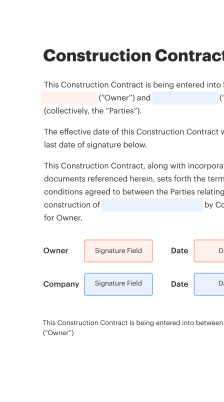
How automated RFP routing and signature flow operates

This overview summarizes the typical document flow from creation to award using automation and eSignature.

  • Create: Author templates and scoring rubrics centrally.
  • Distribute: Send RFPs to listed vendors and stakeholders.
  • Collect: Receive proposals and attachments in one portal.
  • Finalize: Route signed agreements to records storage.
Collect signatures
24x
faster
Reduce costs by
$30
per document
Save up to
40h
per employee / month

Quick setup: creating an automated RFP workflow

Follow these concise steps to configure a basic rfp proposal automation for planning workflow.

  • 01
    Define Template: Create a master RFP template with required fields.
  • 02
    Assign Roles: Map approvers, reviewers, and signers by role.
  • 03
    Add Logic: Set conditional sections for vendor eligibility.
  • 04
    Enable Audit: Turn on logging and signature verification.
be ready to get more

Why choose airSlate SignNow

  • Free 7-day trial. Choose the plan you need and try it risk-free.
  • Honest pricing for full-featured plans. airSlate SignNow offers subscription plans with no overages or hidden fees at renewal.
  • Enterprise-grade security. airSlate SignNow helps you comply with global security standards.
illustrations signature

Recommended workflow settings for RFP automation

Suggested default configurations to start an automated RFP workflow that balances security and usability.

Setting Name Configuration
Reminder Frequency 48 hours
Approval Sequence Sequential
Signature Requirement Electronic
Storage Location Encrypted archive
Access Expiration 90 days

Supported devices and platform requirements for RFP automation

rfp proposal automation for planning solutions typically support modern desktop browsers and native mobile apps for signing and review.

  • Desktop browsers: Chrome, Edge, Safari
  • Mobile devices: iOS and Android apps
  • Minimum bandwidth: 3 Mbps recommended

For reliable performance, ensure teams use updated browsers and install vendor-supported mobile apps; check corporate firewall rules and SSO configurations before large rollout.

Security controls for RFP proposal automation

Data encryption: At-rest and in-transit
Access controls: Role-based permissions
Authentication: Multi-factor options
Audit logging: Immutable activity records
Document integrity: Checksum and tamper-proof
Hosting standards: SOC 2 compliant environments

Industry examples of rfp proposal automation for planning

These case outlines show practical uses of automation in planning workflows across public and private sector procurements.

Municipal Procurement

A city planning office issues recurring infrastructure RFPs using standardized templates to ensure compliance with municipal codes and uniform evaluation criteria.

  • Templates enforce required disclosures and scoring fields.
  • Reviewers save hours by comparing normalized responses.

Resulting in faster contract awards and clearer public records for audit purposes.

Healthcare Vendor Selection

A hospital network automates RFP distribution and collects vendor attachments securely to comply with HIPAA data handling expectations.

  • Secure routing ensures sensitive proposals are limited to authorized reviewers.
  • Automation reduces manual redaction and tracking tasks.

Leading to shorter procurement timelines and preserved patient-data protections during vendor evaluation.

Best practices for secure and accurate RFP automation

Adopt practices that reduce risk, maintain clarity, and improve auditability across RFP cycles.

Standardize templates and scoring criteria across solicitations
Maintain a single source of truth for RFP documents and evaluation rubrics. Regularly review templates for regulatory updates and ensure mandatory fields cannot be bypassed. This reduces ambiguity in vendor responses and simplifies comparative scoring during evaluations.
Use role-based routing and least-privilege access
Limit access to sensitive proposal materials to only those who require it. Configure approver sequences and conditional visibility to prevent unnecessary exposure of confidential vendor data and preserve separation of duties during award decisions.
Enable detailed audit trails and timestamped signatures
Preserve immutable logs showing who accessed, modified, or signed documents and when. Ensure signature records include authentication method and IP or device metadata to support legal admissibility and procurement audits.
Retain records according to policy and regulatory requirements
Implement retention schedules aligned with procurement rules and local regulations. Archive award documentation, signed contracts, and evaluation sheets in searchable storage to simplify future audits and dispute resolution.

FAQs About rfp proposal automation for planning

Common questions and practical answers addressing setup, compliance, and troubleshooting for automated RFP workflows.

Feature availability: signNow versus DocuSign for RFP planning

A focused comparison of common RFP planning features to help procurement teams evaluate baseline capabilities.

Feature signNow (Recommended) DocuSign
Template versioning
Bulk Send capability
API / Developer tools
HIPAA compliance support Limited
be ready to get more

Get legally-binding signatures now!

Typical planning milestones in an automated RFP timeline

Key dates and reminders help teams enforce procurement timelines when using automation.

RFP release date:

Publish the solicitation and notify vendors.

Question submission deadline:

Close vendor queries for fair evaluation.

Proposal due date:

Final deadline for vendor submissions.

Evaluation window:

Period for scoring and clarifications.

Award and signature date:

Finalize contract and capture signatures.

Risks when RFP automation is absent or misconfigured

Noncompliance exposure: Regulatory penalties
Procurement disputes: Award challenges
Data leaks: Confidentiality breaches
Contract errors: Invalid terms
Missed deadlines: Delayed projects
Audit failures: Documentation gaps

Pricing and plan characteristics across common eSignature providers

Representative plan features and pricing notes for procurement teams evaluating providers; values are concise summaries of typical offerings.

Providers signNow (Recommended) DocuSign Adobe Sign OneSpan
Starting price Starts around $8/user/month Starts around $10/user/month Starts around $9/user/month Enterprise pricing
Free trial availability Yes, limited trial Yes, limited trial Yes, limited trial Contact sales
API availability Included with paid plans Available on most plans Available on enterprise plans Available with enterprise contracts
Bulk sending Included or add-on depending on plan Available with higher tiers Available with business plans Enterprise feature
Enterprise support Available with dedicated plans Available with enterprise subscription Available with enterprise subscription Fully managed support
walmart logo
exonMobil logo
apple logo
comcast logo
facebook logo
FedEx logo
be ready to get more

Get legally-binding signatures now!