RFP Software for Microsoft Office for Product Management

Empower your business with airSlate SignNow's seamless eSigning and document management capabilities, designed for efficiency and cost savings.

Award-winning eSignature solution

What rfp software for microsoft office for product management is and how it fits product workflows

rfp software for Microsoft Office for product management refers to tools and integrations that let product teams create, manage, distribute, and capture approvals for request-for-proposal documents directly from Office apps. These solutions streamline document preparation, embed form fields, preserve version history, and support electronic signatures while keeping files in familiar Office formats. For product managers this reduces context switching, centralizes feedback and approvals, and enables consistent RFP templates that reflect product requirements, vendor scoring criteria, and legal terms. Implemented correctly, the integration reduces manual steps and preserves an audit trail for procurement and governance.

Why product teams adopt rfp software for Microsoft Office

Embedding RFP workflows in Microsoft Office keeps RFP drafting and approvals in native document formats, reduces rework, and improves traceability for product decisions and vendor evaluations.

Why product teams adopt rfp software for Microsoft Office

Common RFP workflow challenges product managers face

  • Scattered feedback across email threads and multiple document versions leads to lost or conflicting vendor responses.
  • Manual collection of signatures and approvals slows procurement cycles and delays decision-making.
  • Inconsistent RFP templates cause uneven scoring and make comparative evaluation difficult across vendors.
  • Lack of an auditable trail complicates contract handoffs and regulatory reviews for procurement and product teams.

Representative user profiles

Product Manager

Product Managers draft RFPs to lock down functional requirements and acceptance criteria, coordinate internal reviewers, and consolidate vendor responses into standardized scoring spreadsheets to support procurement decisions and product roadmaps.

Procurement Lead

Procurement Leads manage vendor lists, enforce RFP templates and contracting standards, collect signed proposals, and maintain retention and audit records for legal review and compliance reporting.

Teams and roles that use RFP integrations with Microsoft Office

Product managers, procurement specialists, and vendor operations teams commonly use RFP software integrated with Microsoft Office to coordinate requirements, collect proposals, and capture approvals from stakeholders.

  • Product managers coordinating technical requirements and vendor evaluations for new features.
  • Procurement and sourcing teams standardizing vendor scoring and contract approvals.
  • Legal and compliance reviewers validating terms and retention before signature.

These integrations align document creation with signing and tracking so teams maintain a single source of truth for RFPs and vendor decisions.

Advanced features that improve RFP outcomes for product teams

Beyond core integration, these capabilities address scale, automation, and governance needs for enterprise RFP programs within Microsoft Office.

Bulk Send

Send the same RFP to many recipients from a single Office template with individualized fields, reducing manual distribution overhead and ensuring consistent document versions across vendor outreach at scale.


API and Office Add-in

A programmatic API plus an Office add-in allow automation of template generation, population with product data, and initiating workflows from within Word or Excel without manual export and import steps.

Conditional Fields

Show or hide sections in a Word RFP based on earlier responses or product configuration, which keeps documents concise and reduces irrelevant questions for vendors.

Advanced Reporting

Aggregate vendor scores and response metrics into Excel dashboards automatically, helping product managers compare proposals and produce procurement-ready reports with fewer manual steps.

Compliance Controls

Enforce required legal clauses and data handling flags in templates to ensure each RFP captures necessary compliance attestations and supports audit readiness.

Delegation and Submissions

Allow assigned delegates to collect vendor responses or complete signings on behalf of approvers while retaining audit records of delegated actions for governance.

be ready to get more

Choose a better solution

Core integration features for RFPs in Office

These four features are central to making RFP processes efficient while staying within Microsoft Office workflows and formats.

Template Library

Centralized Word and Excel templates let product teams enforce standard sections, required fields, and scoring matrices so every RFP follows organizational requirements and reduces rework across product lines.

In-document Fields

Configurable form fields embedded in Word documents collect structured vendor responses and map data to scoring spreadsheets, eliminating manual copy-paste and ensuring consistent data for evaluation.

Workflow Routing

Sequential and parallel approval flows route RFPs to product, legal, and procurement reviewers with reminders and escalation options to reduce bottlenecks and maintain an auditable approval path.

Electronic Signatures

Integrated eSignature support captures legally enforceable signatures within Office documents while preserving the signed file and generating an audit trail for compliance and recordkeeping.
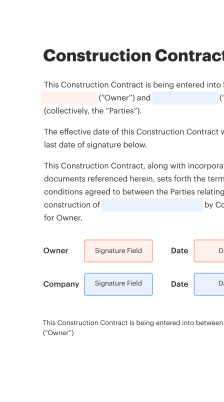
Typical RFP workflow inside Microsoft Office

The process moves from template creation to recipient routing, response collection, and signature capture while maintaining version history inside Office files.

  • Template authoring: Draft the RFP and add fields in Word.
  • Recipient routing: Assign reviewers and set signing order.
  • Response collection: Vendors upload proposals and complete fields.
  • Finalization: Capture signatures and lock the final document.
Collect signatures
24x
faster
Reduce costs by
$30
per document
Save up to
40h
per employee / month

Quick setup steps to start using RFP features in Office

Follow these concise steps to configure an Office-based RFP workflow that preserves templates, routes approvals, and captures signatures.

  • 01
    Install add-in: Add the Office integration to Word and Excel.
  • 02
    Create template: Design a standardized RFP template with fields.
  • 03
    Set approvers: Define reviewers and signing order.
  • 04
    Send and track: Distribute RFPs and monitor status.

Detailed steps for completing an Office-based RFP from draft to signature

Follow this grid to handle core activities when preparing, sending, and finalizing an RFP within Microsoft Office.

01

Draft RFP:

Create the base document with required sections.
02

Insert fields:

Place response and signature fields in the document.
03

Assign reviewers:

Set approvers and signing order.
04

Distribute to vendors:

Send secure links or packaged documents.
05

Collect responses:

Monitor incoming proposals and attachments.
06

Finalize and archive:

Capture signatures and store final files.
be ready to get more

Why choose airSlate SignNow

  • Free 7-day trial. Choose the plan you need and try it risk-free.
  • Honest pricing for full-featured plans. airSlate SignNow offers subscription plans with no overages or hidden fees at renewal.
  • Enterprise-grade security. airSlate SignNow helps you comply with global security standards.
illustrations signature

Recommended workflow configuration for RFP approvals

Use these workflow settings as a baseline when configuring RFP routing, reminders, and archival behavior within Office-integrated solutions.

Setting Name Configuration
Reminder Frequency for Pending Signatures 48 hours
Default Signing Order and Routing Sequential approvals
Document Expiration Window 30 days
Automatic Archival Location Secure cloud folder
Retention and Deletion Policy 7 years

Supported platforms and device considerations

Most Office-integrated RFP features run in Word and Excel desktop clients, Office Online, and supported mobile Office apps, but capabilities vary by platform.

  • Windows desktop: Full feature set
  • macOS desktop: Most features supported
  • Office web and mobile: Core features, limited add-ins

Verify specific feature parity for add-ins and API-driven workflows on your targeted platforms, and plan fallbacks such as PDF signing links for environments with limited integration support.

Security and authentication features to expect

Data encryption: AES-256 at rest
Transport security: TLS 1.2+ in transit
Access controls: Role-based permissions
Multi-factor authentication: Optional MFA support
Audit logging: Comprehensive event logs
Certificate signing: X.509 certificate options

Industry scenarios where RFP in Office helps product teams

Practical examples show how embedding RFP capabilities into Office speeds decisions and maintains governance across industries.

Enterprise SaaS procurement

A product team prepares an RFP template in Word focusing on API performance criteria and security requirements

  • Vendors complete structured responses using preserved tables and embedded fields
  • Scoring sheets in Excel auto-import vendor scores for side-by-side comparison

Leading to faster contract awards and consistent compliance documentation for procurement audit purposes.

Healthcare vendor selection

A healthcare product manager uses an Office-based RFP to include HIPAA-specific questionnaire sections

  • Vendors attach compliance attestations alongside technical proposals
  • Legal and security reviewers use tracked changes for review and approvals

Resulting in a documented approval path that meets internal policy and supports regulatory oversight.

Best practices for secure and accurate RFP handling in Office

Adopt consistent controls and review practices to keep RFPs accurate, auditable, and secure when working in Microsoft Office.

Maintain a centralized template registry
Store approved RFP templates in a locked library with versioning, so all product teams use the same required sections, scoring fields, and legal clauses to minimize inconsistencies.
Use role-based approvals and segregation of duties
Configure workflows so product, procurement, and legal reviewers each have defined responsibilities and cannot bypass mandatory review steps, which preserves governance and compliance.
Validate authentication and signing methods
Require appropriate signer authentication levels based on contract value or sensitivity, and ensure the chosen authentication method provides sufficient identity assurance for legal validity.
Retain signed RFPs with metadata
Archive final signed documents along with their audit trails and metadata in a secure repository to support audits, procurement records, and post-contract reviews.

Common problems and how to resolve them

This FAQ-style troubleshooting section covers frequent issues product teams encounter with RFP workflows in Microsoft Office and practical fixes.

Feature availability comparison among leading eSignature providers for Office-based RFPs

The table summarizes availability and concise technical details to help assess which provider aligns with Office-centric RFP workflows.

Feature Availability by Vendor Table signNow (Recommended) DocuSign Adobe Sign
Bulk Send
Native Office add-in
HIPAA compliance support Available Available Available
API access for automation REST API REST API REST API
be ready to get more

Get legally-binding signatures now!

Typical timelines and retention guidelines for RFP projects

Set clear deadlines and retention policies to manage RFP cycles and satisfy legal and procurement recordkeeping requirements.

RFP issuance deadline planning:

Allow 2–4 weeks for vendor responses depending on scope.

Internal review windows:

Allocate 3–7 business days per reviewer for feedback.

Signature and execution period:

Target 48–72 hours after final approval for signatures.

Document retention requirements:

Keep final RFPs and audit trails for minimum 7 years when contracts are involved.

Periodic template review:

Review and update RFP templates annually or after major policy changes.

Legal and operational risks if RFP processes are not secured

Noncompliance fines: Regulatory penalties
Data breaches: Exposure of sensitive details
Contract disputes: Ambiguous signatures
Audit failures: Missing records
Procurement delays: Extended timelines
Reputational harm: Vendor mistrust

Pricing and plan essentials across providers for RFP use cases

Compare starter pricing, trial availability, and enterprise features that matter for product management RFP processes before evaluating long-term TCO.

Starting price (per user/month) Starts at $8 per user/month Starts at $10 per user/month Starts at $29.99 per user/month Custom pricing available Starts at $15 per user/month
Free trial Yes, trial available Yes, trial available Yes, trial available Yes, trial available Yes, trial available
API included Included in business plans Included in standard plans Included in business plans Included in enterprise Included in paid plans
Enterprise compliance options HIPAA and FERPA options HIPAA, SOC options HIPAA, SOC options HIPAA available SOC and compliance options
Template and bulk send Template library and Bulk Send Templates and bulk features Template management Advanced templates Templates and bulk send
Dedicated support Email and phone support options Tiered support plans Enterprise support available Enterprise success managers Priority support tiers
walmart logo
exonMobil logo
apple logo
comcast logo
facebook logo
FedEx logo
be ready to get more

Get legally-binding signatures now!