Sales Invoice Sample for Procurement

airSlate SignNow streamlines your document signing process with a user-friendly interface and cost-effective solutions that enhance business efficiency.

Award-winning eSignature solution

Why a standardized sales invoice sample matters for procurement

A clear sales invoice sample for procurement standardizes supplier billing, speeds approvals, and reduces disputes by ensuring consistent line-item descriptions, payment terms, and required procurement references. This reduces back-and-forth between purchasing, accounts payable, and suppliers while supporting audit and recordkeeping needs.

Why a standardized sales invoice sample matters for procurement

Typical users and roles for invoice processing

Procurement Manager

Procurement managers oversee supplier onboarding, set required invoice fields and terms, and enforce template use to ensure invoices align with purchase orders and contract language. They coordinate with legal and finance to include mandatory procurement identifiers and approval workflows.

Accounts Payable Analyst

Accounts payable analysts validate invoice accuracy against purchase orders and receipts, flag discrepancies for resolution, and execute payments per approved terms. They rely on consistent invoice formatting to automate three-way matching and to maintain clean audit trails.

Who relies on a sales invoice sample for procurement

Procurement teams, accounts payable staff, and external suppliers use a standardized sales invoice sample to align expectations and speed payment cycles.

  • Procurement teams coordinating purchase orders, approvals, and contract references across departments.
  • Accounts payable teams matching invoices to POs and processing timely payments.
  • Suppliers submitting compliant invoices to minimize rejection and payment delays.

Clear roles and a common template reduce exceptions and make it faster to resolve discrepancies during procurement reconciliations.

Advanced features that enhance procurement invoice workflows

Beyond the template, integrate automation, authentication, and audit capabilities to reduce manual effort and strengthen compliance across the procurement lifecycle.

Automated Matching

Three-way match automation compares invoice, PO, and receipt data and flags mismatches for exception handling to reduce manual reviews and speed approvals.


Conditional Fields

Dynamic fields that appear only when relevant—such as tax exemptions or shipping charges—reduce clutter and ensure required data is captured when applicable.

Bulk Processing

Batch upload and processing of multiple invoices with consistent rules applied to improve throughput for high-volume suppliers and recurring billing.

Signature and Approval Templates

Predefined signing roles and order enforce the approval chain while ensuring consistent capture of signer identity and timestamp data for audit purposes.

Integration Connectors

Prebuilt connectors for ERPs, procurement platforms, and document storage systems enable seamless transfer of invoice data and status updates.

Machine Readable Exports

CSV, JSON, or XML exports for ledger ingestion and analytics support efficient downstream processing and reporting.

be ready to get more

Choose a better solution

Core features to include in a procurement invoice template

Design the invoice sample to support automated matching, clear payment terms, and regulatory reporting so finance teams can process payments without extensive manual review.

Purchase Order Link

A dedicated PO field that accepts numeric or alphanumeric PO identifiers for automated three-way matching and to prevent processing without a valid PO.

Itemized Line Details

Line-level SKU or service codes, quantities, unit price, tax treatment, and total amounts to ensure precise ledger posting and accurate tax reporting.

Tax and Compliance Block

Fields for supplier tax ID, tax jurisdiction, and tax calculation method to support correct withholding, reporting, and to reduce audit risk.

Approval and Signatures

Designated areas for procurement and finance approvals, digital signature placeholders, and timestamps to document authorization and to enforce policy controls.
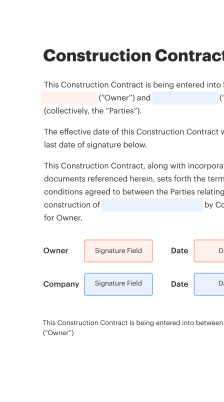
How to use the template in a digital workflow

A digital sales invoice sample for procurement integrates with purchase orders and approval routing to reduce manual handling and accelerate payments.

  • Attach PO: Link the invoice to the originating purchase order or contract.
  • Validate fields: Automated checks confirm tax IDs and totals.
  • Route for approval: Send to procurement and accounts payable approvers.
  • Archive securely: Store completed invoices with immutable audit logs.
Collect signatures
24x
faster
Reduce costs by
$30
per document
Save up to
40h
per employee / month

Quick setup: create a sales invoice sample for procurement

Follow these basic steps to draft a procurement-ready sales invoice sample that supports matching, approvals, and recordkeeping.

  • 01
    Define required fields: Include PO number, supplier ID, tax details, and line-item breakdown.
  • 02
    Standardize descriptions: Use consistent product or service codes and units of measure.
  • 03
    Specify payment terms: State due date, early-pay discounts, and late fees clearly.
  • 04
    Set approval path: Assign approvers and include procurement and finance sign-offs.

Maintaining an audit trail for procurement invoices

Audit trails should capture who did what and when to support compliance and dispute resolution.

01

Capture events:

Log uploads, edits, approvals, and signatures.
02

Include identity details:

Record signer name and authentication method.
03

Timestamp accuracy:

Use synchronized system timestamps.
04

Immutable logs:

Ensure logs are tamper-evident.
05

Retention of logs:

Keep logs aligned with invoice retention.
06

Exportable reports:

Supply CSV or PDF audit reports.
be ready to get more

Why choose airSlate SignNow

  • Free 7-day trial. Choose the plan you need and try it risk-free.
  • Honest pricing for full-featured plans. airSlate SignNow offers subscription plans with no overages or hidden fees at renewal.
  • Enterprise-grade security. airSlate SignNow helps you comply with global security standards.
illustrations signature

Recommended workflow settings for procurement invoice processing

Configure automated checks, reminders, and retention settings to support a reliable procurement invoice lifecycle with minimal manual intervention.

Setting Name Configuration
Reminder Frequency 48 hours
Approval Escalation Time 72 hours
Automatic Matching Threshold Within 2 percent difference
Retention Period for Signed Documents Seven years
Failed Match Handling Route to exceptions queue

Device and platform considerations for invoice processing

Ensure the invoice template and signing workflows are accessible from common devices and support required authentication methods.

  • Desktop browsers: Chrome, Edge, Safari supported
  • Mobile devices: iOS and Android supported
  • PDF compatibility: Printable, fillable PDF format

Test templates and signature flows on representative devices and browsers used by procurement, finance, and supplier personnel to avoid accessibility issues and ensure consistent capture of required data.

Security controls relevant to procurement invoices

Access Controls: Role-based permissions
Data Encryption: AES-256 at rest
Transport Security: TLS 1.2+ in transit
Authentication: Multi-factor options
Document Locking: Editing restricted post-sign
Audit Logs: Immutable event records

Procurement invoice scenarios and outcomes

Two concise examples illustrate how a sales invoice sample for procurement prevents delays and supports compliance.

Supplier PO-matching case

A mid-sized supplier submitted invoices missing PO numbers and line-level costs

  • Template required PO field and standardized line-item descriptions
  • Accounts payable matched items faster and reduced exceptions by 80 percent

Leading to faster payments and fewer reconciliation tasks across finance teams.

Government contractor compliance

A contractor serving municipal procurement needed consistent tax and contract references

  • Template included tax IDs, contract clause citations, and delivery acceptance fields
  • The structured format simplified audit review and supported retention policies

Resulting in smoother audits and demonstrable compliance with contract terms.

Best practices for accurate procurement invoices

Adopt standardized formatting and automated checks to reduce errors and improve processing speed across procurement and finance teams.

Use consistent numeric and date formats
Choose a single date format (MM/DD/YYYY) and numeric separators, and apply them across templates to prevent parsing errors and ensure consistent CSV or system imports into ERP systems.
Mandate purchase order and contract references
Require the PO number and contract ID on every invoice to enable automated matching and to reduce manual research by accounts payable staff during reconciliation.
Include descriptive line items with codes
Attach SKU or service codes and short descriptions for each line to support inventory, cost-center allocations, and to make variance analysis straightforward during month-end close.
Keep approval routing lean and documented
Limit approvers to necessary stakeholders, document their roles in the workflow, and capture timestamps for each approval to improve throughput and support auditability.

FAQs: common issues with sales invoice samples for procurement

Answers to frequent questions about formatting, compliance, and processing of procurement invoices.

Comparing digital signature workflows to paper-based processes

A concise feature-level comparison highlights where digital workflows typically outperform paper-based signing for procurement invoices.

Feature / Criteria signNow (Recommended) DocuSign Paper-based
Turnaround time for approvals Hours 1-2 days Days-weeks
Audit trail completeness Comprehensive Comprehensive Limited
Integration with ERPs
Tamper evidence and document integrity High High Low
be ready to get more

Get legally-binding signatures now!

Retention, backup, and retention timeline for procurement invoices

Define retention periods and backups aligned with finance policy to meet audit and regulatory requirements while managing storage costs.

Standard retention period:

Seven years to meet common tax and audit requirements.

Backup frequency and method:

Daily incremental backups with weekly full backups.

Archival storage policy:

Move closed fiscal year invoices to low-cost, immutable storage.

Deletion and legal holds:

Suspend deletions for invoices under audit or litigation.

Disaster recovery window:

Recover documents within 48 hours for critical finance systems.

Common legal and operational risks with invoices

Late Payments: Interest charges
Incorrect Tax Info: Regulatory fines
Unauthorized Changes: Payment disputes
Missing PO References: Processing delays
Weak Audit Trail: Noncompliance findings
Data Exposure: Breach liability
walmart logo
exonMobil logo
apple logo
comcast logo
facebook logo
FedEx logo
be ready to get more

Get legally-binding signatures now!