Phone Call Authentication
An automated outbound call that delivers a one-time passcode or prompts verbal confirmation, configurable per signer and per document to balance security with user experience.




Phone call authentication strengthens signer identity assurance without requiring specialized hardware, reduces impersonation risk, and integrates with standard eSignature audit trails for legal and operational clarity.

A loan officer uses phone call authentication when sending mortgage or consumer loan documents to ensure the signer is reachable at a known phone number and to reduce fraud during identity verification. They rely on call logs and OTP records to support audit requirements during underwriting reviews.
An HR manager applies phone call authentication for sensitive onboarding forms and benefits elections to confirm a new hire’s identity. The manager reviews the audit trail to verify the authentication event and combines phone verification with document retention policies for compliance.
Teams that need stronger signer verification without full PKI deployments commonly select phone call authentication as a practical step up from email-only workflows.
Implementations are typically focused on specific transaction types or high-risk signer cohorts rather than applied uniformly across all documents.
An automated outbound call that delivers a one-time passcode or prompts verbal confirmation, configurable per signer and per document to balance security with user experience.
A short numeric code spoken during the call that the signer enters or confirms, providing a cryptographic link between the call event and the signing action for audit purposes.
Configurable recording settings enable organizations to capture caller interactions where permitted, with storage and retention settings aligned to privacy and legal policies.
Support for specifying a recognizable caller ID or company name to reduce recipient confusion and improve verification completion rates during authentication calls.
Rules that route signers to alternate authentication methods if a phone call fails, such as falling back to SMS OTP or knowledge-based questions to avoid transaction stalls.
Centralized settings for retry policies, timeout windows, country restrictions, and audit retention to ensure phone call authentication aligns with internal controls and compliance needs.
Use signNow integration to prepare documents in Google Docs, then send through a signing flow that includes phone call authentication for specified recipients, keeping the authoring and verification processes closely linked and reducing manual export and import steps.
Integrate with CRM systems to pull signer phone numbers and trigger phone call authentication automatically when contracts or approvals are generated, ensuring verification is applied consistently to high-value or regulated transactions.
Store signed copies automatically in Dropbox after successful phone call verification and signature completion, maintaining centralized backups and retaining authentication metadata alongside the signed documents for review.
Programmatic API integration allows developers to include phone call authentication in custom workflows, automate call triggers, and retrieve verification status for downstream systems or audit reporting.

| Setting Name and Configuration Value | Default configuration values for phone call authentication |
|---|---|
| Primary authentication delivery channel for signer verification | Phone call with one-time PIN (OTP) |
| Retry attempts and cooldown policy for calls | 2 attempts, 5 minute cooldown |
| Fallback authentication method when call fails | SMS OTP as fallback |
| Call timeout and maximum response window | 60 seconds timeout |
| Audit logging detail level and retention period | Full event logs, retained 5 years |
Phone call authentication requires access to outbound voice services plus standard signNow platform compatibility on web and mobile clients.
Ensure recipient phone numbers are accurate and that outbound calling is enabled for your account region; also consider carrier restrictions and international dialing implications when configuring global workflows.
A lender requires phone call authentication for remote closing authorizations to confirm the borrower’s identity before final signatures.
Resulting in clearer audit evidence and fewer post-closing disputes due to signer identity concerns.
An HR team uses phone call authentication for high-sensitivity onboarding forms to ensure new hires complete background and tax documents securely.
Leading to faster verification, a documented audit trail, and reduced manual follow-up for identity confirmation.
| Criteria | signNow (Recommended) | DocuSign |
|---|---|---|
| Phone Call Authentication Availability | ||
| One-time PIN delivered by call | ||
| Call recording option | Optional | Limited |
| API support for phone authentication |
Store verification logs for 90 days for operational troubleshooting
Retain signed documents and audit trails for 7 years common in contracts
Follow covered entity requirements, often 6 years or as required
Retention configurable; align with privacy and consent rules
Export audit logs for long-term archival outside primary system
| Pricing Metric | signNow (Recommended) | DocuSign | Adobe Sign | HelloSign | PandaDoc |
|---|---|---|---|---|---|
| Starting monthly price | From $8 per user per month | From $10 per user per month | From $14.99 per user per month | From $15 per user per month | From $19 per user per month |
| Standard business plan price | Approximately $12 per user monthly | Approximately $25 per user monthly | Approximately $24 per user monthly | Approximately $20 per user monthly | Approximately $25 per user monthly |
| Enterprise plan available | Yes, enterprise tier available | Yes, enterprise tier available | Yes, enterprise tier available | Yes, enterprise tier available | Yes, enterprise tier available |
| Free trial availability | Free trial available | Free trial available | Free trial available | Free trial available | Free trial available |
| Per-user billing option | Monthly and annual billing available | Monthly and annual billing available | Monthly and annual billing available | Monthly and annual billing available | Monthly and annual billing available |
Make sure your documents are signed by authorized parties only. With phone call authentication, your recipients will be able to sign your documents only after receiving an automated phone call to their number.
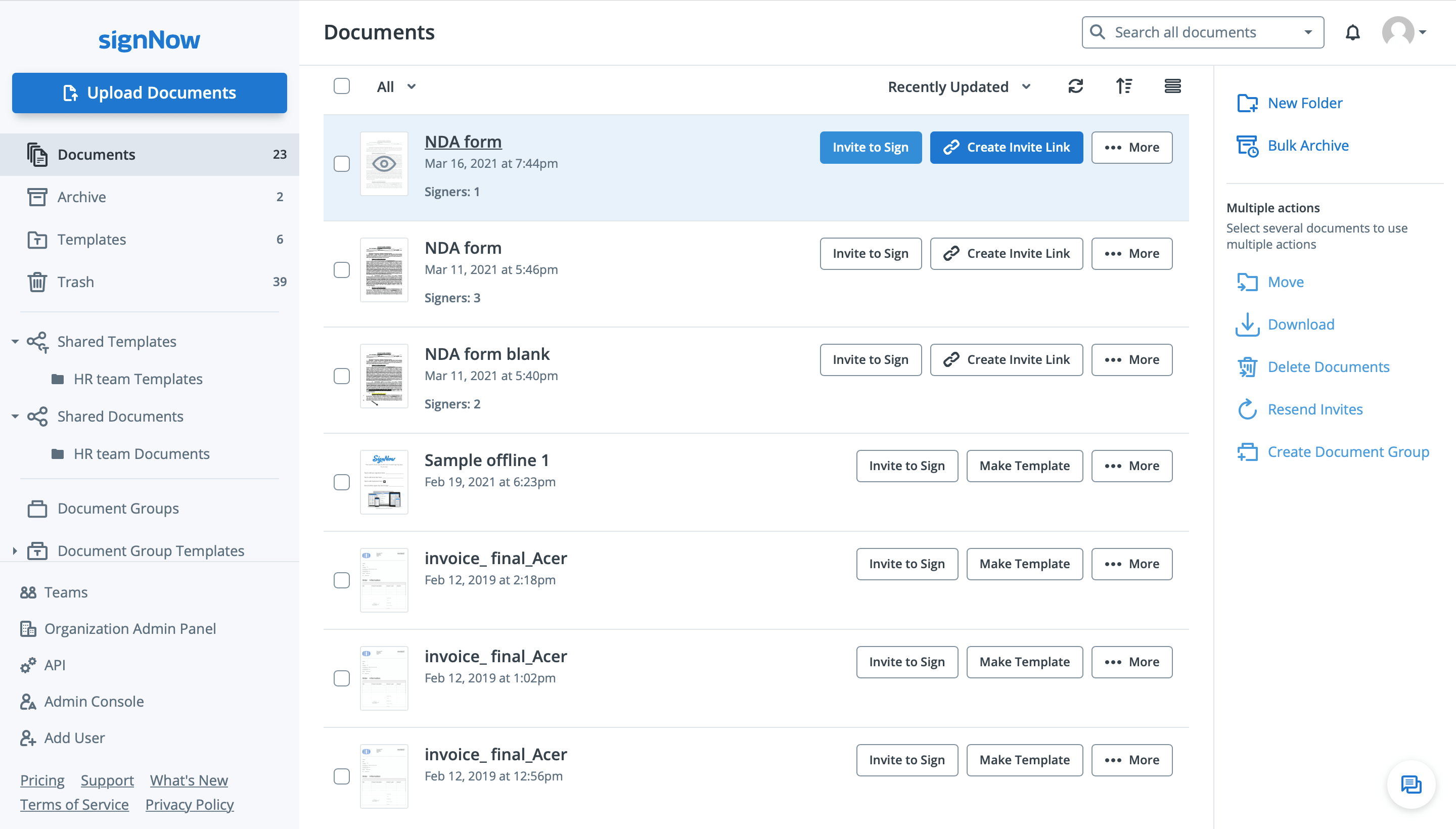
Click Invite to Sign next to a document you need to send for eSignature.
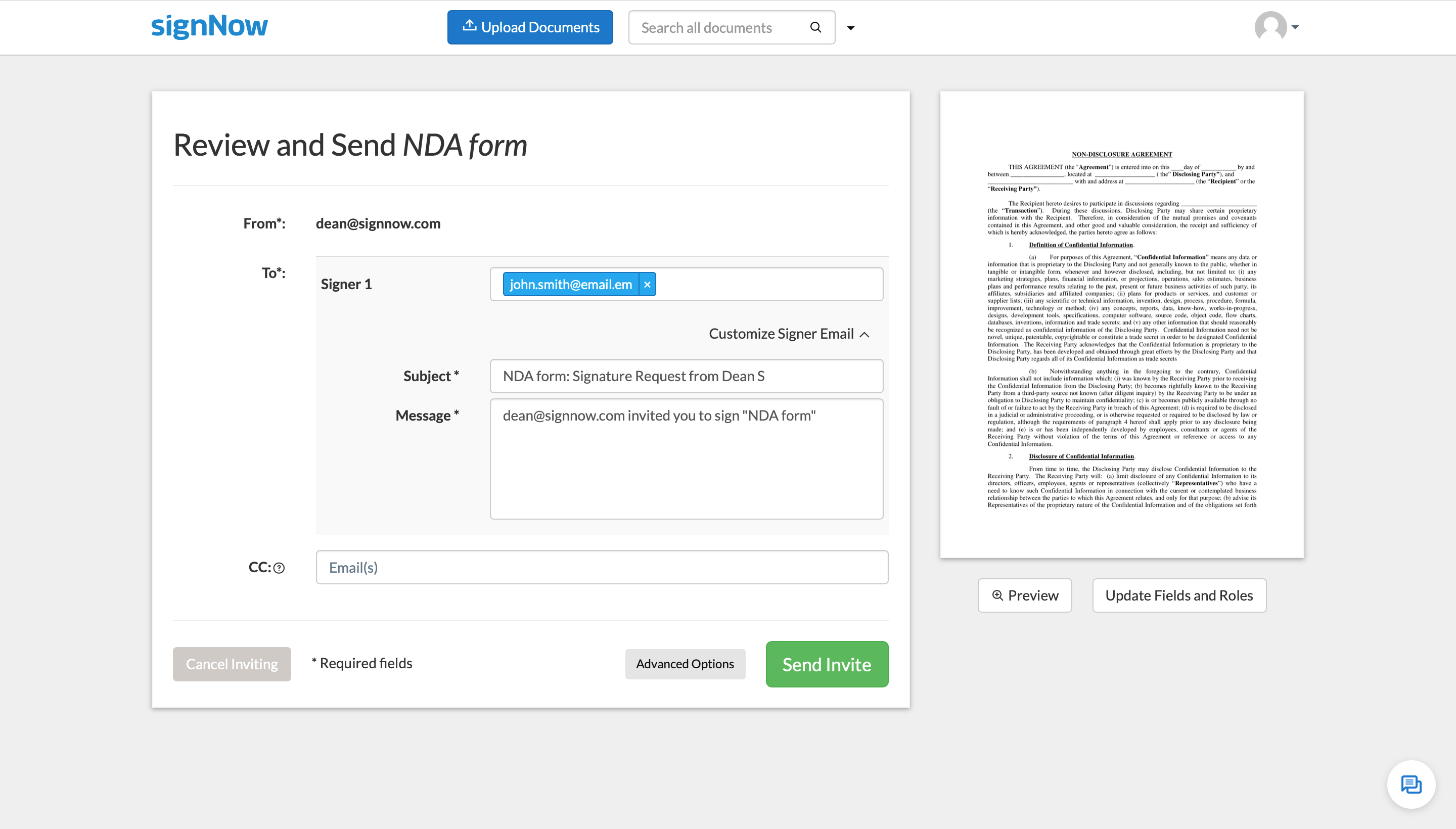
Enter your signer’s email address and customize an invitation subject line and message. Add CC (carbon copy) recipients if you need other parties to receive signed copies of your document. Then, click Advanced Options.
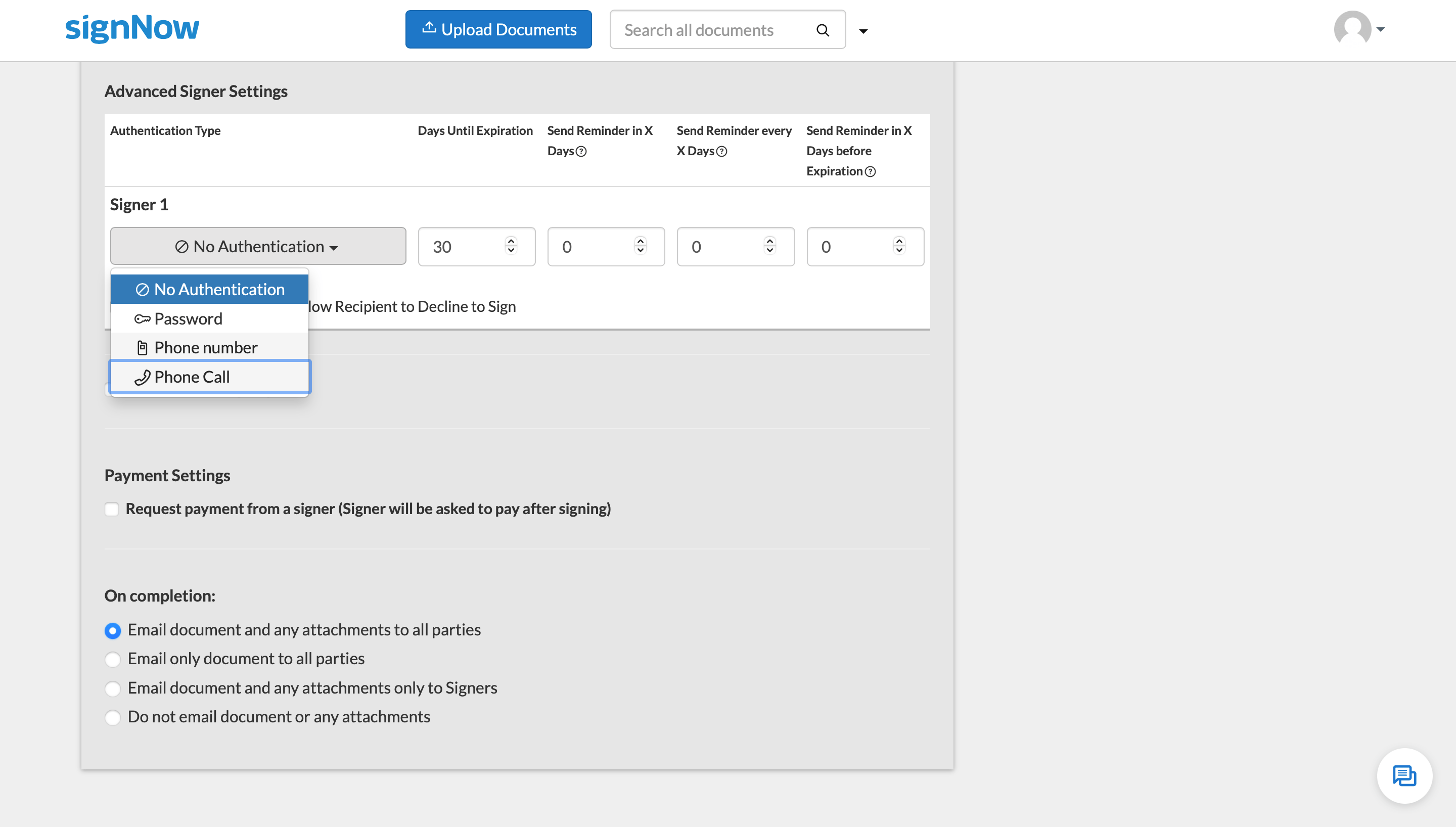
In the Advanced Signer Settings section, click on the No Authentication dropdown and select Phone Call.
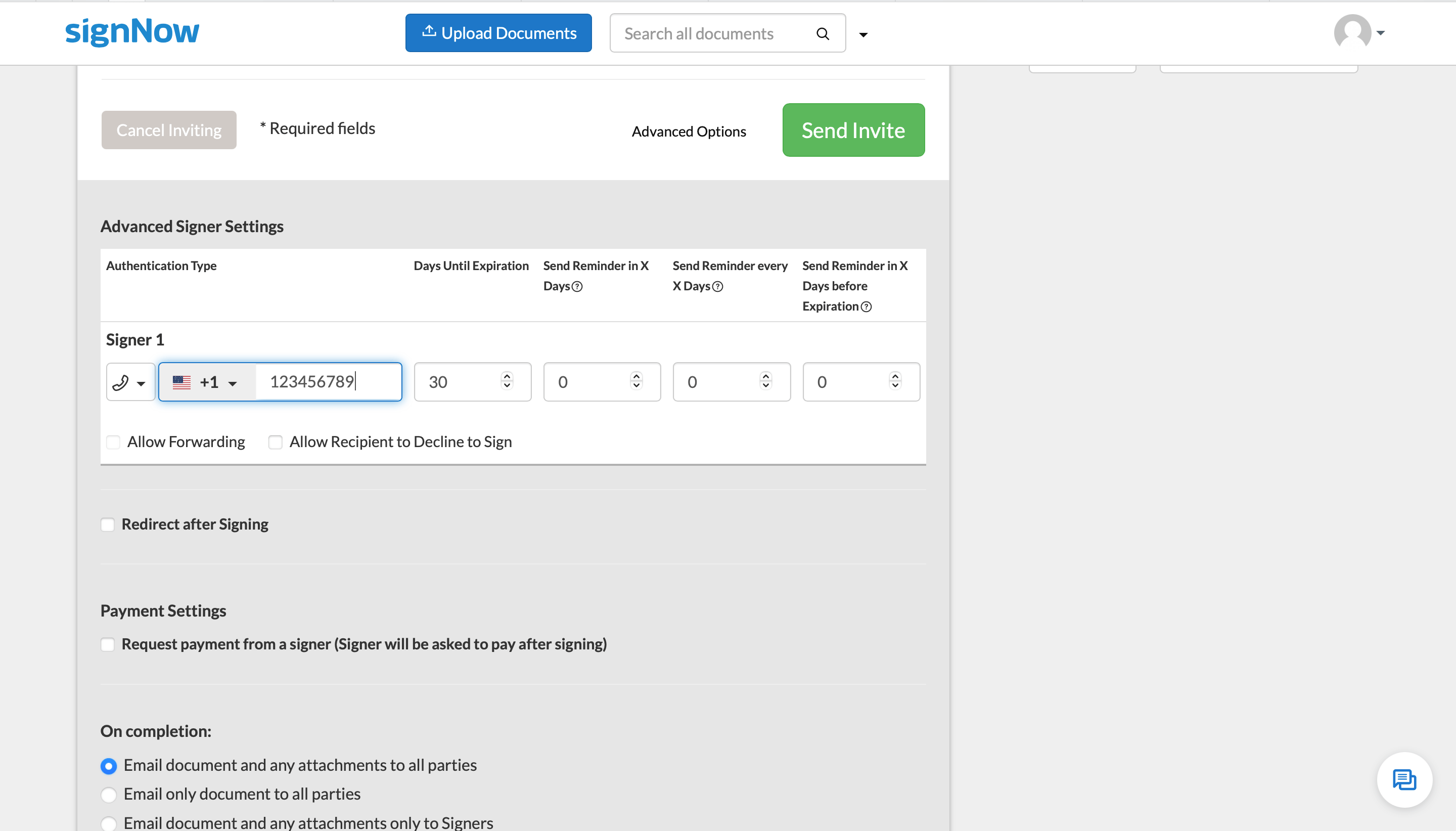
Enter your signer’s phone number and set the expiration date for the document. You can also schedule signer reminders to make sure your document is signed on time. Once finished, click Send Invite to send out your signature request.