Shop Invoice Template for Higher Education

See your invoicing process become fast and seamless. With just a few clicks, you can execute all the required steps on your shop invoice template for Higher Education and other crucial documents from any device with internet access.

Award-winning eSignature solution

What a shop invoice template for higher education is and why it matters

A shop invoice template for higher education standardizes billing for campus shops, bookstores, research departments, and auxiliary services by providing a consistent document structure for goods and services sold to students, faculty, and external customers. It typically includes institutional identifiers, departmental cost centers, tuition or grant billing references, itemized charges, tax and fee fields, and payment terms suitable for university procurement processes. Used correctly, the template reduces manual entry, speeds reconciliation with financial systems, and supports accurate reporting for audits and fund accounting in higher education institutions.

Why adopt a standardized shop invoice template for higher education

Standardized templates reduce errors, speed processing, and improve consistency across departments while supporting institutional accounting and audit requirements.

Why adopt a standardized shop invoice template for higher education

Common challenges when implementing shop invoice templates

  • Decentralized departments use varied invoice formats, causing delays in consolidation and reconciliation.
  • Misapplied fund codes or cost centers lead to inaccurate financial reporting and audit complications.
  • Paper-based workflows create slow turnaround times and increase the risk of lost or duplicated invoices.
  • Inconsistent tax or fee handling across locations results in compliance errors and manual corrections.

Representative users and their roles

Bookstore Manager

Responsible for point-of-sale reconciliation, inventory billing, tax calculations, and producing monthly invoices that align with university chart of accounts and departmental fund restrictions.

Finance Officer

Oversees accounts payable and receivable for campus units, ensures invoice templates meet institutional policy, and coordinates audit responses and end-of-year financial close procedures.

Typical campus users and responsibilities

Departments that manage retail operations, procurement, and auxiliary services commonly rely on standardized invoice templates to streamline billing workflows.

  • Campus bookstore managers handling daily sales and vendor invoicing.
  • Auxiliary services teams billing event rentals, catering, and facility use.
  • Accounts payable teams validating entries and posting to the general ledger.

Central finance and accounts payable teams use completed templates for reconciliation, posting, and audit support across campus.

Six essential features for higher education invoice templates

Focus on capabilities that directly support institutional accounting, approvals, and recordkeeping for campus shops and auxiliary units.

Custom Fields

Allow adding fund, grant, and departmental cost center fields to ensure every invoice maps to institutional accounting structures and reporting requirements.


Validation Rules

Enforce required fields, numeric formats, and code lookups so invoices meet campus policy before submission and reduce downstream corrections.

Approval Routing

Automate multi-step approvals based on department, amount thresholds, or fund source to support internal controls and compliance workflows.

Template Library

Maintain multiple templates for bookstores, catering, and research billing with version control to ensure consistent formats across campus operations.

Export Integrations

Provide CSV or direct ERP connectors to move validated invoice data into Banner, Workday, PeopleSoft, or other campus financial systems.

Audit Trail

Record edits, signoffs, and exports with timestamps to support internal audits, FERPA considerations, and financial compliance reviews.

be ready to get more

Choose a better solution

Integrations and template capabilities to prioritize

Select features that simplify document creation, maintain records, and connect to the systems your institution already uses.

Google Docs Integration

Enable creating invoice templates directly from Google Docs content, preserving institutional branding and allowing collaborative editing with change history compatible with document management workflows.

CRM Connectivity

Sync customer and sponsor records from institutional CRMs to prefill invoice fields, reducing manual entry and ensuring consistent billing information across departments.

Cloud Storage Links

Automatically archive completed invoices to campus-approved cloud storage services for retention, retrieval, and long-term records management in line with policy.

ERP Export

Provide configurable export formats or API connectors to send final invoice data into campus ERPs, minimizing rekeying and reconciliation work for finance teams.
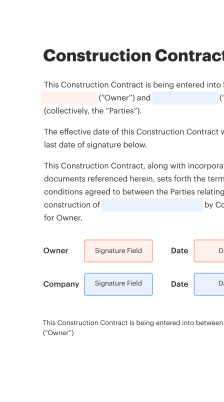
How an online template-based invoice workflow operates

A template-driven workflow standardizes data capture, automates approvals, and exports validated invoice data to financial systems.

  • Create Template: Design fields, layout, and validation rules.
  • Populate Invoice: Staff fill required fields using the template.
  • Approval Flow: Route invoices to authorized approvers automatically.
  • Export Posting: Send final data to ERP or accounting systems.
Collect signatures
24x
faster
Reduce costs by
$30
per document
Save up to
40h
per employee / month

Quick setup steps for a shop invoice template for higher education

Follow these four concise steps to configure a template that meets campus accounting and operational needs.

  • 01
    Define fields: List required invoice metadata and accounting codes.
  • 02
    Set validation: Apply mandatory and format rules for key fields.
  • 03
    Add instructions: Include departmental guidance and payment terms.
  • 04
    Test and deploy: Validate with sample invoices before campus rollout.
be ready to get more

Why choose airSlate SignNow

  • Free 7-day trial. Choose the plan you need and try it risk-free.
  • Honest pricing for full-featured plans. airSlate SignNow offers subscription plans with no overages or hidden fees at renewal.
  • Enterprise-grade security. airSlate SignNow helps you comply with global security standards.
illustrations signature

Recommended workflow settings for invoice approval

Use these common configuration settings to implement reliable approvals and notifications for template-based invoices.

Feature Configuration
Reminder Frequency 48 hours
Approval Escalation After 5 days
Default Approver Department head
File Retention Policy 7 years
Export Format CSV, JSON

Supported devices and platform requirements

Ensure devices and browsers meet minimum requirements to use online invoice templates reliably across campus.

  • Desktop browsers: Chrome, Edge, Firefox
  • Mobile devices: iOS, Android supported
  • Minimum bandwidth: 2 Mbps recommended

For secure campus deployments, require up-to-date browsers, enforce device security policies, and use institutionally approved networks or VPNs when accessing financial templates remotely to maintain data protection and compliance.

Security and access controls for invoice templates

Role-based access: Least privilege enforced
Encryption at rest: AES-256 standard
Encryption in transit: TLS 1.2+ required
Audit logging: Comprehensive trails
User authentication: MFA supported
Document permissions: View and edit controls

Higher education scenarios using a shop invoice template

Two representative case studies show how templates streamline campus billing and improve financial controls.

Campus Bookstore Billing

A midsize university bookstore adopted a standardized shop invoice template to capture department codes and grant references accurately

  • Template enforces mandatory fund fields and tax calculations
  • Faster reconciliation and fewer posting errors

Resulting in reduced month-end adjustments and clearer audit trails for university finance.

Event Services and Catering

A campus events office used the template to itemize venue fees, catering charges, and sponsor contributions

  • Template includes predefined line items and payment terms
  • Improved chargeback accuracy and sponsor invoicing speed

Resulting in faster collections and better alignment with departmental budgets during fiscal close.

Best practices for accurate and secure invoice templates

Adopt these practices to improve accuracy, protect data, and simplify audits when using shop invoice templates across campus.

Enforce standardized naming and codes
Use consistent field names, fund and cost center codes, and controlled vocabularies to ensure invoices map correctly to accounting systems and reduce reconciliation errors across departments.
Require validation and mandatory fields
Make critical fields mandatory and apply format validation to dates, amounts, and account codes to catch errors before submission and avoid downstream corrections during posting.
Keep an audit-ready archive
Retain signed and exported invoices with full audit trails, timestamps, and user actions in secure storage that aligns with institutional retention policies and supports regulatory reviews.
Train staff and document procedures
Provide concise guidance for staff who prepare and approve invoices, and keep documentation on template use, field meanings, and escalation procedures for consistent application across campus.

FAQs about shop invoice template for higher education

Answers to common questions about creating, using, and maintaining invoice templates within campus workflows.

Feature availability comparison for invoice templates

Compare core capabilities across common eSignature and document platforms for higher education invoice workflows.

Criteria signNow (Recommended) DocuSign Adobe Acrobat Sign
Advanced Authentication MFA MFA + SAML MFA + SAML
Bulk Send Limited
Template Management Robust Robust Robust
Audit Trail Detail Full Full Full
be ready to get more

Get legally-binding signatures now!

Retention and timeline considerations for shop invoices

Define retention lengths and review cycles that align with institutional policy and audit requirements.

Minimum retention period:

7 years recommended

Monthly reconciliation deadline:

10 business days

Template review cycle:

Annual review

Approval response time:

5 business days

Export schedule:

Monthly or quarterly

Risks and potential penalties for poor invoice handling

Noncompliance fines: Regulatory fines possible
Audit findings: Negative audit reports
Funding misallocation: Incorrect fund usage
Data breaches: Exposure risk
Payment delays: Cashflow impact
Reputational harm: Stakeholder distrust

Pricing and package comparison for document platforms

Typical entry-level pricing and common package features to consider when selecting a platform for campus invoice templates.

Plan signNow (Recommended) DocuSign Adobe Acrobat Sign PandaDoc Dropbox Sign
Starting Monthly Price $8 per user/mo $10 per user/mo $14.99 per user/mo $19 per user/mo $15 per user/mo
Free Tier Availability Free trial only Free trial only Free trial only Free trial only Free trial only
Bulk Send Limit Up to hundreds Limits vary by plan Limits vary by plan Available on higher plans Available on higher plans
Document Storage Included Basic storage included Limited storage Limited storage Generous storage Integrated Dropbox storage
Support Level Email and chat Email, phone options Email and phone Email and chat Email and chat
walmart logo
exonMobil logo
apple logo
comcast logo
facebook logo
FedEx logo
be ready to get more

Get legally-binding signatures now!