Sign Release of Liability Form with SignNow

Eliminate paper and optimize digital document processing for increased productivity and countless opportunities. Discover a greater manner of doing business with airSlate SignNow.

Award-winning eSignature solution

What a sign release of liability form is and why it matters

A sign release of liability form is a legally oriented document used to record a participant's acknowledgment of risks and to limit an organizer's exposure to certain claims. In digital practice, the form is prepared, sent, and signed electronically using an eSignature solution such as signNow to ensure consistent execution, a timestamped audit trail, and secure storage. For U.S. transactions the electronic document must meet ESIGN and UETA standards to be enforceable; proper identity verification and clear consent language help preserve admissibility and contractual effect in courts and administrative proceedings.

When using a sign release of liability form improves operations

Using an electronic sign release of liability form reduces manual paperwork and centralizes signed records while improving clarity of consent and timestamps.

When using a sign release of liability form improves operations

Common challenges when implementing digital release forms

  • Crafting clear liability language that holds up under state-specific legal scrutiny can require attorney review and iterative edits.
  • Ensuring signer identity beyond a simple email address often needs multi-factor authentication or knowledge-based options for higher assurance.
  • Managing version control and template updates across teams without breaking active signature workflows can cause confusion and mis-signed documents.
  • Retaining signed releases according to corporate and regulatory policies requires a predictable retention schedule and secure backups.

Representative user profiles

Event Manager

An event manager who coordinates public and private gatherings uses sign release of liability form templates to collect waivers from attendees, track signed records per event date, and produce audit logs for insurance or incident investigations. The manager configures reminders and stores completed forms in a secure cloud folder for easy retrieval.

Recreation Director

A recreation director at a municipal facility deploys standardized release forms for camps and classes, assigns signature roles to guardians, and audits completed documents before admitting participants. The director relies on identity verification where applicable and on retention settings to comply with local recordkeeping policies.

Typical users and teams that rely on signed release forms

Organizations across events, recreation, healthcare, and field services commonly use sign release of liability form workflows to manage risk and consent.

  • Event organizers and venue managers handling participant waivers for activities and private events.
  • Sports and recreation providers capturing consent for classes, camps, and athletic programming.
  • Field service teams and contractors documenting site-specific acknowledgements and risk allocations.

These forms are practical tools for small-business owners and enterprise teams alike when combined with consistent storage, audit trails, and access controls.

Additional features to streamline release form operations

Beyond core tools, the following features improve scale, compliance, and integration of sign release of liability form processes across an organization.

Bulk Send

Send a single release template to large recipient lists with individualized fields prefilled to streamline mass signings for events, participants, or registrants while tracking status per recipient.


Conditional Fields

Show or hide fields based on prior answers so the release form adapts to participant responses and collects only relevant information, improving completion rates and data quality.

Team Templates

Share approved release templates across groups with controlled editing rights so departments use consistent language and avoid unauthorized modifications that could affect enforceability.

Notifications & Reminders

Automated reminders reduce unsigned form backlogs and provide administrators with escalation options to ensure deadlines are met and events proceed with required consent.

Integration Connectors

Native or API-based connectors to CRM, event platforms, and cloud storage keep participant data synchronized and signed releases archived where business processes require them.

Role-Based Access

Fine-grained permissions control who can send, view, or export signed releases, supporting segregation of duties and audit requirements in larger organizations.

be ready to get more

Choose a better solution

Core tools that support reliable release form workflows

These four capabilities are essential for consistent execution of sign release of liability form processes and for maintaining evidentiary quality and operational efficiency.

Template management

Reusable, preapproved templates let teams standardize release language, prefill event or client data, and control versioning so staff always send the current form while reducing review cycles and human error.

Authentication options

Multiple signer verification methods — email, SMS, two-factor, and advanced identity checks — help balance usability with legal assurance depending on the transaction risk and internal policy requirements.

Audit trail

A detailed, tamper-evident log of each action including timestamps, IPs, and authentication events preserves a defensible record that supports admissibility and reduces disputes after incidents.

Storage & retention

Secure cloud storage with configurable retention policies ensures signed releases are preserved according to corporate rules and legal obligations while simplifying retrieval for audits and claims.
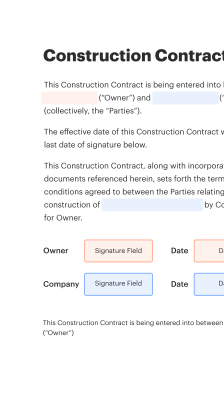
How online sign release of liability form workflows operate

A typical digital signing process moves from template creation to signer verification, signature capture, and secure storage, with the platform recording each action.

  • Create template: Upload or build the form and fields
  • Assign recipients: Specify signer order and roles
  • Authenticate signer: Use email link, SMS, or 2FA
  • Complete and archive: Capture signatures and store a copy securely
Collect signatures
24x
faster
Reduce costs by
$30
per document
Save up to
40h
per employee / month

Quick setup: create and send a sign release of liability form

Follow these basic steps to prepare, distribute, and store a release form securely with an eSignature workflow that records consent and identity.

  • 01
    Prepare template: Draft clear liability language and fields
  • 02
    Add signer roles: Assign signatures and any witness roles
  • 03
    Select authentication: Choose email, SMS, or 2FA verification
  • 04
    Send and track: Distribute, monitor status, and store signed copies

Step-by-step: completing a sign release of liability form

Follow these user-focused actions to complete a release form on most eSignature platforms quickly and correctly.

01

Open link:

Click the signing link sent by email
02

Review terms:

Read the release language carefully
03

Verify identity:

Complete any requested authentication step
04

Fill fields:

Enter required participant information
05

Sign:

Apply signature and date the form
06

Download copy:

Save or receive email copy after signing
be ready to get more

Why choose airSlate SignNow

  • Free 7-day trial. Choose the plan you need and try it risk-free.
  • Honest pricing for full-featured plans. airSlate SignNow offers subscription plans with no overages or hidden fees at renewal.
  • Enterprise-grade security. airSlate SignNow helps you comply with global security standards.
illustrations signature

Recommended workflow settings for release form automation

Configure these workflow settings to standardize how release forms are sent, authenticated, and retained while aligning with internal policies.

Workflow Setting Name and Configuration Default configuration value for each setting
Automatic Reminder Frequency and Delivery Options 48 hours; two reminders by email
Default Authentication and Identity Verification Method Email link plus optional SMS OTP
Template Approval and Version Control Policy Admins approve templates before publishing
Default Signing Order and Role Assignment Sequential signer order enabled
Retention Period and Archive Action Retain three years then archive

Supported devices and platform requirements

sign release of liability form workflows commonly support desktop and mobile browsers plus native apps to accommodate field and office users.

  • Desktop browsers: Recent Chrome, Edge, Firefox
  • Mobile devices: iOS and Android apps available
  • File formats: PDF, Word, and image support

For reliable signing, keep browsers and apps updated, enable cookies and TLS, and ensure mobile users have a stable network connection and the latest app version installed.

Security controls for sign release of liability form workflows

Encryption in transit: TLS encryption for data transfer
Encryption at rest: AES-256 encrypted storage
Access controls: Role-based user permissions
Authentication: Multi-factor authentication options
Audit logging: Comprehensive timestamped trails
Secure backups: Redundant cloud backups

Industry examples showing practical use

Two concise case examples illustrate how digital release forms integrate into real workflows across sectors and improve recordkeeping.

Outdoor Adventure Company

A regional outdoor adventure operator required signed waivers before any guided activity to reduce litigation exposure and clarify participant responsibilities.

  • The operator used prefilled fields and group templates to populate trip dates and guide names.
  • That reduced manual entry and errors for seasonal staff.

Resulting in faster check-in processes, fewer missing waivers, and a consolidated audit trail for each excursion.

University Recreation

A university recreation center needed guardian consent for student participation in intramural events and club sports.

  • They leveraged role-based signing so guardians could sign remotely and staff could verify registration.
  • This improved compliance with institutional policies while offering convenience to families.

Leading to consistent retention of signed waivers for semesters, simpler incident follow-up, and clear documentation for campus risk management.

Best practices for secure and enforceable release forms

Adopt these practical recommendations to improve the clarity, enforceability, and manageability of sign release of liability form workflows across teams.

Use plain, specific liability language
Draft concise statements of the risks being released, name the parties clearly, avoid ambiguous legalese, and have counsel review jurisdiction-specific clauses to reduce the chance a court will find the release unconscionable or inadequate.
Choose appropriate signer verification
Match the strength of identity checks to the sensitivity of the activity; for higher-risk events prefer multi-factor or government ID verification to strengthen admissibility in disputes.
Control templates and versions centrally
Restrict who can edit templates, maintain version histories, and require approvals for language changes so teams don’t use outdated releases that could expose the organization to inconsistent terms.
Maintain retention and access policies
Define retention periods consistent with insurance and legal requirements, enable role-based access for retrieval, and implement secure deletion workflows when records reach end-of-life.

FAQs about sign release of liability form

Common questions address enforceability, signer identity, mobile signing, templates, storage, and steps to fix typical signing problems.

Feature comparison: sign release of liability form capabilities

Compare essential capabilities across leading eSignature providers to match platform features to legal, security, and operational needs.

Enterprise eSignature Vendor Feature Matrix signNow (Recommended) DocuSign Adobe Sign
Legal validity under US laws (ESIGN UETA)
Audit trail and tamper-evidence features Detailed Detailed Detailed
Authentication and identity verification options available Email+SMS+2FA Email+KBA+2FA Email+2FA
Bulk sending and API integration availability
be ready to get more

Get legally-binding signatures now!

Retention and review timeline for signed releases

Standard retention and review points help organizations meet legal obligations and support efficient incident response when releases are needed for claims or audits.

Initial preservation period:

Retain signed releases for at least 3 years

Insurance claim window:

Keep documents for duration of claim exposure

Periodic template review:

Review release language annually

Secure archive transfer:

Move aged records to cold storage after retention

Secure deletion schedule:

Permanently delete per policy after retention ends

Legal and operational risks to consider

Invalid signatures: Risk of unenforceability
Insufficient identity proof: Disputed signer identity
Noncompliant retention: Regulatory penalties
Inadequate disclosures: Contract voidability risk
Poor version control: Conflicting document terms
Data breach: Liability and notification costs

Pricing and plan overview for release form deployments

Review entry and standard pricing elements across providers for budgeting, including per-user rates, API access, and enterprise licensing considerations.

Vendor Pricing and Feature Matrix signNow (Featured) DocuSign Adobe Sign HelloSign PandaDoc
Entry-level plan (per user, monthly) From $8 per user per month, annual billing From $10 per user per month, annual billing From $9.99 per user per month, annual billing From $15 per user per month, annual billing From $19 per user per month, annual billing
Standard plan features included Templates, team folders, reminders included Templates and basic workflows Integrated PDF tools and templates Basic eSign plus templates Templates with sales document features
API access and developer options Available on business plans; reasonable quotas Available on business plans; tiered pricing Available with enterprise licensing API on higher tiers API included with business tiers
Advanced authentication add-ons cost Identity verification add-on at enterprise pricing Additional identity checks priced per verification ID verification via Adobe partners; pricing varies ID verification available at extra cost ID verification via partners; extra fees
Bulk send and volume allowances Bulk send support and scalable quotas on higher plans Bulk send available with limits and add-ons Bulk send for enterprise customers Bulk send on standard plans with limits Bulk send available on mid-tier plans

Streamline challenging workflows

Create, perform, and manage workflows of any complexity, digitally from almost anywhere. Scalable electronic signature features enable you to exchange documents with the right people in the correct way and assign roles for each receiver. Execute document workflows faster and simpler than ever before.

Automate document managing

Enhance sophisticated signing procedures with airSlate SignNow�s effective features to boost your business. Control your automated eSignature workflows to ensure they're running at top performance with fast notices and alerts.

Enhance in team communication

Get teammates together in a safe, shared workspace. Manage documents, use form templates and notices to produce more efficient cross-organization collaboration. Free your employees from having to hang out on recurring actions so that they can give attention to valuable, business-crucial duties.

Integrate into your current systems

Run your jobs with industry-leading integration. Capture Salesforce, Microsoft Teams, and SharePoint all in one business flow. Link up your applications to a single system for countless possibilities and more efficiency.

Remain compliant with industry-leading data security

Feel safe knowing that your data is protected by the newest in encryption security. airSlate SignNow is GDPR and eIDAS certified and offers you transparence into your eSigning process with court-admissible audit trails. Configure user authorization and rights to regulate who has access to what.


walmart logo
exonMobil logo
apple logo
comcast logo
facebook logo
FedEx logo
be ready to get more

Get legally-binding signatures now!