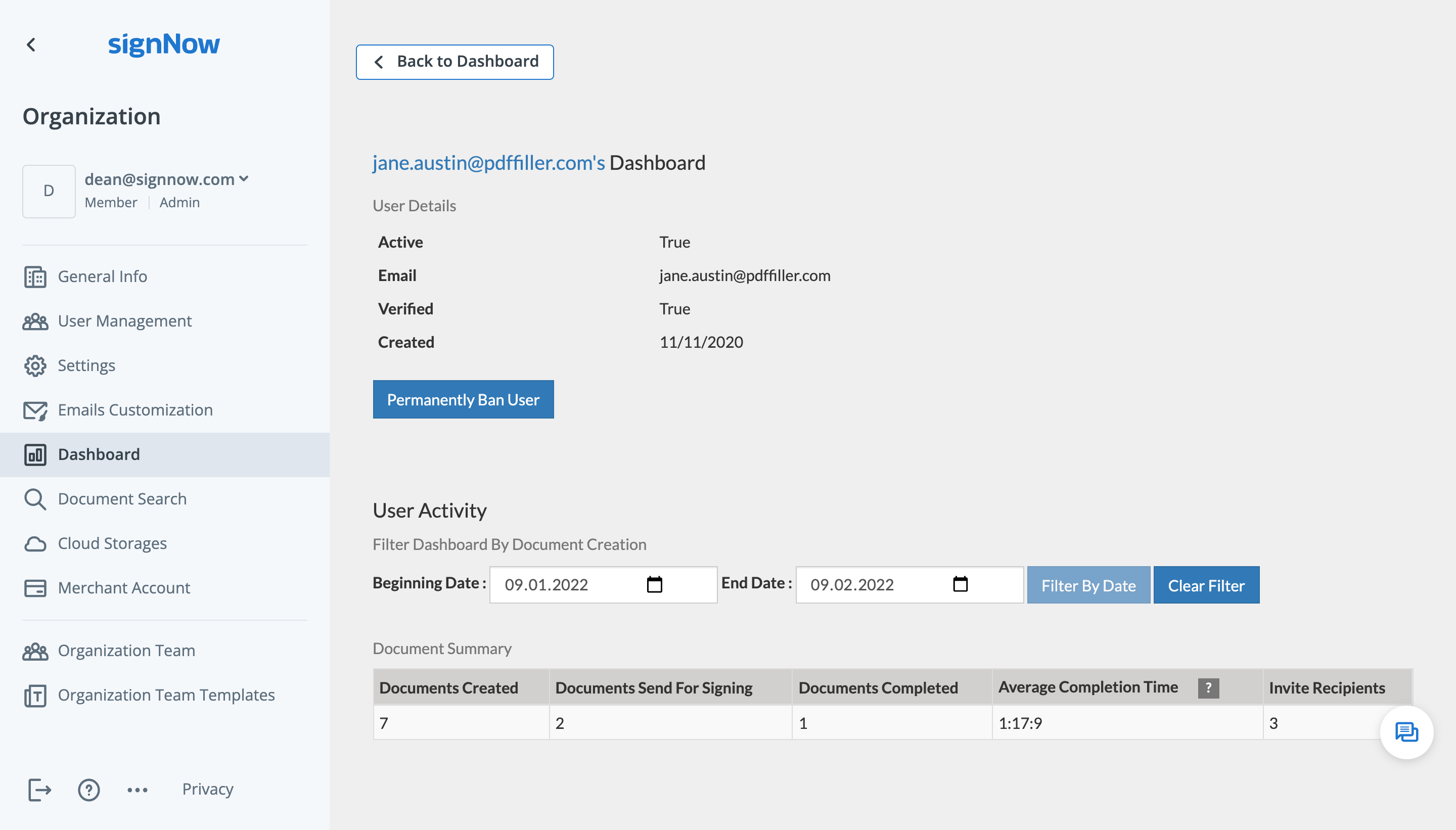
Track User Activity in the Organization Dashboard
What it means to track user activity in the organization dashboard
Why monitoring user activity matters for organizations
Tracking activity provides visibility into document workflows and user behavior, supports audit readiness, and helps detect misconfigurations or unauthorized access quickly.
Common challenges when trying to track user activity
- Incomplete logs when systems do not capture granular events such as field edits or view-only accesses.
- Disparate data across integrations makes it hard to correlate actions from CRM, cloud storage, and eSignature systems.
- Retention policy conflicts can lead to missing historical activity needed for long-term compliance audits.
- Scaling dashboards for large organizations without performance degradation or excessively large exports.
Typical user profiles for activity monitoring
IT Administrator
An IT Administrator uses the dashboard to review authentication events, integration logs, and API usage patterns. They configure retention settings, audit SSO activity, and investigate anomalous IP addresses to maintain platform integrity and uptime.
Compliance Officer
A Compliance Officer examines per-user signature records, exportable audit trails, and policy exceptions. They generate reports for ESIGN and HIPAA reviews, verify consent flows, and maintain evidence for regulatory or internal governance requirements.
Teams and roles that commonly rely on activity tracking
IT, compliance, HR, and operations teams typically use activity dashboards to monitor access, enforce policies, and investigate incidents.
- IT administrators who audit logins and integration activity to maintain system health and security.
- Compliance officers who verify signature chains and retention for regulatory obligations like ESIGN and HIPAA.
- Team managers who review completion rates and bottlenecks in document workflows to improve efficiency.
Using a centralized dashboard enables coordinated responses across teams and makes accountability and reporting simpler during internal reviews or external audits.
Choose a better solution
Essential dashboard tools for effective activity tracking
Activity Log
Comprehensive, timestamped records of user events including sign-ins, document views, edits, sends, and signature completions to create a clear, auditable chain of custody.
Filters & Search
Multi-criteria filtering by date range, user, document, IP address, or event type to narrow results quickly for investigations or regular reporting by compliance teams.
Real-time Alerts
Configurable notifications for unusual behavior such as failed authentication, high-volume exports, or administrative changes so teams can respond promptly to incidents.
Export & Reporting
Support for CSV and JSON exports as well as scheduled reports to integrate audit data with SIEM systems or to retain records for regulatory evidence.
How activity tracking operates within an eSignature dashboard
-
Event capture: System logs each user action
-
Aggregation: Events grouped by user and document
-
Visualization: Dashboards display trends and filters
-
Export: Downloadable audit-ready reports
Quick setup: how to start tracking user activity in the organization dashboard
-
01Enable logging: Turn on organization-wide event capture
-
02Configure retention: Set log retention windows per policy
-
03Assign roles: Grant dashboard access to reviewers
-
04Test exports: Validate CSV or JSON output
Why choose airSlate SignNow
-
Free 7-day trial. Choose the plan you need and try it risk-free.
-
Honest pricing for full-featured plans. airSlate SignNow offers subscription plans with no overages or hidden fees at renewal.
-
Enterprise-grade security. airSlate SignNow helps you comply with global security standards.
Recommended workflow settings to support activity tracking
| Feature | Configuration |
|---|---|
| Activity Log Retention | 90 days |
| Alert Rules | Email and in-app |
| Export Format | CSV and JSON |
| Default Privacy Level | Organization-wide |
| User Activity Sampling | Real-time |
Supported platforms and requirements for reliable activity tracking
Ensure users access the dashboard through supported browsers or official mobile apps and maintain up-to-date clients for accurate event capture.
- Web Browser: Chrome, Edge, Safari
- Mobile App: iOS and Android
- API Access: OAuth 2.0 tokens
For consistent activity records, enforce updated clients, standardize login methods like SSO, and ensure API integrations follow documented endpoints so events are recorded uniformly across devices and services.
Industry examples of tracking user activity in practice
Healthcare Provider
A hospital records every document access and signature event for patient consent forms, capturing timestamps and user roles to meet HIPAA requirements
- granular access controls on a per-document basis
- reduced risk of unauthorized PHI exposure through rapid audits
Resulting in faster investigations and demonstrable compliance for audits and incident reviews.
Higher Education
A university tracks student record requests and departmental approvals in a central dashboard, logging who viewed or signed each record
- automated reports for Registrar and compliance audits
- clearer visibility into processing times and user bottlenecks
Leading to streamlined record handling and improved transparency for accreditation reviews.
Practical best practices when you track user activity in the organization dashboard
FAQs and troubleshooting for tracking user activity in the organization dashboard
- Why am I not seeing recent user events in the dashboard
Check system-wide logging settings and retention windows first; confirm the user’s actions occurred after logging was enabled. Verify that integrations or API calls are not routed through service accounts that obscure the originating user. If events still do not appear, review ingestion logs for errors and examine rate-limiting or connection issues with external storage.
- How do I export activity logs for an audit
Use the dashboard’s export feature to create CSV or JSON files filtered by date, user, or document. Confirm export permissions and, if needed, schedule exports for recurring retention. Validate the export contains expected columns (timestamps, action types, IP addresses) before delivering to auditors or archiving.
- What to do when entries show unknown IP addresses
Cross-check IP addresses against corporate VPN and proxy logs to identify legitimate sources. If IPs remain unrecognized, escalate to security for investigation, disable affected accounts if suspicious activity persists, and collect related audit entries for incident response.
- Why do some activity entries lack user identifiers
Missing identifiers often arise when actions are performed via service accounts or API keys. Ensure API integrations pass user context where supported and map service account actions to higher-level processes. Update integration settings to use OAuth or delegated access to retain user attribution.
- How to reduce noise from automated system events
Implement filter rules or event-type exclusions to hide expected system-generated actions. Create separate ingest streams for high-volume integrations, and configure alert thresholds so only anomalous volumes trigger notifications rather than routine automation.
- How to preserve audit logs for legal holds
Apply retention hold policies that override standard deletion schedules and export affected logs to read-only archives. Coordinate with legal and compliance teams to document preservation scope and maintain chain-of-custody records for any handoffs or disclosures.
Feature availability: tracking user activity across vendors
| Comparison Criteria | signNow (Recommended) | DocuSign | Adobe Sign |
|---|---|---|---|
| Real-time activity logs | |||
| Per-user activity reports | |||
| Exportable audit trails | CSV/JSON | CSV | CSV/JSON |
| Role-based access controls |
Get legally-binding signatures now!
Risks of not tracking activity effectively
How vendor plans compare on core tracking features
| Plan Feature | signNow (Featured) | DocuSign | Adobe Sign | PandaDoc | Dropbox Sign |
|---|---|---|---|---|---|
| Free trial or tier | Free trial | Free trial | Free trial | Free trial | Free trial |
| SSO (Enterprise) | Yes | Yes | Yes | Yes | Yes |
| Bulk Send capability | Yes | Yes | Yes | Yes | Yes |
| API access | Yes | Yes | Yes | Yes | Yes |
| HIPAA-compliant option | Available | Available | Available | Available | Available |
How to use the Organization Dashboard in airSlate SignNow
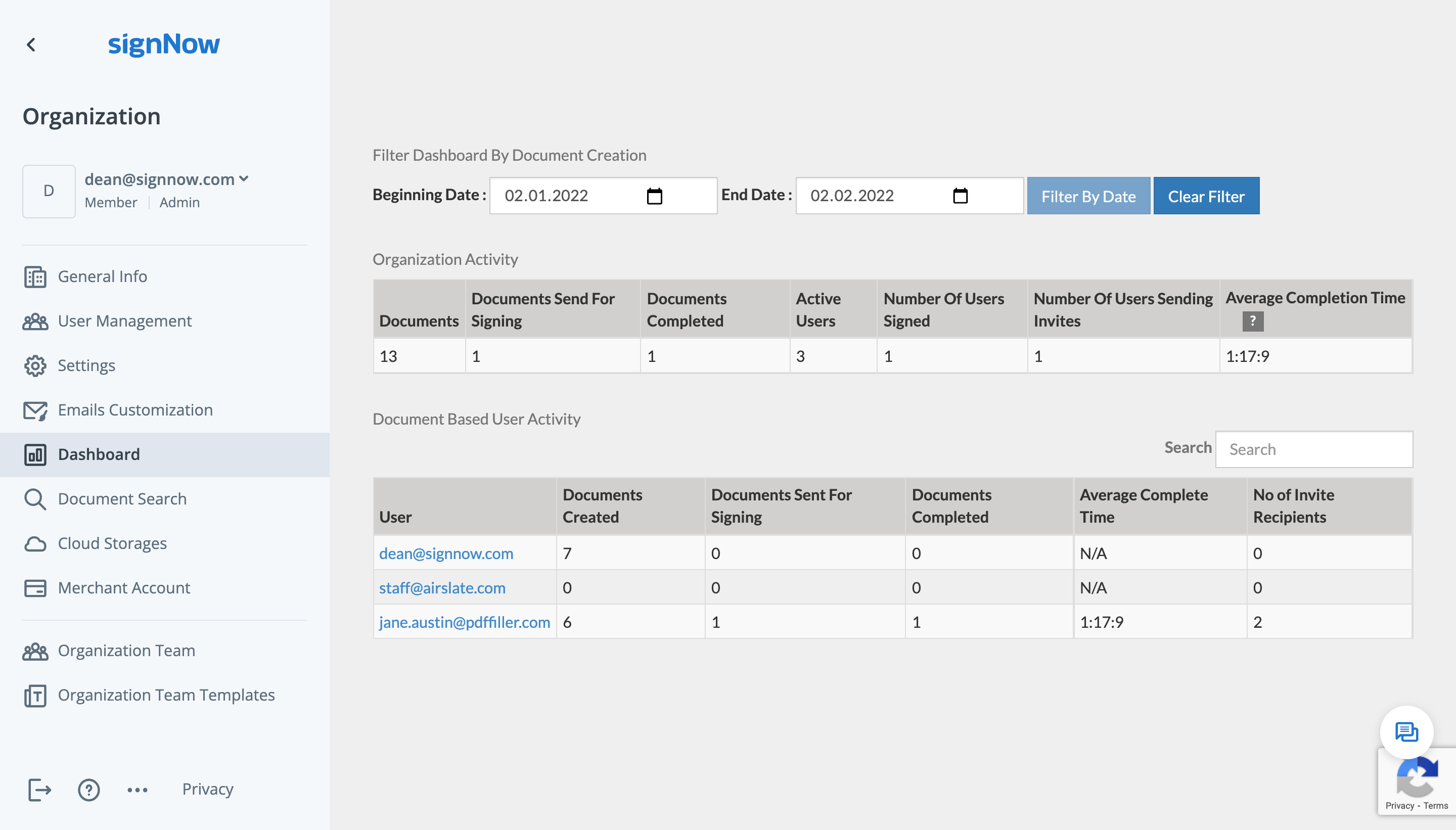
The Organization Dashboard is a centralized tool that allows Admins to monitor, measure, and analyze data about your Organization’s activity based on several key metrics. The Dashboard displays aggregated information on the number of signed documents, sent invitations, and member activity.
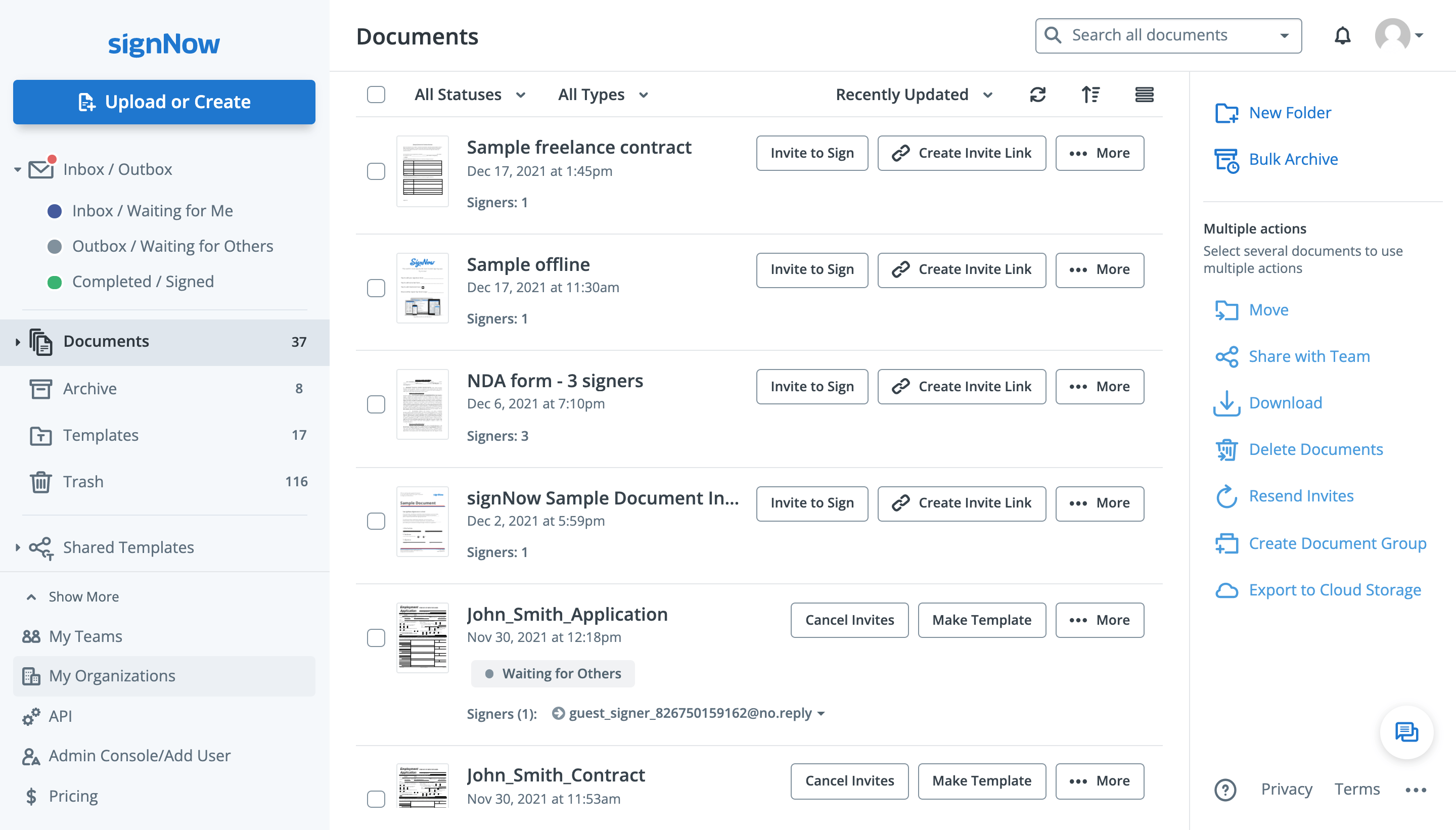
Find the Organization Dashboard in the Admin Panel
Log in to your airSlate SignNow account as an Admin.
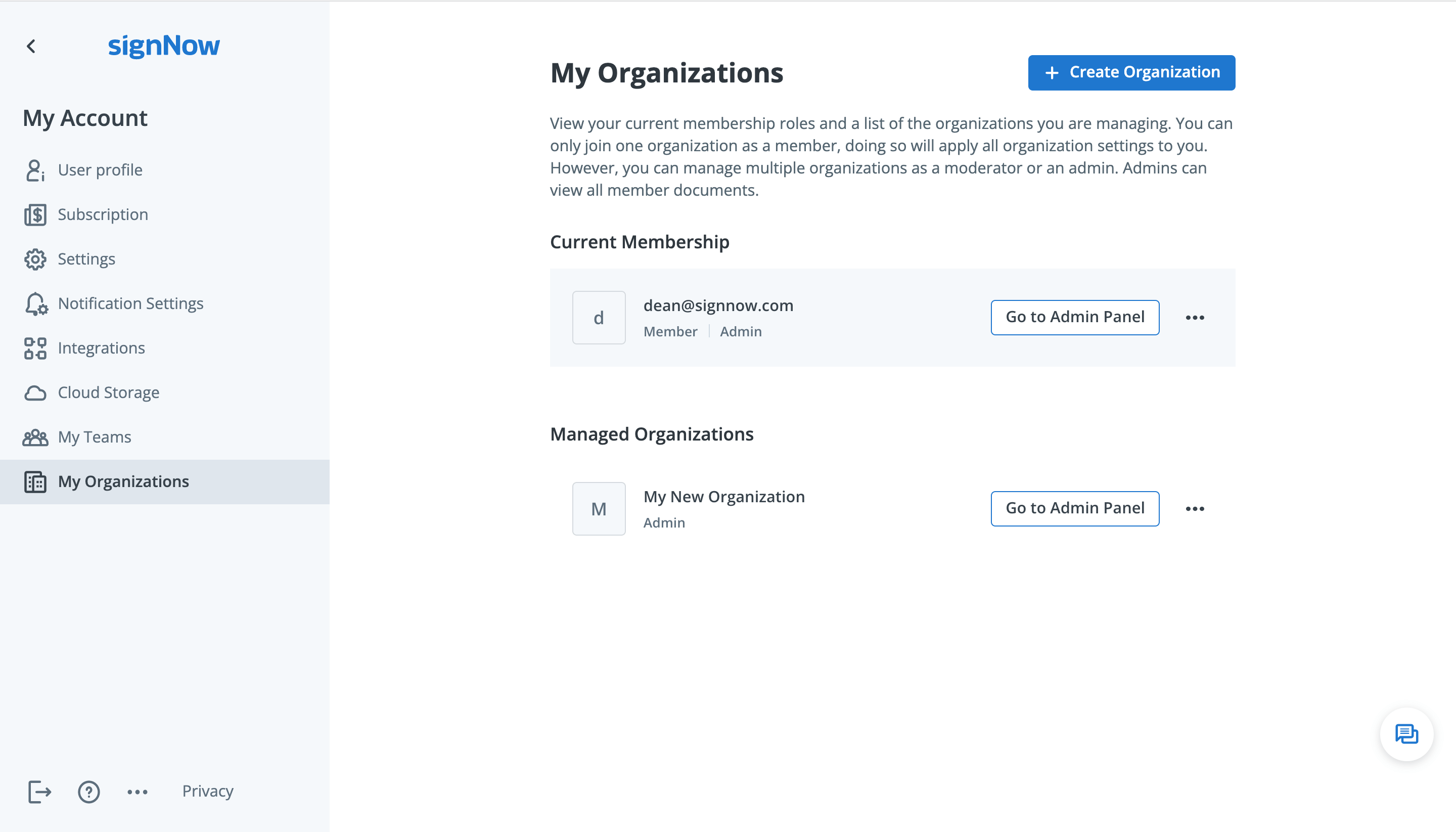
Go to My Organizations in the sidebar on the left (or in your account settings).
Click Go to Admin Panel next to your Organization.
Open the Dashboard tab in the Admin Panel.
Get all the data about Members’ activity in one place
The Organization Dashboard provides Admins with the following information:
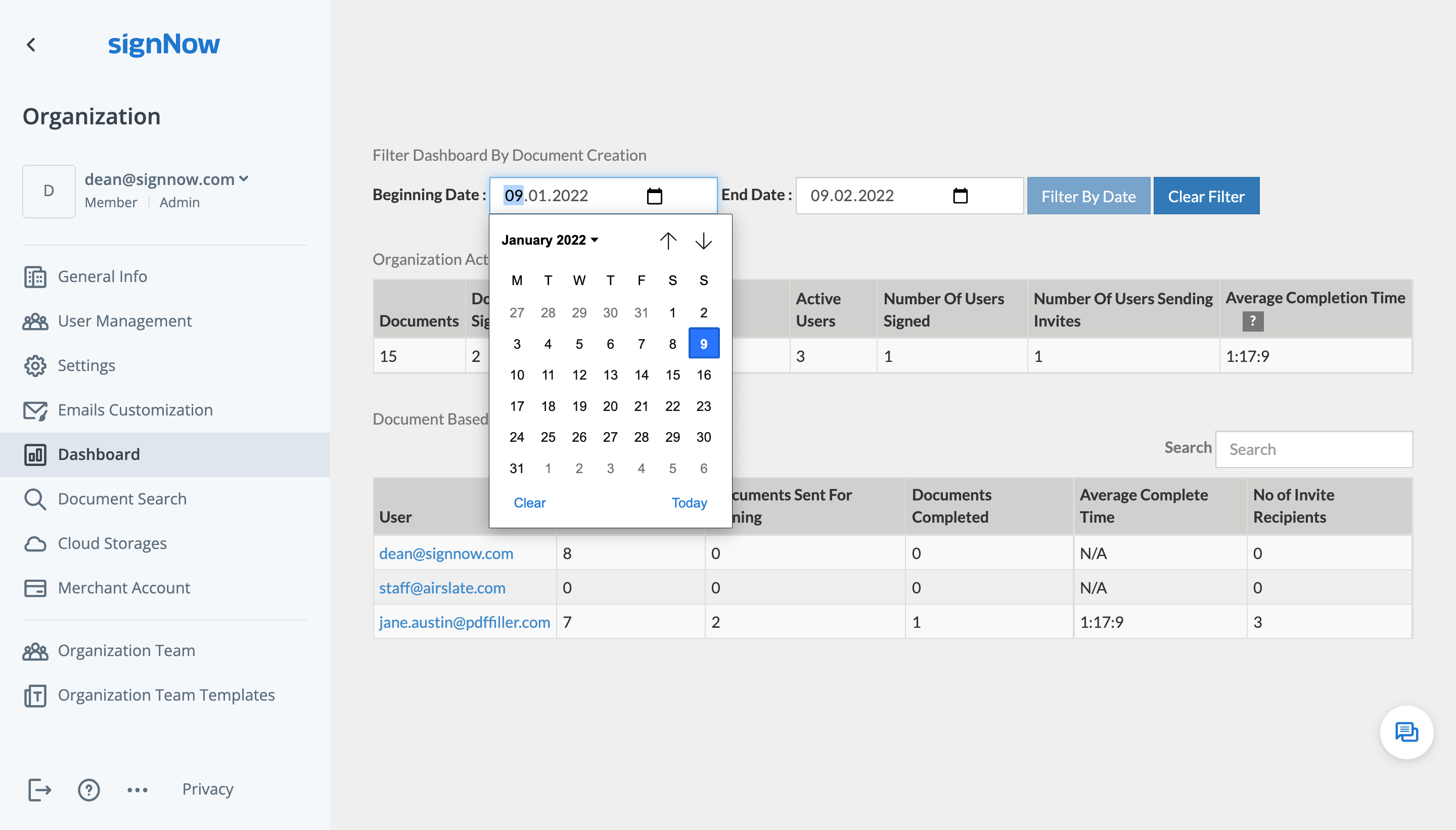
The stats can be narrowed down to a specific period using the filter.
You can also view all your Members in the Dashboard. Select any Member to review their information and activity data.
Explore Advanced Features
- SignNow's Customer Relationship Management vs Salesforce
- SignNow's Customer Relationship Management vs Salesforce for Finance
- SignNow's Customer Relationship Management vs Salesforce
Discover More eSignature Tools
- Unlock the power of electronic signature in PDF with ...
- Enhance your documents with a handwritten signature
- Unlock the power of electronic signature in Word for ...
- Create your eSignature with our easy-to-use signature ...
- Discover the DSC certificate price that suits your ...
- Discover top online signature service providers for ...
- Easily add signature to PDF without Acrobat for ...
- Discover free methods to sign a PDF document online ...
- How to add electronic signature to PDF on iPhone with ...
- How to sign PDF files electronically on Windows with ...
- How to sign a PDF file on phone with airSlate SignNow
- Experience seamless signing with the iPhone app for ...
- Easily sign PDF without Acrobat for seamless document ...
- Easily email a document with a signature using airSlate ...
- How to sign a document online and email it with ...
- How to use digital signature certificate on PDF ...
- How to use e-signature in Acrobat for effortless ...
- How to use digital signature on MacBook with airSlate ...
- Discover effective methods to sign a PDF online with ...
- Effortlessly sign PDFs with the linux pdf sign command