Transport Bill Book Format for Production

Streamline your document processes with airSlate SignNow's user-friendly and affordable eSigning solution, designed to enhance efficiency and reduce costs for businesses.

Award-winning eSignature solution

What the transport bill book format for production is and why it matters

The transport bill book format for production is a structured digital template used to record, route, and archive transport documents for manufacturing and logistics operations. It standardizes fields such as consignment details, itemized manifests, carrier and vehicle identifiers, timestamps, and chain-of-custody signatures. In production environments the format supports batch processing, integration with inventory and ERP systems, and consistent audit trails for compliance and quality control. When paired with an eSignature platform such as signNow, the format can incorporate secure electronic signing, user authentication, and automated record retention tied to production workflows.

Why adopting a digital transport bill book format helps production

A consistent digital format reduces manual errors, speeds approvals, and preserves verifiable records for compliance. It simplifies reconciliation across manufacturing, shipping, and quality teams while enabling integrations with other systems for better operational visibility.

Why adopting a digital transport bill book format helps production

Typical users and their roles

Logistics Manager

Oversees outbound shipping schedules, carrier selection, and freight documentation. Uses the transport bill book format to validate consignment details, track shipment status, and reduce exceptions. Coordinates with production planners and carriers to ensure on-time dispatch and accurate manifest records for each production batch.

Production Supervisor

Manages daily production runs and handoffs to logistics. Uses the format to confirm load compositions, record weight and item counts, and sign off on batch releases. Relies on the digital trail to support traceability and to resolve discrepancies during post-production audits.

Who relies on transport bill book formats in production environments

Production, logistics, and compliance teams depend on standardized transport bill book formats to coordinate shipments, control inventory, and meet regulatory obligations across the supply chain.

  • Manufacturing operations teams responsible for dispatch, inventory checks, and shipment batching across plants and warehouses.
  • Logistics coordinators managing carriers, route assignments, and pickup/delivery confirmations within production cycles.
  • Compliance and quality assurance staff who need tamper-evident records and auditable chains of custody for inspections.

These stakeholders use the format to reduce disputes, accelerate handoffs, and maintain traceable signatures and timestamps for audits and customer reporting.

Additional features that enhance production transport bill workflows

Beyond core capabilities, these additional features help scale and secure transport bill book formats for enterprise production environments.

Bulk Send

Ability to send a single transport bill template to multiple carriers or recipients simultaneously, reducing repetitive steps when dispatching multiple consignments from a production run.


Conditional Fields

Dynamic fields that appear or require entry based on previous inputs, ensuring forms remain concise while capturing all necessary data for specific shipment types.

Mobile Capture

Support for mobile devices to capture signatures, photos of loads, and condition notes at pickup or delivery, improving on-the-spot validation from drivers and warehouse staff.

Offline Mode

Offline form completion for areas with limited connectivity, with automatic synchronization and signature verification once a connection is restored.

Role-Based Workflows

Configurable approval chains and role assignments that ensure the right personnel sign and verify different sections of the transport bill before release.

Retention Policies

Automated document retention schedules and export capabilities to meet regulatory and company recordkeeping requirements for transport and production documentation.

be ready to get more

Choose a better solution

Four essential capabilities for effective transport bill book formats

A robust transport bill book format includes signing, templating, auditability, and integrations to support production and logistics workflows end to end.

Custom Templates

Support for configurable templates enables production teams to include fields for batch numbers, carrier assignments, load counts, and compliance checkboxes. Templates should allow conditional logic and required field enforcement to prevent incomplete records during fast-paced dispatch operations.

Secure Signing

Electronic signatures with identity verification and tamper-evident seals provide legally admissible proof of approval. Security controls should include user authentication options and cryptographic sealing to protect records after signatures are applied.

Audit Trail

Comprehensive, immutable logs capture signer identity, IP addresses, timestamps, and every document change. Auditable trails support compliance reviews, dispute resolution, and internal quality checks without relying on paper forms.

System Integrations

Integration with ERP, WMS, and CRM systems ensures transport bill data synchronizes with inventory, invoicing, and shipment tracking. APIs and prebuilt connectors reduce manual re-entry and maintain consistency across production and logistics systems.
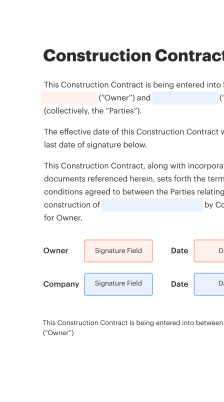
How the transport bill book format works in a digital workflow

This sequence describes how a transport bill flows from creation to archival using a digital template and eSignature platform.

  • Document creation: Populate template with shipment data
  • Recipient routing: Assign approvers and carriers
  • Electronic signing: Signatures and timestamps applied
  • Storage and audit: Secure archive with full audit trail
Collect signatures
24x
faster
Reduce costs by
$30
per document
Save up to
40h
per employee / month

Quick steps to set up a transport bill book format for production

Follow these concise steps to create a usable transport bill book template and start capturing signed transport records in production workflows.

  • 01
    Define fields: List mandatory and optional data fields
  • 02
    Create template: Design digital layout with required sections
  • 03
    Assign roles: Map who fills and approves each field
  • 04
    Enable signing: Attach eSignature and authentication rules

Detailed checklist to complete a transport bill book entry

Use this grid as a checklist to ensure each transport bill is complete, verifiable, and stored correctly in production workflows.

01

Shipment Identification:

Assign unique ID
02

Itemization:

List SKUs and counts
03

Carrier Details:

Record carrier and vehicle
04

Condition Notes:

Add photos and notes
05

Signatures:

Collect required eSignatures
06

Archive:

Store with audit log
be ready to get more

Why choose airSlate SignNow

  • Free 7-day trial. Choose the plan you need and try it risk-free.
  • Honest pricing for full-featured plans. airSlate SignNow offers subscription plans with no overages or hidden fees at renewal.
  • Enterprise-grade security. airSlate SignNow helps you comply with global security standards.
illustrations signature

Recommended configuration for an automated transport bill workflow

Suggested workflow settings provide a starting point for automating transport bill creation, approvals, and storage while aligning with production cycles.

Default Active
Reminder Frequency 48 hours
Approval Order Sequential
Storage Location Encrypted cloud
Signature Authentication MFA required
Retention Rule 3 years

Security controls for transport bill book records

Encryption at rest: AES-256 encrypted storage
Encryption in transit: TLS 1.2+ connections
Access controls: Role-based permissions
Multi-factor authentication: Optional MFA for users
Audit logging: Immutable signature trails
Single sign-on: SAML / OIDC support

Industry examples where the transport bill book format adds value

Two practical scenarios illustrate how a standardized transport bill book format improves production-to-shipping handoffs and compliance documentation.

Food Manufacturing Example

A regional food producer standardized its transport bill book format to include batch numbers and temperature logs

  • Template fields captured batch ID and cold-chain readings
  • Operational staff reduced manual entry errors and sped up carrier handoffs

Leading to faster inspections and fewer spoilage claims due to consistent traceability and verifiable signatures.

Automotive Parts Example

An automotive supplier implemented a digital transport bill book format for serialized parts

  • The template recorded serial numbers and assembly station IDs
  • Integration with ERP matched shipments to invoices in real time

Resulting in more accurate invoicing, simpler warranty traceability, and reduced chargebacks from OEM partners.

Best practices for accurate and secure transport bill book formats

Follow these recommended practices to ensure your transport bill templates remain accurate, secure, and legally defensible across production operations.

Standardize mandatory fields across templates
Define a core set of mandatory fields such as shipment ID, product codes, quantities, carrier ID, and signer role. Standardization reduces discrepancies between departments and simplifies automated reconciliation.
Use role-based access and approval order
Limit editing and signing privileges to appropriate roles and enforce approval sequences to ensure accountability. This reduces the risk of unauthorized changes and preserves a clear chain of responsibility for each transport record.
Enable verifiable authentication for signers
Require appropriate signer authentication, such as MFA or SSO, for high-value or regulated shipments. Verifiable authentication strengthens legal defensibility and helps meet compliance obligations.
Archive with immutable audit logs
Store completed transport bills with secure, tamper-evident audit trails and apply retention policies aligned with regulatory requirements and internal recordkeeping practices to support audits and dispute resolution.

FAQs About transport bill book format for production

Common questions and troubleshooting tips for implementing and maintaining transport bill book formats in production and logistics environments.

Quick feature comparison for transport bill format support

Compare how major eSignature providers support transport bill book formats and related production workflow capabilities.

Transport Bill Book Format Criteria Comparison signNow (Recommended) DocuSign Adobe Sign
Format Template Support
API Integration Capability Robust REST API Robust REST API REST API
Bulk Send / Batch Processing Bulk Send available Bulk Send available Limited bulk
Mobile Offline Access Offline mode Limited offline Limited offline
be ready to get more

Get legally-binding signatures now!

Typical deadlines and retention guidelines for transport bill records

Common timelines and retention rules help production teams meet operational needs and legal obligations when managing transport bill records.

Immediate signature and dispatch record:

Sign at pickup or delivery within one business day

Discrepancy reporting window:

File disputes within 5 to 10 business days

Operational retention minimum:

Keep records for 1 year for routine audits

Regulatory retention period:

Retain documents 3 to 7 years where required

Long-term archival policy:

Move to cold storage after 2 years

Risks and penalties for improper transport bill handling

Regulatory fines: Monetary penalties
Shipment delays: Operational disruption
Lost traceability: Recall exposure
Contract disputes: Liability claims
Data breaches: Compliance violations
Audit failures: Corrective actions

Pricing and plan comparison relevant to production use

High-level pricing and plan characteristics to consider when selecting an eSignature provider for transport bill book formats in production.

Plan and Vendor Pricing signNow (Recommended) DocuSign Adobe Sign Dropbox Sign PandaDoc
Free tier availability Limited free plan Trial or limited free tier Free trial only Free limited plan Free limited plan
Starting price per user per month Plans from $8/user/month Plans from $10/user/month Business plans from $25/user/month Plans from $15/user/month Plans from $19/user/month
Enterprise contract options Available with volume discounts Available enterprise agreements Available enterprise licensing Available enterprise agreements Available enterprise plans
Bulk send and API in base plan Included in many plans Requires higher-tier plan Often enterprise feature Available in paid plans Available in paid plans
Compliance add-ons HIPAA additions available Advanced compliance packages FedRAMP / enterprise add-ons Third-party compliance options Compliance modules available
walmart logo
exonMobil logo
apple logo
comcast logo
facebook logo
FedEx logo
be ready to get more

Get legally-binding signatures now!