Establishing secure connection…Loading editor…Preparing document…

Letter Announcing Going Out of Business Sale

This template is fully customizable. Edit the text, fill out the fields, and send it for signature. Give it a try!
Letter Announcing Going Out of Business Sale

What a Letter Announcing Going Out of Business Sale Is

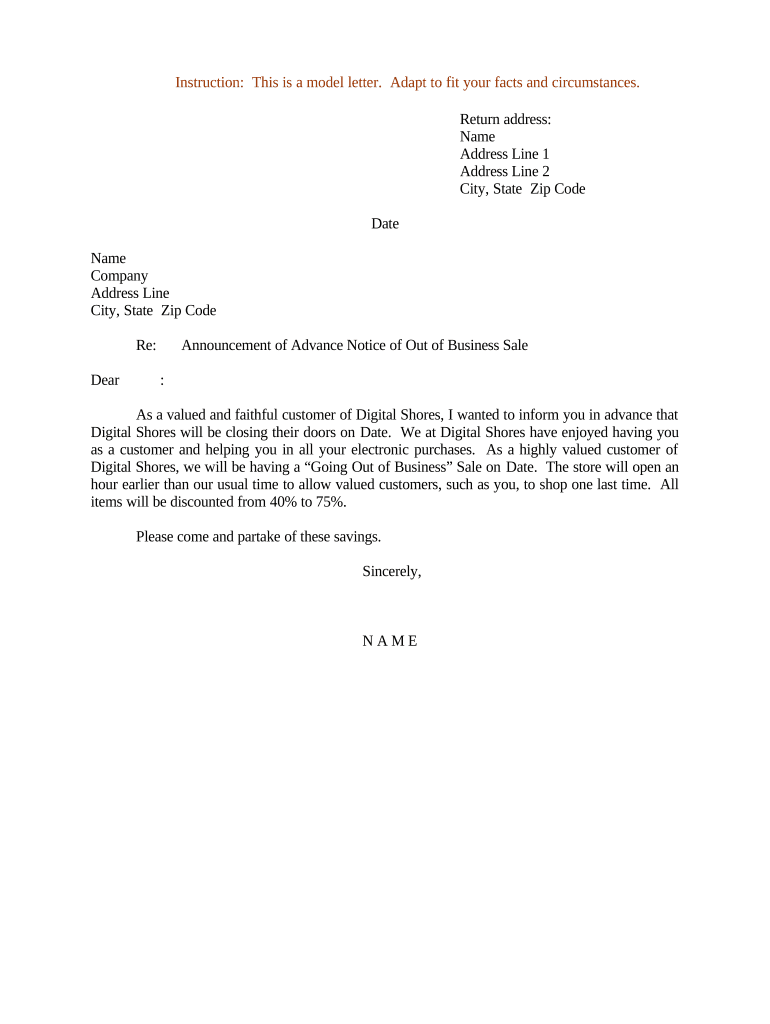
A Letter Announcing Going Out of Business Sale is a formal written notice from a business informing customers, suppliers, landlords, and other stakeholders that the business will cease operations and is conducting a liquidation sale. The letter states the sale start and end dates, locations, types of merchandise or services affected, and any special terms such as discounts, returns policy, and warranty limitations. It also identifies contact information for inquiries, clarifies whether inventory is limited, and may state how outstanding orders, repairs, or gift cards will be handled.

Why Issuing This Letter Matters

Issuing a clear Letter Announcing Going Out of Business Sale informs stakeholders, preserves legal notice obligations, reduces customer disputes, and documents sale terms. It supports inventory liquidation, protects against claims, and creates a transparent record for contractual and regulatory review.

Why Issuing This Letter Matters

Who Typically Issues This Letter

Retailers, service providers, and small wholesalers commonly use a Letter Announcing Going Out of Business Sale when closing a location or winding down operations.

  • Owner-operators closing a single storefront and liquidating stock quickly for cash.
  • Franchises or multi-location chains announcing a specific outlet closure or clearance sale.
  • Landlords, receivers, or liquidators notifying tenants and creditors about liquidation timelines.

Core Elements to Include in the Letter

Essential elements to include when drafting a Letter Announcing Going Out of Business Sale to ensure clarity and legal sufficiency.

Sale Dates

Clearly state the sale start and end dates using MM/DD/YYYY format. Accurate dates determine notice periods, affect inventory accounting, and set customer expectations for returns and warranties.
Affected Goods

Describe categories or specific SKUs included and any excluded items, including brand names and model numbers where relevant to avoid buyer confusion and disputes.

Discounts

State exact discount percentages or dollar reductions, any maximums per transaction, and whether markdowns are cumulative or final. Transparency reduces customer complaints and false advertising risk.

Returns

Specify whether returns or exchanges are accepted, time limits, restocking fees, and how warranties will be handled during liquidation to avoid consumer disputes and clarify liability.

Outstanding Orders

Explain how pending orders, layaways, and service commitments will be fulfilled or canceled, including refund timelines and contact procedures for affected customers.

Legal Notices

Include statements required by lease, franchise, or state law, such as landlord notice or consumer protection disclosures, and retain proof of delivery for compliance and audit support.

Step-by-Step: Prepare and Send the Letter

Follow these steps to prepare and send a compliant Letter Announcing Going Out of Business Sale.

  • 01
    Draft Letter: State dates, location, items, and contact details.
  • 02
    Review Legal: Check lease, contract, and consumer notice requirements.
  • 03
    Distribute Notice: Send via email, posted sign, and published notice.
  • 04
    Document Records: Save signed copies, delivery receipts, and communications.

Set Up a Digital Template and Routing

Configure digital templates and routing to automate distribution and recordkeeping for the sale announcement across channels.

Field Configuration
Template Name Standardized letter template for all locations
Routing Owner, Legal, Finance approval order
Authentication Email link with optional SMS code
Retention Archive signed PDF for records

Platform and File Requirements for eDelivery

Digital delivery options and platform requirements for e-submission and tracking include accepted file formats, signer authentication, and audit trail capture.

  • File Formats: PDF and DOCX supported
  • Signer Authentication: Email link with SMS or KBA
  • Integrations: Connect to CRM and cloud storage

How Digital Distribution Typically Works

A typical workflow for issuing and recording a Letter Announcing Going Out of Business Sale.

  • Prepare Draft: Create letter content and legal review.
  • Get Approvals: Owner, legal, and finance sign-off.
  • Distribute: Email, post in store, and notify landlords.
  • Archive: Store signed copies and delivery proof securely.

Timing and Statutory Deadlines to Watch

Key timing considerations and statutory deadlines to track when announcing and formally winding down business operations and sales.

Notice to Landlord:

Follow lease notice periods; some require 30 to 90 days' written notice or landlord consent.

Customer Notice:

Notify customers by email and in-store signage at least when sale begins.

Tax Reporting:

Collect sales tax data and report per state requirements; filing follows usual sales tax cycles.

Gift Card Handling:

State whether gift cards remain redeemable; include refund or credit policies.

Final Payroll:

Process final wages per federal and state deadlines and issue final paystubs.

Key Milestones From Decision to Close to Archive

Sequential milestones to follow from the closing decision through public notice, sale execution, and final recordkeeping for the going-out-of-business sale.

01

Decision Made

Document board or owner resolution to close.

02

Legal Review

Confirm lease, franchise, and notice obligations.

03

Public Notice

Distribute letter, post signs, and update website.

04

Closeout Records

Archive signed letters, receipts, and communications.

Security and Compliance Considerations

In-Transit Encryption: TLS 1.2 and TLS 1.3
At-Rest Encryption: AES-256 encryption for stored data
Compliance Certifications: SOC 2 Type II; ISO 27001
Legal Frameworks: ESIGN Act and UETA compliance
Healthcare Support: HIPAA compliant with BAA option
Audit Trail: Detailed timestamps, IPs, and history

Penalties and Practical Risks to Avoid

Consumer Claims: False advertising suits risk
Lease Breach: Landlord damages and accelerated rent
Tax Reporting: Sales tax audits possible
Refund Obligations: Unfulfilled orders trigger refunds
Notary Defect: Missing acknowledgments affect filings
Recordkeeping Failure: Inadequate proof increases liability

Common Preparation Challenges

  • Coordinating multiple notice channels while ensuring consistent wording and timing can be resource-intensive and may require legal review to avoid conflicting obligations under lease or franchise agreements.
  • Determining which items are final-sale, excluded, or warrantied requires inventory reconciliation and vendor input; misclassification leads to customer disputes and potential regulatory complaints.
  • Managing outstanding warranties, service commitments, and gift card liabilities during liquidation often involves accounting adjustments and careful communication to avoid accrual or disclosure errors.
  • Complying with state-specific notice or permit requirements, including landlord notice periods or disposal permits, can vary widely and require counsel or local agency confirmation.

Who Is Authorized to Sign

Owner — CEO

Typically the business owner or CEO signs formal closure notices and authorizes liquidation terms. Their signature confirms corporate intent to cease operations and binds the company to sale terms; include a board resolution if required by bylaws or lending agreements.

Liquidator — Manager

An appointed liquidator, store manager, or authorized agent may sign when delegated authority exists. Provide written delegation or power of attorney and ensure the signatory is identified in records to validate actions for creditors and regulatory filings.

How to Amend or Revoke the Announcement

Steps to amend or revoke a previously issued Letter Announcing Going Out of Business Sale.

01

Identify Change:

Determine scope and reason for revision.
02

Draft Amendment:

Prepare revised letter with clear change language.
03

Legal Review:

Confirm obligations and consult counsel.
04

Notify Recipients:

Send amendment to all prior recipients.
05

Document Delivery:

Retain proof of distribution for records.
06

Archive Versions:

Keep both original and revised letters.

eSignature Pricing and Feature Comparison

A concise vendor comparison of eSignature pricing and features relevant to preparing and signing a Letter Announcing Going Out of Business Sale.

signNow DocuSign Adobe Sign PandaDoc HelloSign
Starting Price $8/user/mo $15/user/mo $14/user/mo $19/user/mo $15/user/mo
Free Trial Yes, 7-day free trial Varies by plan and billing term Varies by plan and billing term Varies by plan and billing term Varies by plan and billing term
Bulk Send Yes — included on paid plans with no cap Yes — feature available; envelope cap applies Yes — included on most business plans Yes — available on paid plans No — bulk send not supported on plan
Audit Trail Yes — full audit trail and reporting available Yes — audit trail available Yes — audit trail available Yes — audit trail available Yes — audit trail available
HIPAA Compliant Yes — BAA available for covered entities Yes — BAA available on qualifying plans Yes — BAA available No — BAA not available No — BAA not available

Practical Best Practices

Best practices to draft, distribute, and preserve a legally sound Letter Announcing Going Out of Business Sale.

Use clear and unambiguous language in notices
Avoid vague terms such as 'limited time' without dates; explicitly state start and end dates, discount mechanics, and any exclusions. Clear language reduces regulatory risk and customer disputes over advertised offers.
Keep proof of delivery and archives
Retain copies of sent emails, certified mail receipts, photographs of posted signs, and signed acknowledgments. Maintain a tamper-evident archive for at least three years to support audits and potential legal claims.
Coordinate with landlords and creditors
Review lease terms and notify landlords per contractual notice clauses. Inform secured creditors and utility providers as required to avoid breach, equipment liens, or service interruptions during wind-down.
Consult counsel for complex situations
Seek legal advice for franchise obligations, mass employee layoffs, environmental disposal requirements, and contested creditor claims. A lawyer can help tailor notices and minimize exposure under state and federal laws.

Illustrative Use Cases

Real-world examples showing how organizations issue a Letter Announcing Going Out of Business Sale and manage follow-up.

Small Retail Chain — Closing Clearance

A small retail chain announced a ten-day clearance sale after lease termination, mailing letters to loyalty program members and posting prominent in-store signage to inform customers and suppliers.

  • Used staggered discounts to move stock quickly.
  • They retained copies of all mailed notices, saved signed acknowledgements where available, and reconciled sales by SKU to ensure accurate tax reporting. Clear documentation resolved two vendor disputes and supported final lease accounting.

Medical Practice — Patient Notice

A small medical practice closing a clinic sent individualized letters to patients explaining record transfer options, how to obtain copies, and where to direct outstanding billing inquiries.

  • Protected PHI and directed records requests.
  • They included HIPAA-compliant language, informed patients about access timelines, and offered secure methods to transfer records. Retaining delivery confirmations and consent forms helped meet 45 CFR §164.530(j) retention expectations.

FAQs: Common Questions About the Letter

Answers to common questions about preparing, signing, and distributing a Letter Announcing Going Out of Business Sale.


Need help? Contact support

be ready to get more
Join over 28 million airSlate SignNow users