Establishing secure connection…Loading editor…Preparing document…

Affidavit Forma Pauperis

This template is fully customizable. Edit the text, fill out the fields, and send it for signature. Give it a try!
Affidavit Forma Pauperis

What the Affidavit Forma Pauperis Is and When It’s Used

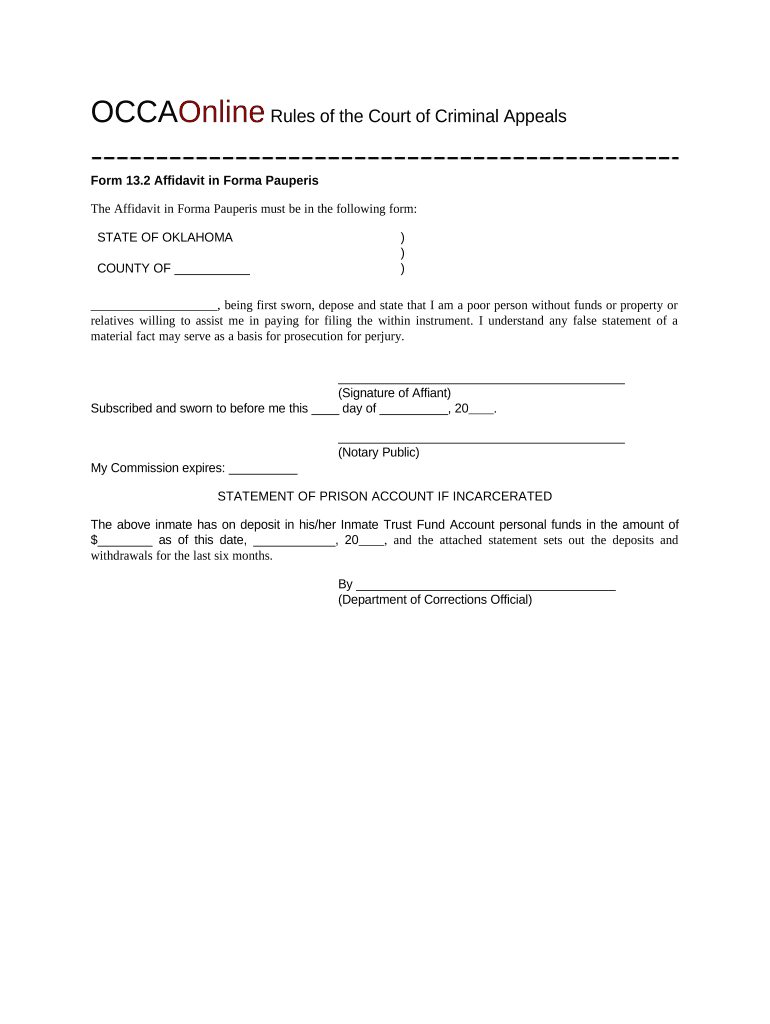
The Affidavit Forma Pauperis is a sworn statement used to request a waiver of court filing fees when an individual cannot afford them. It documents the applicant’s financial situation, household composition, and sources of income so a judge can decide whether fee waiver criteria are met. Courts use the affidavit to evaluate indigence, and decisions are discretionary; some jurisdictions require supporting documentation or a local court form. The affidavit is usually submitted with the initiating filing or as a motion at the earliest practical stage of the case.

Why Completing an Affidavit Forma Pauperis Matters

A properly completed affidavit preserves access to courts by removing financial barriers to filing; it may prevent default judgments and protect rights that require timely judicial action. Clear disclosure reduces the chance of denial and subsequent sanctions.

Why Completing an Affidavit Forma Pauperis Matters

Who Typically Prepares and Relies on This Affidavit

The Affidavit Forma Pauperis is used by people seeking to file or defend actions without paying court costs; it is commonly prepared by non-lawyers and legal professionals alike.

  • Pro se litigants who need fee relief when filing a new case or motion
  • Legal aid organizations and public interest attorneys handling low-income clients
  • Court clerks and judges who review fee-waiver eligibility and supporting facts

Completing the form accurately helps the court decide promptly and reduces administrative follow-up or requests for more information.

Core Elements Found in a Professional Affidavit Forma Pauperis

Most affidavits follow a consistent structure to document finances, identity, and the legal basis for a fee waiver request.

Affirmation Statement

A sworn declaration that the facts are true under penalty of perjury; establishes legal weight for the financial disclosures.
Personal Details

Full legal name, address, date of birth and contact information to identify the applicant for the court record.

Income Summary

Itemized monthly and annual income sources including wages, benefits, and regular contributions from others.

Asset Inventory

List of liquid and non-liquid assets such as bank balances, vehicles, property, and retirement accounts relevant to ability to pay.

Supporting Documents

Attachments such as pay stubs, benefit letters, or bank statements that corroborate income and assets.

Signatures & Notary

Applicant signature with date and the required witness or notary block, when jurisdictionally mandated.

Step-by-Step: Preparing and Filing the Affidavit

Follow a concise sequence to gather proof, complete the affidavit, and submit it with your filing to minimize delays.

  • 01
    Gather Documents: Collect pay stubs, benefit letters, and bank statements.
  • 02
    Complete Form: Answer every question clearly; fill zero where none.
  • 03
    Attach Proofs: Staple or upload supporting documents in the order listed.
  • 04
    File with Court: File together with your complaint or motion per local rules.

Typical Filing Flow for Fee Waiver Requests

A basic workflow ensures the affidavit travels with the case file and reaches the assigned judge or clerk for review.

  • Prepare Packet: Affidavit, exhibits, and initiating papers.
  • File Electronically: Attach packet in e-filing system when available.
  • Clerk Review: Clerk confirms completeness and docketing.
  • Judge Decision: Judge grants or denies fee waiver request.

Digital Configuration When Completing the Form Online

If you submit electronically, ensure file types and authentication meet the court’s e-filing requirements.

Field Configuration
File Format PDF/A preferred for long-term preservation
Authentication Use court e-filing credentials or verified email
Attachments Combine exhibits as single PDF when required
Signature Method Electronic signature or scanned wet signature per court policy

Platforms and Technology Considerations for eSubmission

Courts and e-filing systems differ; confirm acceptable file types, signature methods, and maximum file sizes before submitting.

  • Supported Formats: PDF, DOCX often accepted
  • Authentication Options: Court login or verified email
  • eSignature Support: ESIGN-compliant electronic signatures

Verify the local court’s technical requirements and retain a stamped copy of the filed packet for your records.

Timing: When to File the Affidavit and What to Expect

Timely filing affects case progression; submit the affidavit with the initial pleading or as soon as inability to pay becomes apparent.

With Initial Filing:

File the affidavit when you submit a complaint or petition.

With Motions:

Attach waiver requests to motions requiring a filing fee.

Clerk Processing Window:

Clerk review usually occurs within days to weeks.

Response Time:

Courts typically allow 14–30 days to supply missing information.

Appeal or Refile:

If denied, you may have limited time to cure defects or appeal.

Key Milestones from Submission to Decision

A typical milestone sequence shows the main events from submitting the affidavit to the court’s decision and any follow-up steps.

01

Prepare Affidavit

Draft, verify facts, and attach proofs before filing.

02

File with Court

Submit the affidavit with the initiating documents or motion.

03

Administrative Review

Clerk checks completeness and places matter before the judge.

04

Judicial Ruling

Judge grants or denies waiver and issues docketed order.

Common Preparation Pitfalls to Avoid

  • Incomplete financial details: leaving fields blank or providing partial income data leads to requests for more information and processing delays.
  • Missing supporting documents: failing to attach pay stubs or benefit notices commonly leads to denials or a clerk’s request for proof.
  • Unsigned or undated forms: unsigned affidavits are invalid and will be returned or rejected by the court clerk.
  • Incorrect court or case information: listing the wrong court or case number can misroute the filing and delay review.

Consequences of Incorrect or Fraudulent Statements

Perjury Risk: False statements can lead to criminal charges
Denial: Waiver requests may be denied for incomplete information
Monetary Exposure: Applicant may be ordered to pay past-due court fees
Sanctions: Court may impose procedural or monetary sanctions
Case Dismissal: Failure to obtain fee waiver may risk default or dismissal
Loss of Trust: Misstatements can impair credibility in ongoing proceedings

Data and Security Considerations for Submitted Documents

Encryption: TLS 1.2/1.3 in transit
Data at Rest: AES-256 encryption
HIPAA Support: Business Associate Agreement required
Audit Trail: Timestamped action log available
Identity Controls: Multi-factor and authentication options
Regulatory Compliance: ESIGN, UETA, SOC 2 certified

How Fee Waiver Filing Differs from Standard Fee Filing

A concise comparison highlights differences between filing with a fee waiver request and filing with payment.

Criteria Affidavit Forma Pauperis Standard Filing
Fee required no (if granted)
Supporting documents often required rarely required
Timing at filing or soon after at filing
Judicial review no routine review

eSignature Vendor Pricing and Feature Overview for Submitting Affidavits

Compare common eSignature options used to sign and submit legal affidavits electronically; signNow is listed first per platform comparison conventions.

signNow DocuSign Adobe Sign PandaDoc HelloSign
Starting Price $8/user/mo $15/user/mo $14/user/mo $19/user/mo $15/user/mo
Free Trial 7-day free trial Varies by plan Varies by plan Varies by plan Varies by plan
Bulk Send Yes Yes Yes Yes No
Audit Trail Yes Yes Yes Yes Yes
HIPAA Compliant Yes Yes Yes No No
Envelope Cap No envelope cap 100 envelopes/user/year Varies by plan Varies by plan Varies by plan

Practical Tips for Accurate, Efficient Completion

Adopt consistent intake practices to reduce errors and accelerate judicial review.

Be Complete and Precise
Provide full numerical amounts, dates, and names. Ambiguous entries invite follow-up and may delay or deny the waiver.
Organize Supporting Evidence
Label and paginate exhibits to match affidavit references; include a cover index to help clerks and judges locate proofs quickly.
Follow Local Court Rules
Use any court-provided form when available and comply with local e-filing formatting, signature, and submission requirements.
Keep Copies and Audit Trail
Retain signed originals or verifiable electronic copies with timestamps and an audit trail for future verification or appeal.

Real-World Use Cases and Practical Outcomes

Illustrative examples show how fee-waiver affidavits function in common scenarios.

Pro Se Civil Plaintiff

A low-income plaintiff files an affidavit with the complaint to avoid a $350 filing fee

  • The court requests two pay stubs for verification
  • The waiver is granted after timely proof was uploaded, allowing the case to proceed without fee payment and preventing dismissal for nonpayment.

Legal Aid Intake

A legal aid clinic standardizes an affidavit template for intake

  • Staff attach verified benefit letters
  • Standardization reduced clerical follow-ups and shortened time to judge review by eliminating missing-document requests.

Electronic Signature Versus Wet Signature for Fee Waiver Forms

Understand the differences and when courts accept electronic signatures on sworn affidavits.

Criteria Electronic Signature Wet Signature
Legal Validity acceptable under esign/ueta traditional standard
Authentication audit trail available notary verifies in person
Remote Notarization possible in many states in-person only
Record Retention digital copy retained original paper retained

Frequently Asked Questions and Troubleshooting

Answers to common questions about preparing, signing, and submitting an Affidavit Forma Pauperis.


Need help? Contact support

be ready to get more
Join over 28 million airSlate SignNow users