Establishing secure connection…Loading editor…Preparing document…

Affidavit of Ownership

This template is fully customizable. Edit the text, fill out the fields, and send it for signature. Give it a try!
Affidavit of Ownership

What an Affidavit of Ownership Is and when it’s used

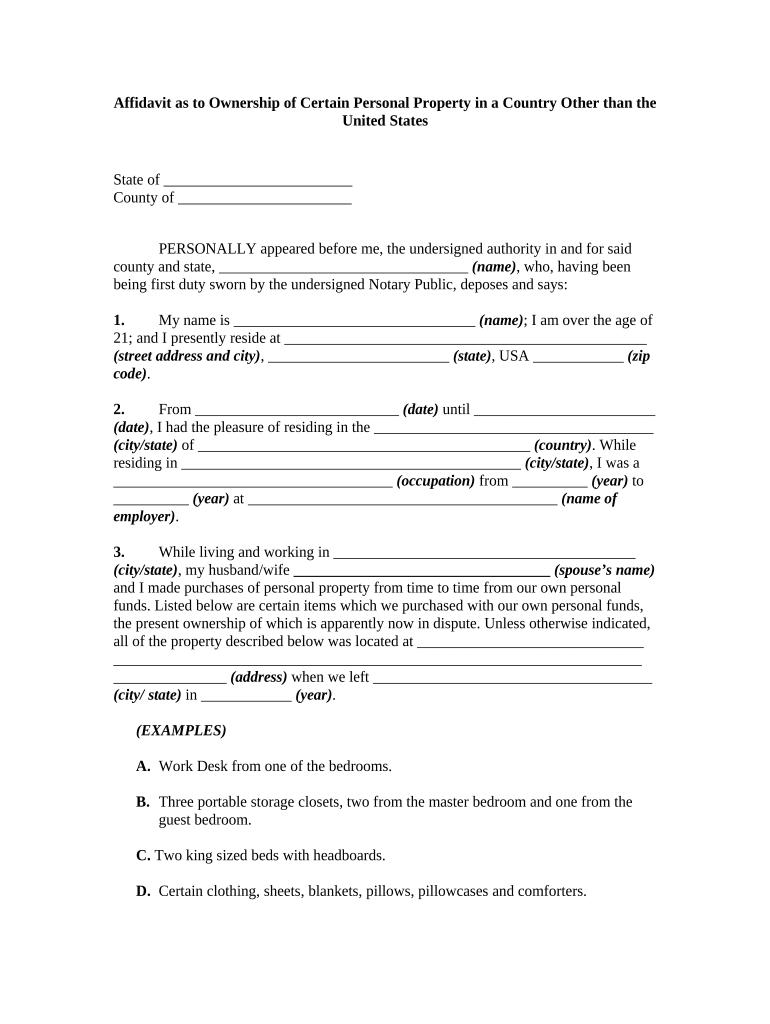
An Affidavit of Ownership is a sworn written statement in which an individual or entity declares legal ownership of property, goods, intellectual property, or accounts. It is executed under oath and usually notarized or witnessed to support title transfer, clear a chain of title, verify asset control for a sale, or resolve property disputes. The affidavit identifies the owner, describes the property, states the basis of ownership, and often includes representations about encumbrances, liens, or prior transfers. Courts and third parties rely on the affidavit as a record of asserted ownership.

Why an Affidavit of Ownership matters

An affidavit creates an official, sworn record that documents who claims ownership and under what basis, which simplifies title clearance, supports legal transfer, and documents facts for lenders or courts.

Why an Affidavit of Ownership matters

Who commonly completes an Affidavit of Ownership

Professionals and private parties complete affidavits when clear, signed proof of ownership is required for transactions or administrative processes.

  • Individuals selling real property or personal property who must establish title for closing or transfer
  • Business owners documenting asset transfers, inventory ownership, or intellectual property assignment
  • Attorneys, title companies, and lenders requesting a sworn ownership statement to support claims or loans

Use the affidavit that matches the purpose — e.g., real property, vehicle, business assets, or IP — and verify notarization or witness rules before submitting.

Core parts of a professional Affidavit of Ownership

A clear affidavit follows a standard structure so recipients can verify facts quickly and rely on the sworn statement.

Caption

State the document title, jurisdiction, and the declarant’s name to identify the governing authority and signatory immediately.
Declarant identity

Provide full legal name, address, and capacity (individual, corporate officer, trustee) so the signer’s authority to assert ownership is clear.

Property description

Describe the property precisely—address, VIN, serial number, account number, or IP details—so the subject is unambiguous and verifiable.

Ownership statement

Declare how title was acquired (purchase, inheritance, assignment) and the effective date, including any supporting transaction references.

Encumbrances

Disclose liens, claims, or outstanding interests; negative or affirmative disclosures affect third-party reliance and closing procedures.

Oath and signature

Include sworn language, signature block, date, and a notarization or witness section that satisfies local authentication rules.

Step-by-step: how to complete an Affidavit of Ownership

Follow these sequential steps to prepare a compliant, usable affidavit for signing and submission.

  • 01
    Gather documents: Collect title deeds, bills of sale, invoices, or corporate minutes.
  • 02
    Complete fields: Enter legal names, descriptions, dates, and disclosures.
  • 03
    Review for accuracy: Confirm identifiers and spellings match source documents.
  • 04
    Authenticate: Sign before a notary or required witness per state rules.

Typical submission flow for an Affidavit of Ownership

The affidavit moves through a short workflow from preparation to acceptance; document each handoff for auditability.

  • Prepare document: Creator completes affidavit and attaches supporting documents.
  • Authenticate signature: Notary or required witness verifies identity and signs.
  • Deliver to recipient: Send to title company, lender, or court clerk.
  • Record or archive: Recipient files or stores the affidavit per retention policy.

Configuring a digital workflow for affidavits

Set up fields and routing so affidavits are completed, authenticated, and archived consistently.

Field Configuration
Signature field Require signer and date; lock after signing
Notary block Include notarization fields and audio/video option if RON
Supporting uploads Allow PDF/JPG uploads for deeds and invoices
Routing Auto-send final copy to owner, title company, and archive

Technical considerations for e-submission and electronic notarization

Choose tools that support secure signing, notarization options, and audit trails appropriate for legal reliance.

  • Document formats: PDF and DOCX accepted
  • Authentication options: Email, SMS, or two-factor
  • Integration points: CRM, cloud storage, and API

Ensure the selected platform supports ESIGN and UETA compliance, audit logs for attribution, and RON features if remote notarization will be used; confirm HIPAA BAA if the affidavit contains protected health information.

Legal risks and penalties for inaccurate affidavits

Perjury Risk: Criminal penalties or fines
Civil Liability: Damages for false statements
Contract Voidance: Transaction may be rescinded
Tax Consequences: Reporting errors can trigger penalties
Title Delay: Closings postponed for additional proof
Notary Irregularity: Authentication failure can invalidate affidavit

Common mistakes to avoid when preparing an affidavit

  • Using informal or vague property descriptions that do not match recorded documents, causing rejection by title companies or courts.
  • Failing to sign in the notary’s presence or omitting the notarization block, which can render the affidavit inadmissible.
  • Mismatching names between the affidavit and supporting documents (misspellings, omitted suffixes), delaying verification and acceptance.
  • Neglecting to disclose known liens or claims, creating exposure to civil suits and undermining third-party reliance.

Practical tips for accurate and efficient completion

Apply consistent quality checks and verify identity and supporting documents before finalizing the affidavit.

Use precise identifiers
Always include legal addresses, VINs, serial numbers, or account identifiers. Precise identifiers reduce follow-up requests and speed acceptance by title companies or lenders.
Confirm signer authority
If signing on behalf of a company or trust, attach proof of authority such as corporate resolution, trust certificate, or power of attorney to avoid later challenges.
Prefer notarization when unsure
When in doubt, notarize. A notarized affidavit generally increases evidentiary weight and reduces the risk of refusal by third parties or courts.
Archive signed records securely
Keep original signed affidavits and supporting documents in a controlled repository with restricted access, and maintain digital audit trail records for at least the required retention period.

Real-world scenarios where an affidavit is used

Two common examples show how affidavits of ownership speed transactions and clear title issues.

Residential Property Transfer

A homeowner confirms ownership and discloses liens

  • Used to clear title for a buyer's lender
  • The notarized affidavit, together with the deed and payoff statements, resolved a cloud on title and allowed the sale to close without litigation by providing a sworn, verifiable ownership record.

Business Asset Sale

A small business owner documents sale of equipment and IP

  • Supports buyer confidence and financing
  • The affidavit listed serial numbers and assignment terms, reducing escrow holds and enabling prompt release of funds after buyer verification.

Comparing common eSignature pricing and feature points

Below is a succinct vendor comparison for typical eSignature needs; signNow appears first per platform placement rules.

signNow DocuSign Adobe Sign PandaDoc HelloSign
Starting Price $8/user/mo $15/user/mo $14/user/mo $19/user/mo $15/user/mo
Free Trial Yes, 7-day free trial Yes Yes Yes Yes
Bulk Send Yes Yes Yes Yes No
Audit Trail Yes Yes Yes Yes Yes
HIPAA Compliant Yes Yes Yes No No
Envelope Cap No envelope cap 100 envelopes/user/year Varies by plan Varies by plan Varies by plan

Frequently asked questions about Affidavit of Ownership

Practical answers to common issues encountered when preparing, signing, or submitting affidavits of ownership.


Need help? Contact support

be ready to get more
Join over 28 million airSlate SignNow users